… a drink with jam and bread


Has anyone else woken up to March with an incredulity that the third month of the year is here already? Maybe it’s the pace of life in Dubai, or the stage of my own life where I’m juggling work, teens on the run up to major exams and a busy social life. Every day that passes flags up that I am on the cusp of change. My elder teens ‘this is my last’ before she goes off to University (we’ve just had her last half term). The mornings are lighter and warmer pointing to a time soon where we won’t be able to sit outside in the balmy evenings and will crave the icy blast of the air conditioner.
The produce at the weekly farmers market has been phenomenal this season. I start every Friday morning there buying my picked-that-morning, organic vegetables for the week from the farmers that grow the food. On my return the teens ask immediately for the 2 kilo bag of fresh peas in the pod and eat the whole lot raw.
A look into my kitchen reveals some of the things I got up to in February. There are quite a few goodies including:


How could I resist some jam called Cherry Amour with labels inspired by the Paul Nash designs and from the fly-leaves of old books? Gulfood is the polar opposite of the farmers market (a huge trade exhibition with 20000 brands, 4500 exhibitors) and I struggled between the stands of highly processed packaged foods, big brands and hordes of men trailing wheelie computer bags. However, there were a few artisan producers among them all and a tweet brought me to England Preserves.
I met founder Kai Knutsen, who, with Sky Cracknell, started making high quality jams on their kitchen hob and selling them at local farmers’ markets. When I asked why he said that he and Sky came from families who had always made jam. The Raspberry Deluxe was pure and intensely fruity, the gooseberry and elderflower sharp and moreish, the London Marmalade dark and tangy; they don’t boil the jam so the fruit flavours shine through and the sugar content is kept low. I’ve got lots of plans for this cherry preserve (a Bakewell tart, over Greek yoghurt or ice cream…) if it doesn’t disappear ladled onto fresh bread and butter first. Don’t you love this tea towel too?


Another message from another friend/food blogger took me to Gaby Machel on the Argentinian section at Gulfood who raved about the quality of the juicy, juicy mangoes grown in Argentina, that were the inspiration for her range. I went away clutching a very large jar of cranberry chutney which is fabulous eaten with meltingly ripe Brie.
I first tasted this variety of Lindt in France two years ago so hope the rumour is true that it will be on our shelves here in Dubai soon. Stop press: Just informed it’s available in Choitrams.


Have a mentioned Balqees honey before? This raw honey from remote areas of Yemen is now a permanent fixture in my kitchen. I naively thought that all honey was the same until I was educated by owner Riath at the market. Most honey is flash-pasteurised (for consistency and longer shelf-life) and many contain sugar-solutions or the bees are fed with sugar. Tasting Balqees honey you are first struck by the totally different texture, it’s not so sticky and has an almost waxy mouthfeel like molten toffee. And it is toffee-like in taste but not as sweet, with none of the metallic tones you often get, just pure floral notes. I wish I could send you some.


I hauled home this great can of olive oil from the market too (it does come in smaller sizes). Kostas on the Astraea stall lives in Dubai but his brother lives on the Greek island of Samothrace and tends the family olive grove. Astraea olive oil is smooth tasting, not aggressively grassy and I use it in everything. My bread making resolution has been undermined by the ease of picking up a sour dough loaf or focaccia made from organic flour at the market. So patting myself on the back for baking this flaxseed loaf inspired by a Dan Lepard recipe and prompted by Kellie who managed to make this loaf while suffering severe jet lag.


I buy good wine, the best olive oil and finest raw honey. So I get a bit embarrassed when people ask for a coffee in my house. Tea drinker to the core, I’ve hummed and haaaed quite a bit about getting a special machine. Coffee Planet, a start-up company here in the UAE, serve really good coffee at the Farmers Market and offered me a try-out of their Mocca Master and range of their locally-roasted beans. Grinding the beans and brewing fresh does produce fantastic coffee. I was surprised at the differences I tasted between the single origin beans (loved the Kenyan) and how refreshing it was too. It’s made up my mind though – we don’t drink enough coffee do justify a machine, so I regretfully sent it back. I will buy a coffee grinder and the beans though and make do with my cafetière.
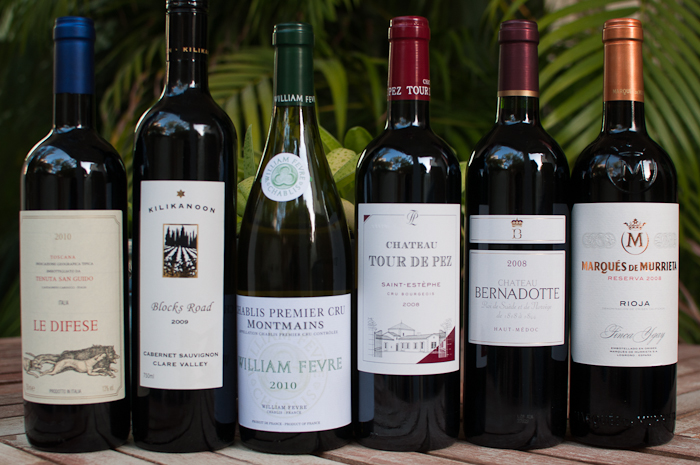
Six fine wines for 600 aed from The Cellar
In my kitchen …. of course wine shouldn’t really be in my kitchen as it’s the worst place to store it. Wine likes cool, constant temperatures and to be kept away from the light (whoops – this picture was taken in my garden). However, food needs wine and wine needs food and I drove to Ras Al Khaimah to visit The Cellar, Al Hamra and picked up these bottles among other things. Driving outside Dubai means that it’s lower tax (30% in the off-licenses here) and I can spend more than my liquor license limit which is vital for drinking more than cheap plonk. These six interesting bottles were an offer (buy six for 600 AED) from the Le Clos (fine wine) section in the shop. Well worth the easy drive down there.
I don’t think Julie Andrews had this kind of drink in mind with her jam and bread but it’s what’s in my kitchen this month. Pop over and see what’s in Celia’s kitchen (at Fig Jam and Lime Cordial) as well as links to a whole host of other kitchens.
What’s in your kitchen this March?

Glenmorangie single malt, cheese and men
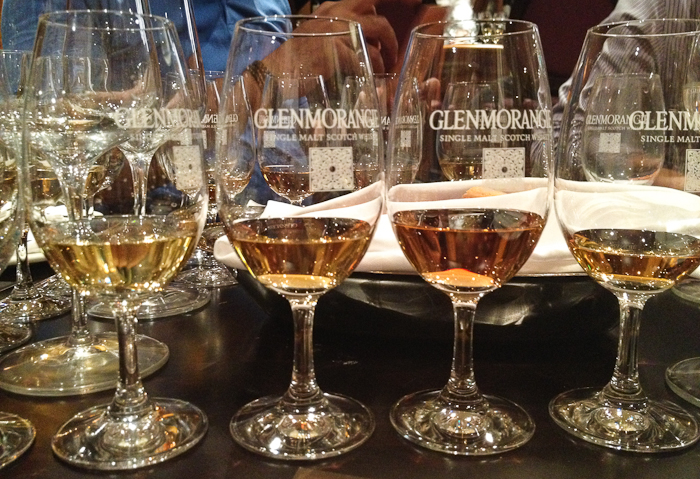 Craig is a self-confessed whisky geek. He knows about the nuances of the flavours that casks impart and the symbiosis with whisky makers and other users of barrels. He is on first name terms with the movers and shakers of the Scottish whisky industry. If he was sitting in the black chair with Magnus Magnuson firing specialist subject questions at him he’d be a single malt Mastermind.
I’m in an oak panelled room with a group of whisky nerds hanging off his every word. Craig peppers his sentences with the famous names of single malt as though everyone in the room has memorised a map of the distilleries of Scotland. He asks “has anyone not heard of the solera system?”*. He’s so excited about the whole topic that he moves rapidly from one side of the room to the other as he talks, turning his head like a bearded crane. Sipping from various drams and watching him is like drinking single malt while watching Wimbledon so I look down and concentrate on the aromas and flavours.
This is miles away from wine tasting – my usual descriptive lexicon is in the bin and it seems as though different parts of my tongue and taste buds are involved. Nuts, vanilla, sandalwood – the malt whisky tasting notes make wine ones seem positively austere. I take a wine nosing sharp sniff and the alcohol strength knocks me out. I have to hold the glass at a tilt and much farther away to sense the aromas which are delicate, like the scent of flowers on a summer breeze.


And why does this amber liquid attract such nerdiness and obsession by men? Outlet Manager Jovana, Glenmorangie account manager Remé, whisky-lover Ekta and myself are the only women in the room at Grape Escape (Hilton Jumeirah). Craig’s enthusiasm is infectious and while there are enough funny stories and anecdotes to keep everyone’s interest I start to drift during some of the detailed questions from the floor and the warmth of the whisky. Although it’s billed as a whisky and cheese tasting, there is no formality and we are encouraged to taste our way through the cheeses and pile of charcuterie so I nibble my way through the board trying a bit of this and a bit of that. The sweetness of the Comte (I’m guessing as nothing is labelled) goes brilliantly with the Glenmorangie The Nectar D’or (12 years old), a pear and Roquefort starter only goes with the Glenmorangie Original and the blue cheese is a quite nasty match with everything else. Surprisingly a soft rinded cheese (Camembert?) is great with them all. A bite-sized slab of Argentinian beef cooked rare is best with The Quinta Ruban.


Do I like the flavours of Glenmorangie? At the start I struggle, and this says as much about me as the whisky. There was a moment during a recent Kilchoman tasting when I was transported into the countryside. I was standing under pale blue skies, in a salty maritime breeze, watching the waving golden barley. The Glenmorangie is smooth and sophisticated; it lacks a sense of place for me. And then they pour the 18-year-old which is like being wrapped in a soft golden blanket.
For whisky nerds, this is what we tasted (and my inexpert tasting impressions):
- Original – 10 year old: strongly mandarin oranges on the nose, with a freshness that was minty, overwhelmingly silky vanilla taste (perhaps just too smooth for my tastes).
- Nectar D’Or – 12 year old: Orange peel, ginger and nutmeg aromas with a creaminess on the palate and burnt orange flavours. The tasting notes said lime but I didn’t detect any of that kind of freshness but nutmeg came through in the finish. Paired extremely well with a dried apricot from the cheese plate.
- Quita Ruban – 12 year old: Agreed wholeheartedly with the tasting notes about chocolate, Christmas pudding and sandalwood aromas. I would add caramel to that list. Chocolate smoothness and candied orange peel flavours predominate.
- Lasanta – 12 year old: Caramel toffee on the nose with rum and a touch of citrus (tangerine?), orangey and buttery flavours with all the nuances that you’d expect from maturation in Oloroso sherry casks. There was a sweet nuttiness on the finish.
- Glenmorangie 18 years old: The tasting notes read “appeals to the luxury spirits drinker who appreciates serious quality” – that’ll be me then as I preferred this way and above all the rest! Honey aromas captivate and the geranium mentioned on the notes was really alluring. Creamy honey tastes with caramelised grapefruit and a coffee finish. Not sure how much this retails for in the UAE but it’s £85.00 in the UK. so I probably won’t be tasting this very often.
- We also tasted something which was extremely rare and from my photos (see below) seems like it was
100%57.2% proof. I have no recollection of what it was like except that I enjoyed it!


Will I return to the Single Malt Society? Oh yes indeed – met some lovely men people over some delicious cheeses and charcuterie. I’ve learned a huge amount about malt whisky courtesy of engaging and entertaining malt whisky expert Craig. It’s exceptionally good value – 275 AED for (at least) 5 drams with cheese and charcuterie (and more) on this occasion. The events are varied too – the next one is hosted by a bourbon distiller who is flying in from Heaven Hills in Kentucky, at a Cajun restaurant with food cooked by a chef from Louisiana. Sounds good? See you there…
To join the MMI Single Malt Society register here and Craig will send you news of up and coming events. There’s a Facebook page and you can also follow him on Twitter.
* The solera system is complex system of barrel aging (usually sherry or port) and a method of fractional blending in which old wine is constantly refreshed with younger wine.
I left my camera at home so all images are taken on an iphone – sorry.


Related articles
- Do in Dubai: MMI Single Malt Society (dollzindubai.com)
- Glenmorangie Quinta Ruban (thewhiskyphiles.wordpress.com)
The taste of an island


Even if I didn’t know Anthony and Kathy Wills of Kilchoman, the whole story and ethos behind this farm distillery and single malt whisky would appeal to me. A bit of history explains why.
While there are bottles of whisky on every off-license shelf now, commercial production of the spirit didn’t start until the late 1700s. Before then farmers in Scotland who grew barley couldn’t store the crop for long due to the damp climate so they germinated any grain left over, dried it over peat fires, brewed it into ale (the rough barley grown then was called “bere” which is where the word beer comes from). Some of the ale was also distilled and the leftover barley meal (called draff) was fed to their animals.
Improvements in farming yields and a reduction in tax in 1823 led to the establishment of many commercial distilleries and at one point there were 23 on the isle of Islay alone. But by the 1990s, only seven remained, all owned by large multi-nationals such as LVMH, Suntory and Diageo, most using barley purchased from malthouses. Anthony and Kathy had the vision and nerve to build the first new distillery on the island of Islay for 124 years and they started production in 2004. Going back to traditional methods similar to those early farmers, the whisky is made from start to finish at Kilchoman, from the barley grown in the fields that surround it, to germination on the malting floor, drying over peat fires, combining with water from the brook to make ‘mash’, distilling, maturing and bottling. They even feed the draff to farm animals.


When we visited the distillery in 2010, Kilchoman was at the very early stages of its journey. The start is a precarious time for a business that cannot sell its new product for three years (it must be matured for three years minimum to earn the name of single malt whisky). However, designing and building a distillery around the whisky they were aiming to produce has reaped rewards in distinctive styles and flavours. Since then Kilchoman has earned a place in the BBC Food and Farming awards, various IWSC medals and the 2007 Vintage was awarded Islay Single Malt of the Year by the Whisky Advocate Magazine. Tasting from the very beginning means I’ve been able to follow its journey through flavour; as a young whisky it is good, but age will change with each release and it’s predicted to get better and better over the years.


Four years on in Dubai and I am welcomed to the bar at Celebrities in the Royal Mirage with a single malt whisky sour made with Kilchoman Machir Bay, lemon juice, a touch of sugar syrup and a dash of bitters. It’s the perfect blend of refreshing sharpness and mellow smokiness. I quiz barman Raoul for the recipe and Craig from MMI’s Malt Whisky Society promises to send it to me. We sit at tables for dinner and Anthony talks us through every glass of Kilchoman, two of which have never been tasted in Dubai before, each matched with a different course.
Honestly, I have reservations about drinking whisky with every course instead of wine, but enjoy the experience. Machir Bay is a typical Islay style, floral and peaty, and cuts through the fattiness of the first course foie gras beautifully; a herb coated, lightly smoked soft salmon fillet benefits from the delicate, floral notes of the 100% Islay (3rd edition). The smokiness of the 2007 Vintage Release (the oldest release by Kilchoman to date) goes incredibly well with pink lamb. The golden mellowness of the Single Cask Release 2008 momentarily takes me to Islay, the nose is like walking through peat bogs while breathing the maritime breeze, with a minerality which is almost salty on the palate. It’s a pretty good match with the soft chestnut and whisky cream inside a chocolate cigar but I just want to savour it on its own.


The light golden colour of the whisky in the glass is seductive and totally natural – Kilchoman use no colouring or caramel. Neither do they chill filter which ensures clarity but can strip out proteins which add to the character and texture.
The thing that struck me when I was talking to the distillers at Kilchoman was how in tune with the environment and the stunning natural surroundings they were. The whisky seems to capture this and bottle it; it truly is a scenic tour by taste of one tiny corner of a very small island. I’m looking forward to the next chapter…


How to make the best whisky cocktail I have ever tasted.
Machir Bay Sour
30 ml Kilchoman Machir Bay
30 ml fresh lemon juice
15 ml sugar syrup
Dash of Angostura Bitters
Shake together over ice, strain and pour into an ‘Old fashioned’ glass over ice garnished with a slice of lemon.
- Read more on the Kilchoman website and Facebook page;
- To buy in U.A.E: MMI, Al Hamra Cellar and Le Clos
- Join the Single Malt Society register here and Craig will send you news of up and coming events.
- See more pics of the distillery here and the stunning Islay scenery here.


Related articles
- An audience with Kilchoman drams (thewhiskysnob.wordpress.com)
- Kilchoman Machir Bay 2013 (thewhiskyphiles.wordpress.com)
- Exploring Islay’s farm-based Kilchoman Distillery (scotsman.com)
- Whisky Review – Kilchoman 2007 Vintage (boozedancing.wordpress.com)
Totally devoted to Beaujolais?


It takes a fair bit of devotion to keep toiling year in year out to make a highly unfashionable wine. A wine that’s right next door to a revered appellation. A wine that was once on everyone’s lips for all the wrong reasons and then was dropped like a hot stone into partial obscurity tinged with derision. Perhaps it’s a bit harsh to talk about Beaujolais in these terms, but the Nouveau craze of the 80s, a marketing ploy, became more about racing and hot air balloons than the taste of the wine. A clever idea to take a traditional drink of the harvesters – the just pressed wine of the new vintage – to a wider audience to generate a bit of cash-flow, eventually back-fired; a wine became craze, became yesterday’s news and the mass market moved on leaving a whole region in shadow.
So is it possible for Beaujolais to make a come back, slipping out from under the invisibility cloak of Nouveau? This week it was listed as one of six exciting wine regions to explore, in a Forbes article and The Guardian reports that “a new movement of young, enthusiastic winemakers throughout the region is producing exceptional wines, often using organically grown grapes.”


At the Foodies Festival last summer in the UK, I joined a Beaujolais tasting session led by Susy Atkins. It was my first opportunity to taste a wide range of wines from the region, from Beaujolais Villages (a group of 38 villages allowed to use this designation of higher quality differentiating them from plain Beaujolais AOC) to some of the Cru Beaujolais – 10 areas allowed to use the highest classification on the label. The ten Crus are Brouilly, Chénas, Chiroubles, Cote de Brouilly, Fleurie, Juliénas, Morgon, Moulin à Vent, Régnié and Saint Amour.
Susy took us through six wines, urging the audience to think differently about Beaujolais. All grapes are picked by hand and the main grape variety of the region is Gamay; wines are juicy, with fresh acidity when young but, despite its reputation, is capable of producing serious wine and some age.

1. Arnaud Aucoeur, Beaujolais-Villages Blanc 2012 – Yapp Brothers
Susy couldn’t have started with a more unusual wine – a white Beaujolais in a region that almost exclusively makes red. This was made of Chardonnay, from 25 year old vines, not surprising as the region has often been considered as part of adjacent Burgundy. Pale lemon in colour, with citrus and almost floral notes on the nose with a restrained, buttery hint (from old oak), rounded body and good acidity.
2. Château de la Terrière, Beaujolais-Villages 2010 – Majestic Wine
Ripe, fresh strawberries on the nose, soft-tannins, bright red berry fruits with a cherry drop twist on the palate and mouth-watering acidity made this deliciously refreshing on such a hot summers day. The fresh lift of acidity was reminiscent of Sangiovese and would be great with charcuterie.
3. Domain de la Madone, Fleurie Vieilles Vignes 2011 – Corks of Cotham and Davis Bell McCraith
This had elusive aromas of cherries and raspberries, an elegant wine with some green notes and fine tannins that lingered on the finish. Fleurie is one of the most Northern areas in Burgundy and this Cru produces restrained and more mineral wines. It’s not as light and delicate as the name suggests and will take a bit of aging.
4. Juliénas, Château de la Bottière, 2011 Laurent Perrachon – Christopher Piper Wines and Averys
Made from Gamay grapes from 40 year old vines, this had a slightly vegetal nose, a spicy, rich, deep black cherry palate lifted by a hint of raspberry leaf. Not quite as high acidity as the previous wines but still juicy, with more forward soft tannins and a slightly herbaceous finish.
5. Château Thivin, Cote de Brouilly, Les 7 Vignes 2007 – Nick Dobson Wines
This ‘Cuvee Zaccharie’ is from some of the oldest planting of the Chateau and grown on well-drained soil of volcanic blue stone (diorite porphyrite). Soft, savoury aromas on the nose with a hint of tar which is repeated on the palate. A rounded, spicy finish with a hint of cherry syrup.
6. Château du Moulin-à-Vent, Moulin-à-Vent 2010 – Berry Bros & Rudd
Moulin-a-Vent make some of the biggest wines Beaujolais following a more Burgundian style of wine making. With this wine there is no carbonic maceration and the wine is aged in French barriques. This one was big and broad with more structure that the other wines. There was a spicy pepperiness, with forward tannins and although still juicy there were blackcurrant characters within the cherry and strawberry fruit flavours. It’s a style I loved and my favourite of the day.


This tasting took place inside a marquee on a very hot summers day in England and it made me wonder if Beaujolais isn’t the perfect red wine to drink in Dubai. On days when you long for something more complex but the thought of a fruit bomb or heavy tannins is just too exhausting, the fleshy mouthfeel and bright, fruit of a slightly chilled glass of Gamay could be just the thing. In fact one I could be totally devoted to when the warmer weather arrives.
Submitting this (by the skin of my teeth) for the Monthly Wine Writing Challenge (MWWC7). The theme was ‘Devotion’ and set by SAHMmelier. Do pop over to MWWC to read the other entries and vote.
P.S. A generous friend let me taste some Domaine de La Chapelle des Bois, Fleurie 2006 Paul Beaudet – Le Clos – last weekend and it added further evidence to my case (of Beaujolais being the perfect red wine to drink in Dubai).
If you’d like to know more about Beaujolais there’s a great explanation here and Jancis Robinson casts her cool gaze towards the region and explains why unfashionable wines can deliver great value.
Walking in Jaipur
 Walking in Jaipur can be a bit like tackling an obstacle course. The small stretch of pavement by the bazaars is full of people and abstract merchandise overflowing from the small shops and stalls on the roadsides to almost meet in the middle. Then they’ll be a heap of sand with a sacred cow on top of it pushing you out into the tumultuous traffic.


The guide books focus on attractions although the city of Jaipur was designed on a grid system and is pretty easy to navigate once you cut through the chaos. On our way out in Jaipur airport, after we’d negotiation two-thirds of the bureaucratic forms, checks and stamps (6 in total on our boarding passes alone before we got to the plane) we found a book shop in departures which on closer inspection revealed some interest and wasn’t extortionate in price, once you got past the absolutely haphazard nature of the display. Oh how I wish I’d brought home ‘Italian cooking in Jaipur’ for novelty value; but Jaipur – 10 easy walks by Dharmendar Kanwar is a treasure which makes me want to return to the pink city to explore at leisure.
More about Jaipur:
Jaipur – eating, staying and getting about


“You need three things to drive in Jaipur”, said Kadir with a twinkle in his eye. “Good horn, good brakes and good luck.” As we darted through the throng of tuk tuks, rickshaws, bicycles, four-wheel drives, taxis, camels, donkeys, horse-drawn carriages, meandering pedestrians, sacred cows and stray dogs I closed my eyes and prayed for the latter.


Getting about
Apart from our airport drivers arranged through the hotel, Kadir was our transport and guide for three days. He was quietly spoken, tried hard to guide us to sights we would enjoy and was a bit protective of us without being bossy. He showed us his guest book, packed with glowing testimonials, with pride. He asked us for 250 rupees for the first afternoon and evening (about £2.50).
In the course of three days, I went from white-knuckle terror with my eyes closed to slightly jumpy. The low-down carriage and open sides meant we were level with everything. We rattled through the streets and when my eyes were open I hardly blinked not to miss a thing. We didn’t see a single bump or crash during our time there which was an astonishing testament to the crazy system somehow working, relying on the ability to get through the smallest gap, gauge where traffic was coming from by the sound of the continual beeping and stop at very short notice. It did explain a lot about some of the driving here in Dubai too (where 40% of the population is from India).
On our drive back to the airport (by car not tuk tuk) on the Sunday morning we noticed people with numbers on their backs, running through the usual mayhem. They were taking part in the Jaipur marathon. No roads closed, no police escort, just a very small section cordoned off for the finish line where all traffic diverted to the oncoming lane to bypass. Thinking about it now still makes me chuckle and admire the brave/foolhardy athletes who attempted it.


Eating and drinking
Intending to eat only cooked vegetarian food during our stay to minimise the chance of the famous ‘Delhi belly’ we found the hotel food was of a high standard and even ate bacon for breakfast one day. We had a thali in the elegant courtyard on the first night with a bottle of wine. The list was pretty good and we decided to sample our first ever wine from India – a Fratelli Cabernet Sauvignon – which was well balanced and fruity. One night I spotted D’Arenburg The High Trellis that I’d not tried before;at around £20 a bottle this was great value for a restaurant list. We also sampled Sula Merlot, another Indian producer, which was well made, balanced, easy-drinking. Gin and tonics (Blue Riband Indian gin) went down very well sipped to the sound of the gurgling fountain mingled with the sitar player.


Our lunch choice on day two was so good we returned the next day too. Kadir said he’d take us to candle wall which turned out to be Khandelwal. We climbed up the stairs to this minimal, airy, canteen style restaurant where local families and a few tourists sat at the simple tables. The Kaj Kari was recommended, a rich, brick-red curry topped with cashew nuts. We plunged the piping hot fluffy bread into it with relish. Missy roti, a slightly spiced bread was also good for dipping into Dal Makhani (a very good lentil dish), Shahi Paneer (spinach and cheese), Alu Mutter (spicy potatoes) and Dal fry. Second time around we tried Began Barter – a very, rich aubergine dish, Paneer Butter Masala which was our favourite of the day and Gatta Masala (with chickpeas).


We couldn’t visit Rajasthan without a bite of Daal Baati Churma – I knew this from my first Frying Pan Food Tour. It’s a strange dish – evolved from having to transport food – a ball of hard wheat that you soften by crumbling into dhal and eating with a spicy sauce. We enjoyed the dhosa more I’ll admit, at the restaurant that Kadir called ‘Rambo’ which turned out to be Rainbow. This had a much more sophisticated décor than our lunch venue and was a whole £2 more expensive.
I loved looking at all the street food stalls dotted along the streets, with chai stalls on every corner, but we didn’t chance trying anything. Perhaps we were too reticent – the pani puri stalls with their crisp coatings and spicy insides, really tempted me. The fruit and vegetable stands were filled with the most beautiful fresh produce.

Staying
We bucked the trend of budget accommodation we usually choose for our long weekend travel adventures and I’m very glad we did. The Samode Haveli was a lavish residence built for the royal family over 175 years ago, which was metres away from the crowded, ramshackle streets but an oasis of calm we welcomed at every return; the constant honking horns only dimly audible in the distance. Other guests were all slightly older but very varied nationalities including one band of motorcyclists stopping off on a tour, all riding original Royal Enfield vintage motorbikes. A turbaned sentry welcomed us at the top of the elephant ramp entrance each time we came back from another adventure.


The gardens were full of very English flowers like nasturtiums and dalias, and the lawns the site of a puppet sho, a game of cricket and a daily dog walk conducted by staff round the perimeter leading the residents’ canine pedigree pets. We tried a massage at the spa and despite all asking for different ones ended up with the same – not the best ever but relaxing. Areas that were a bit lacking from usual 5 star standards, like thin mattresses and very unfluffy towels, were amply made up for by friendly attentive staff (four porters were sent to take our luggage from the room) and the palatial surroundings including marble fountains, purdah screens and a gorgeous painted dining room. I wouldn’t have wanted to stay anywhere else.


Street life and a conundrum
There’s something that really puzzled me about India. We saw quite a bit of squalor and some people who are not very well off at all. Families were living on the street and there were quite a few beggars. So I presume that some people do not have enough to eat. However, food was being scattered around the streets in abundance. Women made special long sausage things to give to fish, there were great platters of food to give to the multitudes (and I mean mega population explosion) of pigeons outside the City Palace, monkeys got special peanuts, great rubbish heaps punctuated the street corners with stray dogs and cows munching happily away in the debris with passers-by popping up now and then to heap a bit of greenery under their noses. I’m exceptionally grateful that there were no rat temples about. All this in the name of karma. And yet… bony old horses dragged carriages, cobras were denuded of venom and very likely drugged and the sound that a particular goat made next to our hotel indicated that it was far from happy.
What about giving food to people? And why were some animals favoured over others? But then I wondered whether we are just as guilty of animal double standards in the West. We spoil our pampered domestic pets, visit petting farms and get agitated about culling bushy-tailed foxes (who wreak havoc in the countryside if left to their own devices) yet we tolerate (and actively encourage by our buying habits) the insufferable cruelty of millions of industrially farmed animals. You learn not to judge so hard.


Last impressions
Once home, my head hit the cool cotton pillow and I sank into the comfort of a good mattress truly spent – but my mind was still revolving like a kaleidoscope. I returned from Jaipur feeling like I had seen every single shade and hue known to man, and a few extra; as though I’d tasted all the spices in the world, tested every muscle and bone in my body, filled my head with so many sights and sounds that there wasn’t room for a single syllable, mote of dust or beep of a horn. And this was after only thee days in the city. I came back to Dubai feeling extremely grateful for my life, perhaps with a slightly better understanding about some of the residents of this Emirate. Some of my expectations were confirmed but some blown away in smithereens. Witnessing India in reality was so much more than the books and films promised. I was glad to experience at first hand all its colourful, dirty, frenetic, crazy, grand, bonkers splendour.


Ice cream seller


More info
We flew direct from the UAE via Sharjah on Air Arabia Flight time about 3 1/2 hours. We booked ahead and the flight cost less than 1000 AED per person. A note of caution though – they changed our flight times both ways at short notice.
We stayed at Samode Haveli – there’s a nice review and a video of the rooms (as well as more about food and drink in Jaipur) here by Gourmet Chick. It’s very popular and gets very booked up so plan ahead.
You can find Kadir near to the hotel or check his website. Highly recommended.
We used the Eyewitness book on Jaipur as a guide book which was pretty good. There is a very interesting book shop in departures at the airport (after your boarding pass has been stamped 6 times – no joke) where I bought this very interesting edition on 10 Easy Walks in Jaipur.
Visa: Check in plenty of time before you go. The forms are extensive and for UK Citizens you have to apply in Bur Dubai and it takes about a week (go early). Visas on arrival soon thank goodness.


So this concludes three posts about our three days of adventure in Jaipur, the sights and sounds, the shopping and the getting about. Thanks joining me in a look back, all your comments so far and for your shared experiences of India. It seems to have a special place in many people’s hearts.
Jaipur – shopping


I’m clutching at the back of my friend’s jumper like a small child. This is one of the most terrifying things I have done in a long time. I’m crossing the street in India. We have gazed at the painted doorways of the City Palace, marvelled at the wonders of centuries-old instruments that measure the stars and planets, and looked down on the bustling pink city of Jaipur through a purdah screen on high. It’s time to attack the shops and we cross the road by the entrance to the Hawa Mahal. There’s the English way of crossing the road: look right, look left, look right again and if all clear, cross the road looking and listening. But this is the Indian way of crossing the road: step out into the constant stream of traffic, chatting to your friend and looking straight ahead, the traffic will brake and allow you to cross, resuming millimetres away from you when you’ve passed that individual vehicle’s section of road. I’ve now booked the hairdresser to cover the traces of my extra grey hairs.
Jaipur was built for shopping; Maharaja Jai Singh II planned the city with nine blocks or chowkris and the bazaar areas are neatly contained within this grid system (well as neat as anything in Jaipur can be). We dive down a narrow side alley and are surrounded by gleaming things; this area is dedicated to parties so contains decorative hats, streamers, party bags and even fireworks. We won’t be taking any of those back on the plane.


Easing our way through the crowds of haggling shoppers party glitter turns into wedding splendour, with crimson turbans and jewelled material for saris. Emerging out on the edge of the market, by rows and rows of motorbikes parked so close you can’t see the pavement, we find a shop with raw silk stoles. We take our places seated on the floor with the shopkeeper who, although very grumpy, gets the whole shop out for us to inspect. He will not budge from his fixed price although we try every trick in the book developed over years of living in the Middle East, but we leave happy, clutching lengths of colour.


We return several times to the bazaars, meandering down along the shop fronts. I peer into little nooks set in the wall between the shops which contain tiny shrines or utensils for chai-making. A seller presents a highly scented rose to me in the flower market; salesmen sit cross-legged on the floor behind rows of orange garlands and other pink and white blooms. We find the source of the kites that appear as soon as the sun starts to fade and children head for the rooftops with paper, bamboo and string that bob over our heads. We’ve asked Kadir about Bapu bazaar several times and he is uncharacteristically evasive. Walking towards it, the bright street starts to become gloomier. There is a soup kitchen and with disheveled men hunched over bowls of food. The eyes upon us are more intense. Flocks of birds of prey swoop and soar overhead. Reaching the corner we are lured into one of the first shops. The salesmen are very intense and pushy. They argue and argue asking inflated prices and packing things away for us when we haven’t agreed to buy. Suddenly we’ve had enough and go to leave, but one bars our way. It’s very intimidating and we flee at speed. Reaching the spice market we gaze half-heartedly at bottles of rosewater and piles of saffron but we’re relieved when Kadir finds us and his tuk tuk whisks us away.


Next time we make sure we shop during the day and in areas where there are lots of women. We adore the textile bazaars where groups of ladies all sit amid jewel coloured cloth and taking hours to choose just the right material for saris.


Of course this is not the only way to shop. Jaipur is famed for its craftsmen and in particular blue pottery, traditional camel-leather shoes, paper, wooden painted statues, block printed materials and carpets. Inevitably (as referrals are an income source) Kadir takes us to some showrooms. They pretend to make the things on site but actually bring them in from surrounding areas. This was not a bad experience as it took us into the quiet, residential back streets of Jaipur and its a less frenetic place to buy than in the bazaar. I pity the poor shopkeeper who tries to sell us pashminas (Dubai is the land of pashminas).


On our way to another showroom we stick our heads into a courtyard where they are dyeing cloth, heated over a wood fire and then visit a man dyeing thread. Our least favourite place is Handicraft Haveli – presented to us as a ‘museum’, it is chock-a-block with very expensive items for sale which other tourists are buying. There are some lovely things and fun to browse but the prices are way over the top. As we return to the hotel, for some reason R walks through the archway next to the entrance. She runs back with excitement. Right next door there are craftspeople block printing, spinning and weaving. No hassle at all, in fact everyone ignores me as a wander round with my camera.


A list of the main bazaars in Jaipur is here and the Eyewitness guide book has an excellent map, however they all merge into each other so it’s best just to wander.
We bought pashminas, raw silk shawls, cotton scarves, cushion covers, silver bangles and loose cotton baggy trousers. Sorry KP, I didn’t buy you a kite.
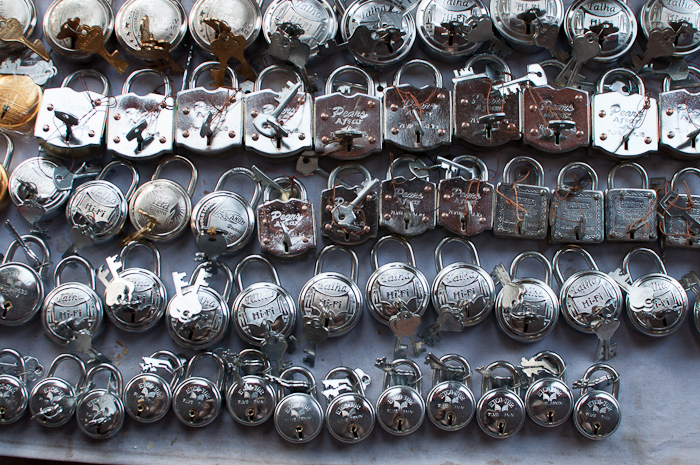
 What’s your favourite thing about a bazaar? The shopping or the people watching?
Read more about the sights we visited here. More about where to stay, eat and getting about to follow soon.
Jaipur – sights and sounds
 From the moment I mentioned that I was going to Rajasthan, KP kept singing “Jaipur” – to the tune of the Slumdog Millionaire dance tune, with increasing intensity and volume as the day of my departure drew near. Many of us form our opinions of the Indian sub continent from a variety of media. For me it was through the pages of many books from White Tiger, to Midnight’s Children, A Suitable Boy, The God of Small Things, Heat and Dust, Eat, Pray, Love, The Best Exotic Marigold Hotel, Life of Pi, Narcopolis to Shantaram and more, plus films such as Monsoon Wedding and the aforementioned Slumdog. Through food I now count many lovely people who hail from different parts of India as friends; over 40% of residents in the UAE are Indian nationals and via Fooderati Arabia I’ve got to know a lot more about the people, cuisines and country. So with all these preconceptions in mind I headed off with two friends for a long weekend in Jaipur; now I can hardly believe that we were there for only three days and the tumultuous impressions won’t all fit into one post. So this is part one about what there is to see in Jaipur, with more to follow about shopping, where to stay, how to get there and what to eat. This is not a guide book with all the facts and figures – these are my random experiences and impressions of the sites we visited (and loads of pictures).
Jaipur is known as the pink city as in around 1876, Maharaja Ram Singh II decided to give everything a fresh coat of paint in honour of the visit of The Prince of Wales and he chose pink. It is now a regulation colour for all houses and shops although the hue changes because of light, surface, age and circumstance from rusty terracotta to delicate rose. The original capital of was in nearby Amber but the new city, including many temples and palaces was planned by Sawai Jai Singh II who laid it out on a grid system, referring to the Hindu treatise on architecture (Vastu Sastra) with wide roads, a city wall and seven gates in collaboration with two architects Vidyadar Bhattacharya and Sir Samuel Swinton Jacob. Throughout the centuries the royal families activity encouraged artists and craftsmen to move to Jaipur and it is still famed for artisan craft skills such as block printing of textiles, hand-dyeing, weaving, blue pottery and paper making.

City palace
Our first port of call and feeling vulnerable as we leave our tuk tuk and approach the arch to the palace. A snake charmer appears and we pounce with cameras, but the lid is swiftly thrown on and the cobra disappears until notes are proffered. We refuse a guide but the signs are not very helpful (Jaipur 10 city walks has very clear info to all the rooms). We meander around taking in elegant pillars, the imposing palace fascia, some museum rooms of costumes and armaments, and the marble-floored Diwan-I-Khas, a private audience hall with enormous silver vessels that Maharaja Sawai Madho Singh II filled with water from the Ganges to take with him on a two week trip to England. The Pitam Niwas Chowk which portrays the four seasons and Hindu gods is truly stunning especially the peacock arch with delicate designs and vibrant colours. Closed doors indicate the continued residence of the current Maharajah; we are still in the presence of royalty.


Jantar Mantar
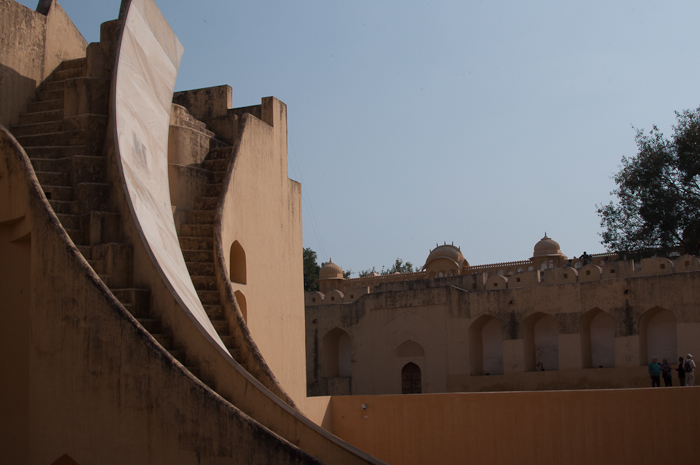
These extraordinary and ingenious structures, listed by UNESCO, for reading the weather, astrology, astronomy nevertheless look like an extreme skateboard park from an inner city estate. Korean tourists with made to measure face masks wander in groups. A couple of disenfranchised young men, possibly lovers, use the surroundings as a tableau backdrop to pose and display their fashionable clothing; silk voluminous drop crotch pants for one, gold trainers for the other, sharp haircuts and cheekbones in common. The instruments are still used to used to predict the intensity of monsoons; pretty amazing as they were built in the early 18th century. It’s quite peaceful, despite the tourist hordes and feels like a garden of modern sculpture.




Hawa Mahal – the palace of the winds
The view from the road is disappointing as pictures give the impression of serenity and isolation; it is nothing of the sort. Rickshaws lurch, camels groan, hawkers pester, aromas rise up from the drains, pores, nooks and crannies and the ornate facade that I took to be pink stone from the pictures, in reality, is painted pink. However, we seek the back entrance and the real delights unfold. The view of the street below is much more alluring when viewed through the eyes of the women in purdah from behind a screen. The lacy lattice frames, the cacophony dims, the rapidly lowering late afternoon sun bathes everything in its kinder glow. Baboons frolic on distant rooves below; we are on top of the world. Beginning our shaky descent we hear a sudden communal gasp. The fountains have been switched on.


Jantar Mantar visible in the background


Jal Mahal – water palace
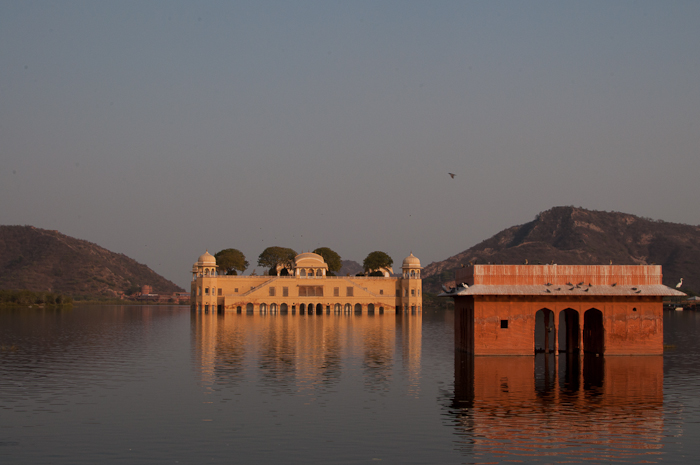
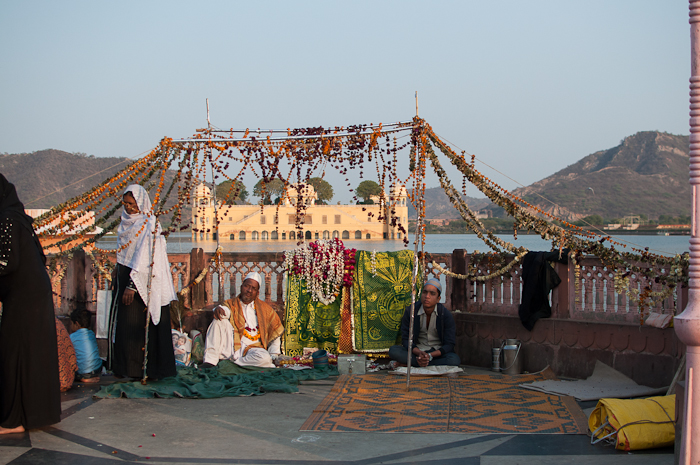
In need of revitalising after our packed first day and thinking of roof top bars looking over the city on our Istanbul trip we ask Kadir (our guide) to take us to something similar. Arriving at a clean, modern coffee bar on the top of a petrol station we realise he isn’t quite on our wavelength but glancing to the other side of the road see that it looks out onto Jal Mahal. The evening light is perfect and we’re glad of the happy accident that has brought us here now rather than the next morning as planned. Families gather near the edge of the lake and there is a constant swell and thrashing of fish which come to the surface to be fed. Sari-clad ladies are occupied in the futile action of rolling a paste into small sausages to sell as fish food; patently these beasts will eat anything.


Amber fort (also called Amer fort)
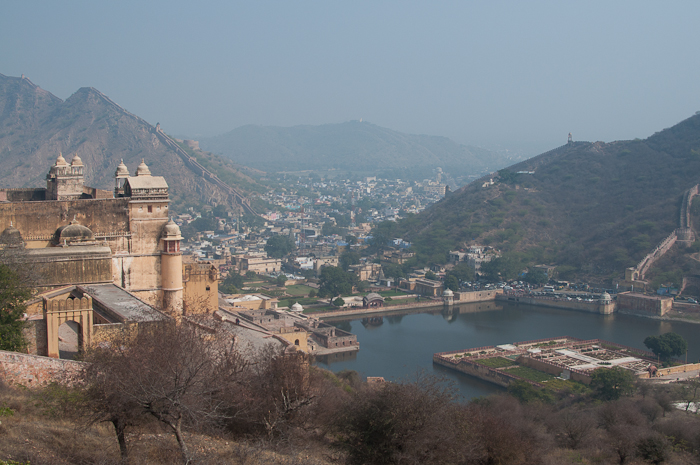
Our tuk tuk engine starts to wail as it tackles the gradient of the winding approach road to Amber. “No overtaking” we command as Kadir indicates with his body language that he is considering passing a truck on a blind bend. Suddenly the fort appears reflected in the Maota lake below in the misty morning light and there is a snake charmers 100 metre sprint to get to us as we stop with our cameras. Walking up the cobbled approach lane, painted elephants with tourists in swaying howdahs on their backs rise up above us. Warned to keep off the elephant road by a passing guard “elephants are very hard to control and it is dangerous”, the two routes eventually merge and we are forced very close to their pounding feet.
 The fort is vast and signage not great but we resolutely eschew having a guide so just ramble about happening upon labyrinthine corridors, purdah screens, latrines (there were more than 100 throughout the fort all leading directly out into the fresh air), the famous mirror room – the Sheesh Mahal – and the king’s bedroom which has private entrances leading directly to it from the ladies’ apartments. The scale of the place is pretty mind-blowing and we try to imagine life there in late Medieval times; secure behind walls, freezing cold in Winter, a vast army of people required to maintain the life of the court. Not being part of a group means that we find ourselves alone a few times, a nice respite from the competitive clickers. ‘The garden in the lake is closed’ says a guard placed there for the sole purpose of communicating this information – it only opens at night during the light show and there are serried rows of benches set for this purpose. We climb higher along the wall which snakes through the surrounding hills. The concrete cladding, streaked black by polution-laden precipitation lends a weird sense of Cold War era Eastern block to the hills even though the Medieval forts lower above us on higher hills. We are shadowed by a man who is following us at distance to beg; we are relieved when he gives up after twenty minutes. Our entry fee to this astonishing place as foreigners is 200 rupees each – about 2 GBP (12 AED). The charge is 25 rupees for Indians.


Mirror room


Galtha, Galta, Galtaji, Galwar Bagh or monkey temple
This has many names depending on which guide book or guide you follow. We approached from through the Galta gate. Pigs wander about the dirt rubbish-lined track, monkeys swim in a water trough. A boy selling food to give to the monkeys thrusts peanuts in our faces. Through the grinding poverty Ravi approaches dressed in an bright white cricket jumper and chinos. “Galta is my birth place” he says proudly. Nervously, we scan the monkeys and dogs that line the route for signs of rabies and climb up the winding path giving us a view over Jaipur shimmering in the haze of pollution of a million two-stroke motors. Not sure we are in the right place, I keep asking about the tanks of water from seven springs which I’ve seen in the guide book but which is not apparent in this decrepitude. Cresting the brow of the hill, which has a cluster of shabby looking shrines and equally shabby Holy men, we descend into a valley. The red-haired monkeys are everywhere and doing everything, we quickly avert our eyes from one enthusiastic couple. Ravi gives us a pep talk before we reach the temples warning us that the first one is small, we will feel uncomfortable and they will demand money. We see what he means when we are level with the entrance and refuse the invitation of the persistent Holy Man. Walking round a rank pond of water (‘for the monkeys to swim in) we look down on the first pool over a high wall topped with jagged, coiled razor wire. Apparently a prevention against further suicides. It is all fairly grim but there is enthusiastic washing going on at the bottom of the stairs.
 The lower pool is closed for washing as the water is not clean – although it has exactly the same amount of floating debris and scum as the upper pool. The once grand temples are crumbling and dotted with modern Holy paraphernalia. A piece of string is tied round our wrists – for long life – and a blob of yellow dabbed on our heads by a young, earnest ‘Holy Man’; we give money. A less reticent member of the religious community harangues our guide as we exit and I sense that this is because we avoided the Hanuman shrine, which Ravi confirms as true. We retrace our steps up the hill, taking a ‘short cut’ which thankfully avoids aforementioned pushy mystics. Ravi chats about cricket and how the monkeys often raid his house and steal things like shoes (and his brand new trainers). “They are having sex” he points out helpfully; we quickly avert our eyes. The path is steep and hot but we are rewarded by the view of Jaipur again as we reach the top. Proudly, Ravi points out the school where he is a student; small children are helping their mother wind thread on a rickety wooden contraption in a garden; families beg from tents along the track. The approach from the Surajpol Gate has given us a pleasant walk and a very different view from just arriving at the main entrance to the shrine. The tranquil peace of the hotel grounds has never seemed so welcoming.


Hindu Temple
We’ve had an uncomfortable moment when out in the bazaar and fled to find Kadir. It’s too early to eat but we have no more appetite for shopping. He speeds through the streets to a Hindu temple – we are all too tired to notice where it is. Removing our shoes we are too nervous to leave them at the street gate in case they disappear. Intending to carry them round, disapproval makes us leave them at the door but the rest of the greeting is in kind gestures and very welcoming. It is bright, light and every surface is dazzlingly reflective. People visit the altar or shrine in the middle then do a circuit in a corridor around it, touching pictures on the wall as they go. It is tranquil to the ears and soul, if not the eyes. Our bad experience is forgotten.


This is merely one dimension of our three days in Jaipur. I felt that I could hardly blink or I would miss something. More about the sights from street level, the shopping, where we stayed, how to get about and, of course, what to eat, to follow soon.
Related articles
- Sightseeing in Jaipur (atasteoftravelblog.com)
- The secret road to the monkey temple in Jaipur (actoftraveling.com)
- Amber fort (richardarunachala.wordpress.com)
- Jaipur Literature Festival 2014 (arabiczeal.com)
Celebrating with custard


Somehow I’ve been scribbling down my thoughts about food, my family life in here in Dubai and away, plus visits to UK for four whole years. Weirdly, I now can’t image life without blogging – something that my non-blogger readers might find equally weird. The wonderful richness plus a touch of the rollercoaster it has brought to so many aspects of my life is something I wouldn’t swap for anything. No not even a custard tart. From developing a writing style, learning how to use a proper camera (plus all the editing software) and online tools, meeting an incredible bunch of people both on and offline, it’s now part of who I am. I’m proud to wear the title food blogger, foodie or whatever other term encapsulates loving the topic of food so much you feel compelled to take pictures of it…on any occasion. With time ticking at an alarming rate until the teens fly the nest, the slightly surreal world of food blogging gives me a purpose and a network outside work for when it’ll be just KP and me. Ah, where did it all go? So true that the days are long, but the years are short. I’ve seen other friends struggle with the void that departing children leave and I hope I’ll be kept too busy for the pain of separation to bite too hard. Anyway… before we all get too maudlin’ … how to celebrate this anniversary? There’s really only one way. With custard.


Despite the title, a search for custard on this blog will be a bit spartan and something I’m determined to rectify. My love of custard continues unabated and one of my favourites is made by my Mother-in-law. Luckily it’s the easiest too. Thanks to all of you who’ve visited, read, commented and shared over these 1460 days, 48 months and 238 blog posts. You’ve been an indispensable part of the journey. And thanks to Anita for feeding me so much lovely custard and this recipe:
Microwave custard
Ingredients
- 300 ml double cream (or single cream or full-cream milk)
- 3 egg yolks, free range
- 1 tablespoon caster sugar
- 1 teaspoon cornflour
- Vanilla extract (not flavouring)*
Method
- Measure the cream (or milk) into a microwave-safe jug. Heat the cream on high and bring to the boil. Keep checking as it will only take about 2 minutes (depending on the power of your microwave).
- Meanwhile place the egg yolks into a microwave-safe bowl. Add 1 heaped tablespoon of caster sugar plus 1 rounded teaspoon of cornflour to the egg yolks. Whisk together lightly with 2 drops of vanilla extract. (*I ran out of extract so boiled the milk with a vanilla pod and kept it in the custard until the end for a lovely vanilla seed flecked appearance).
- Pour in the boiling cream (or milk), stirring all the time and give it a really good whisk. Wipe the sides of the bowl with kitchen towel.
- Put the bowl in the microwave and heat at 80% power (or medium-high) for 20 seconds. Remove and give it a good whisk. Repeat for another 10 seconds at a time until thick and creamy. This can take anything from 30 seconds to 3 minutes. Do not overheat (but if you do and it starts to look less than smooth, remove from heat and whisk briskly).
- Pour into a jug and serve. If not eating immediately place a piece of cling film on the surface to stop a skin forming (unless, like me, you like the skin of the custard).
A note on ingredients in Dubai: I used four egg yolks as the ones from the Farmers’ Market are a little bit small, plus the UHT whipping cream from a carton. Tavola sells real natural vanilla without alcohol.


Serve with apple pie, apple crumble, steamed pudding, Bakewell tart, treacle tart, Christmas pudding, stewed fruit, baked apples or cold in trifle. Custard’s list of friends is endless. And what of blogging? Will I still be doing this in four years time? I hope so. Adam Roberts aka Amateur Gourmet sums it up in the last two paragraphs of (an epic) post about his 10th blogging anniversary here. It’s “the desire to connect with a bunch of strangers over a shared enthusiasm for food and cooking” that keeps you going. You are most welcome to dine at my virtual kitchen table any time.


Where to eat and drink in London


“Oh there’s nothing to eat in London, Just get a sandwich from Pret”. I read this on a blog – no joke. I’d just returned from a couple short visits to the capital and was looking enviously at cows in fields; those lucky creatures with four stomachs. Fan of home-grown sandwich chain Pret a Manger though I am, you’d need six months to sample just a smidgeon of the exciting eats on offer. Tinkering with Samuel Johnson’s quote, “when a man is tired of food in London he’s tired of life.”
The vast amount of choices can get a bit bewildering though. London districts are like a series of villages, many with their own distinct food scene. Googling is not much help as the top sites are full of paid-for links and very overwhelming; you don’t really get the inside story.
Starting to dream of a return this year I needed a guide to some hot picks in the capital. So I trawled the brains of some people who are really in the know; food and wine bloggers in London. Massive thanks to Anthony, Fiona, Jeanne, Jeff, Kat, Rachel, Regula and Urvashi. Some are London born and bred and others have made it their home or visit often, from other parts of the UK and beyond. Read more about them further down the page. Now, are you feeling hungry? Back to the food:


Street food
Food trucks, stalls and markets are popping up all over London. I’ve tasted my way through quite a few of them at Food Blogger Connect in 2012 and 2013 and found some of the most delicious and exciting food you’ll eat in the capital. The focus on great quality ingredients is what sets these small vendors apart. They are all a bit mad and creativity doesn’t just extend to their food, but their appearance and presentation as well. I’ve eaten masses of tasty morsels from burgers made with offal (Tongue n Cheek) to freshly fried churros and food from Mauritius, Brazil, Russia and Jamaica to name a few. My very favourite has to be Belle of Bell & Brisket who as well as thrusting a meltingly, savoury, roll of home-cured salt beef into my hand (I can still taste those beefy juices as they dripped down my chin), she also tempted me to try a pickled egg for the very first time. Runners up are Funky Chicken – for the van, name and banter alone, Yasmin of Lovedesh – who set up a tripod and cauldron over a wood fire on a pavement in Battersea to cook a Bangladeshi curry from scratch, and a panini from Gurmetti. Yes an Italian sandwich can be that memorable.
Jeanne recommends South African Grant Hawthorne’s African Volcano stall at Maltby Street Market for a variety of peri peri-infused dishes like chicken prego rolls on homemade Portuguese bread, slow-roasted pulled pork on a peri peri bap and giant flame-grilled tiger prawns. Rachel rates The Wild Game Co., Sporeboys, Kimchi Cult, The Rib Man and the irresistible Yum Bun. Urvashi’s tips include the Real Food Market on Southbank, Kerb at Kings Cross (see below) and a bit off the beaten track for Indian food would be a wander along Southall High Street for brilliant take-aways.
Ways to find street food in London:
Kerb – a directory of street traders and events. Worth browsing the traders list for the witty names alone.
Street Feast – regular street food night markets (mainly in East London).
London Street Foodie – a blog written by the Food Editor of the London Evening Standard which tracks down the best of London’s street food.
Street food carts and stalls are often a big part of markets like Exmouth Market for instance. For more market info head to my post about Borough.
The Underground Restaurant and Ms Marmite Lover ©KerstinRodgers
Supper clubs
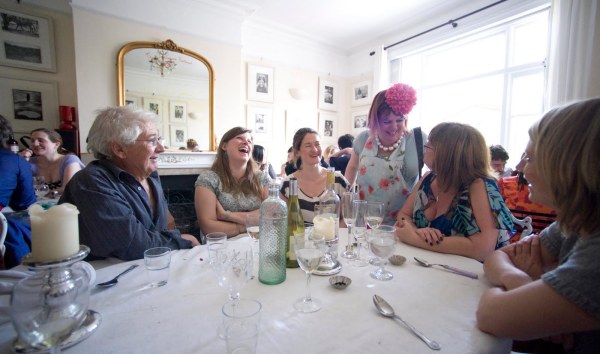
In many countries the best food is eaten in people’s homes – and why should London be any different? One of the pioneers of the underground restaurant scene in the capital was Kerstin Rodgers aka Ms Marmite Lover. My dates in the UK have yet to coincide with one of her legendary events but I’ve attended them vicariously via her blog and book. The themes are wildly imaginative with food to match. Check out the Maggie handbag biscuits she made for a Thatcher tea (she’s a staunch socialist) and stuffed tulips for a Midsummer night’s dream dinner.
My friend May rustles up authentic Malaysian food and you can even have supper in a wine shop (sounds pretty good to me).
Jeanne has no hesitation about her favourite. “Without a doubt The London Foodie, who does Japanese and now French supper clubs. Restaurant quality food for £40 per head. Have been twice and loved it both times.”
James Ramsden’s Secret Larder is a weekly event which sells out fast, check the website of eco chef and food waste activist Tom Hunt to locate his next The Forgotten Restaurant event, and visit Hackney to taste authentic Vietnamese food cooked by Uyen Luu – all Rachel’s recommendations. Urvashi says “I have only been to Asma Khan’s Indian Supperclub and Sabrina Ghayour’s Persian Supperclub and both were amazing. Would advise not eating for at least a week prior.”
Where to find supper clubs in London:
Find a supper club has an amazing list of around 100 supper clubs in London (plus lists for the rest of the UK and the world). It’s run on the Ning platform so you have to register to use the site but well worth it.
London pop-ups has a shorter list of supper clubs in London with good descriptions.
Edible experiences is another good lexicon of supper clubs and pop-ups.
The London Foodie (as above) reviews quite a list of supper clubs here.


Theatre land
Seeing a show in the West End is high on most people’s London to do list. And don’t worry if you just pitch up around the area between Covent Garden and Leicester Square where the streets are a buzz with restaurants and, especially compared with Dubai, the prices are reasonable. My teen and I hung out in Old Compton street which was vibrant on a warm summer’s evening and popped into Made in Italy for a wood-fired pizza before seeing Once (the food was far better than the show). However, if you’re in the know and plan ahead there are really superb places to go.
“10 cases is excellent, I’ve also been to Mishkins deli which is pretty good fun.” So says Kat – both have shot to the top of my must try list.
Terroirs Wine Bar – Anthony, Jeff and Rachel all recommended this wine bar that focuses on seasonal produce and homemade charcuterie, as well as wine of course. Sounds right up my street.
J Sheekey is a fish restaurant (sustainable) that offers pre and post theatre dining. Anthony says “Only one choice here. Hop and a skip from Leicester Square station, just the best seafood from anywhere but the coast… And better than most of them!”
Great Queen Street, a gastro pub serving a British menu, also gets a recommendation from Ant. “10 mins from Covent Garden. They do rusticity with real charm; fabulous sharing plates such as 6 hour cooked shoulder of mutton (converted my wife from vegetarianism!)”
Fiona advises, “the main thing to remember is that some REALLY good restaurants do pre-theatre deals. She went to Hix Soho and had an excellent meal where the set menu was around £20 a head. But, the flip to that is that a lot of places don’t offer reservations.
Small chains can deliver good value, as Jeanne says, “The Med Kitchen (on Old Compton Street) is cheap and no nonsense. My favourite for good value is Cote – a chain of French brasseries that does good, traditional French.” Both do good value pre- and post-theatre menus.
Not theatreland per se but if you are taking in some Shakespeare at The Globe (or the newly opened Sam Wanamaker Playhouse), plan to dine next door at The Swan At The Globe. Jeanne rates it as “the best view at the price in London, lovely room, great food.”
Rachel’s choices are Gordon’s Wine Bar – the oldest wine bar in London with some reassuringly down to earth pub grub and decent wine list; Dishoom (Covent Garden branch) – a Bombay Cafe that I’m now itching to visit; Brasserie Zedel – a Parisian-style brasserie with a historic Art Deco interior, serving a la carte and prix fixe French menus; and Quo Vadis, a legendary restaurant and club from the 1920’s, now serving modern British food and a daily menu (available on line) with Chef Jeremy Lee in charge of the kitchen. A lovely restaurant selling South Indian food called Woodlands in Piccadilly is Urvashi’s choice.
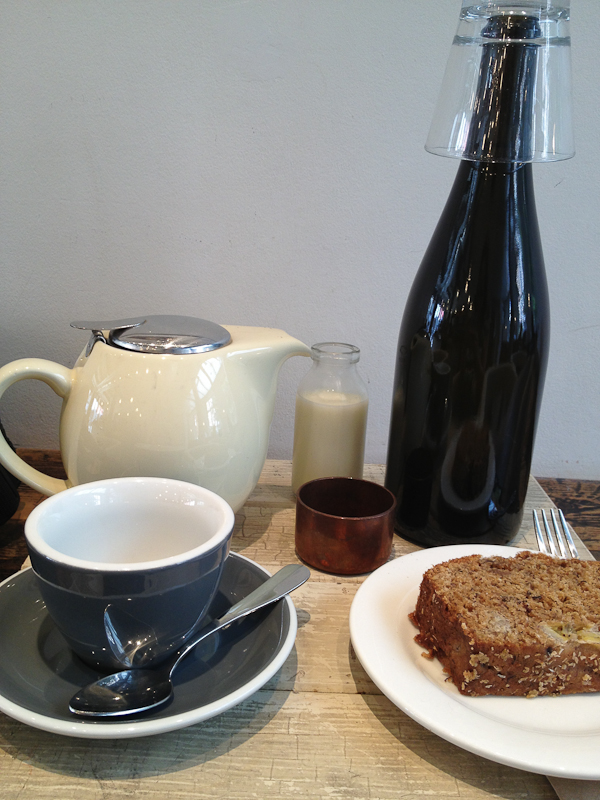
Tea at Timberyard – but read on for some much more lavish options
Afternoon tea
Despite the myriad coffee bars, afternoon tea is a British ritual that shows no signs of dying out and thank goodness for that.
Starting with traditional favourites, Fortum & Mason is meant to be super (thanks Rachel) and if it’s good enough for HM the Queen to reopen it… . Worth also noting if travelling by Eurostar that Fortnums have opened a tea salon in St Pancras railway station. The Dorchester and The Ritz (set in the beautiful Palm Court tea salon) are both on Kat’s list and the latter is first choice of Ant’s other half. Kat also recommends Sketch – very quirky, Alice-in-Wonderland-like surroundings and The Orangery in Kensington Gardens (more Royal connections) which also gets Regula’s vote. Across the road from Kensington Palace is the Milestone Hotel which serves another sumptuous tea fit for Royalty (and Jeanne); Queen Victoria hosted her tea receptions here.
Urvashi chooses The Langham for a traditional and a classic afternoon tea, St Martins hotel in Covent Garden is more modern and quirky, Mandarin Oriental is again classic but modern, The Pudding Parlour at the Athenaeum Hotel in Mayfair is a stunning ‘must visit’, and Laduree in Harrods for some lovely French classics.
Less rarified and more contemporary is The Modern Pantry which certainly takes the tea drinking part very seriously (see menu). It’s Rachel’s pick “for value, as well as delicious food and lovely crockery!”
You could be lucky enough to time your visit when Rachel’s friends, Milli and Victoria put on their “wonderful – if a little sporadic – afternoon tea pop ups overlooking the river”.
There are a few more tea suggestions from Ant’s friend here.


Drinking
Moving onto to something a little stronger, there are a few places I’d like to investigate. Vinopolis is a ‘wine attraction’ not far from Borough Market on the South Bank. You can book guided wine tasting every day but some of their special tasting events sound intriguing. As a devotee of ‘Mother’s ruin’ I’ve watched the re-emergence of gin as a trendy drink in the UK from afar, and tried to sample some of the new exciting gins from small distillers. The Ginstitute sounds utterly beguiling. And I’ve wanted to take a cocktail masterclass at Rules (the oldest restaurant in London) ever since I read this. Who’s coming with me?
Rachel recommends Sager & Wilde and Anthony thinks that it is just the most amazing wine bar in London (read his review), enjoys cocktails at Charlotte Street Hotel, and Gordon’s Wine Bar gets another mention for tradition.
Kat’s list is eclectic and intriguing: Drakes Tabanco – is dedicated to serving sherry from the barrel and other wines of Jerez; Bar Pepito is another sherry bar dedicated to the food and drink of Andalucia; Berners Tavern – highlights are a beautiful setting, the chance to play pool in the bar afterwards and an interesting cocktail that contained pickle juice!; New Street Wine Shop – a wine shop with expert sommeliers, many tasting events and where you can also enjoy some cheese and charcuterie; Planet of the Grapes sounds like the perfect way to enjoy good wine out of the house. They stock over 450 wines, plus wines by the glass. You add a flat £10 fee to any bottle regardless of the retail price to drink it in the bar; 28-50 – all three venues of this wine workshop and kitchen sound like tremendous fun; Charlottes in Chiswick – which I notice holds a regular gin school; and El Camion – Mexican restaurant and bar where they do a lot of good things with tequila.
I’ve sipped a cocktail with Jeanne at 101 here in Dubai, but in London she favours Harry Gordon’s Bar in Selfridges and Ember Yard in Berwick Street.
With an open fire crackling in the grate and a bartender fixing your favourite drink it feels like private residence of a most beloved, eccentric and indulgent great aunt – we call her Wilhelmina.
I couldn’t resist quoting this from the website of Zetter Town House. Everything about it sounds exquisite. And while I’m quoting, Bar Nightjar says of itself ‘a hidden slice of old-school glamour on the fringes of Shoreditch’. Both these gems recommended by Rachel. For traditional London pubs, she likes The Royal Oak and The Carpenter’s Arms (both local to her in E2) and Urvashi also thinks her local the King’s Head in Winchmore Hill is brilliant.


Trends
You know what to expect from other European cities noted for their food (like Paris and Rome) but London is always changing and adapting to new trends. One of the new waves of eating crazes is for superior fast food. I can’t begin to understand why anyone would queue for Shake Shack. Thank goodness Anthony is on hand to choose a few of his favourites:
#1 Honest Burger – Soho – go to the restaurant, they book you in on iPad and call you when your table us ready. Burgers are sublime – cooked to perfection, great buns and chips. Beetroot coleslaw also superb.
#2 Patty & Bun – be prepared to queue for 30 mins but you won’t be disappointed. As well as fine burgers, the confit chicken wings are awesome.
#3 Meat Liquor – be prepared to queue again. Burgers very good but the star of the show are the deep fried onion rings and deep fried pickles. This place is very dark and just a bit too cool for school!
Personally I’ve followed the foodie antics of someone who was completely ahead of the game – Daniel from Young and Foodish. If there is even a hint that you might visit London, sign up now to receive news of his next Burger Monday or Spag Wednesday event.


Foodies top picks
I’ll let the foodies explain:
- Anthony: The Tapa Room is my go-to place. They don’t take bookings but Peter Gordon’s fusion food is the way cuisines should be crossed. Plus an amazing all New Zealand wine list.
Kat: Berners Tavern (as above), Pied a Terre (Michelin Star restaurant in Charlotte street) Duck & Waffle (the highest restaurant in London) Roka (contemporary Japanese robatayaki cuisine) and The Ledbury (two Michelin stars).
Jeanne: My fave best value lunch in London by a country mile is Club Gascon in Smithfield – £25 for 3 courses of uttter French gorgeousness (love the plating and the crockery!); and as you know I am a huge fan of Vinoteca Farringdon (for obvious reasons!) Editor’s note: the obvious reason is because she met me for lunch there and I absolutely loved it too.
Rachel: Maltby Street over Borough Market. Crockery from Anthropologie. Check out the Hansen & Lydersen salmon smokery. Try to infiltrate The Food Room and Library in Eton Square. Food at 52 for great cooking classes. Early morning trips to Billingsgate are always worth the effort – if only for the bacon & salmon sandwiches. Bagels on Brick Lane, and curry at Tayyabs. Support young cooks with lunch in the Escoffier Room at Westminster Kingsway college – dreadful service, but seven course taster menu for £25! - Regula: Gauthier Soho (fairly pricey but worth it); Duck & Waffle (worth it for view, also pricey); Viajante (pricey but worth it, as a chef they might find it interesting); Alyn Williams (great food, £65 for tasting menu); Pollen St. Social (lunchtime £30 for 3 courses); Bob Bob Ricard (service beautiful, £40/head-ish); Pizarro (beautiful food)
Zucca (really good Italian food, I had a lovely meal there); Polpo small plates; Bocca Di Lupo my fav Italian, also has a gelato bar; Bone Daddies Ramen Bar; Ceviche Peruvian Kitchen (very nice); St John for nose to tail cooking. - Urvashi: I love Sushi Samba in the Heron Tower in Liverpool street – just amazing food and lovely atmosphere inside and outside on the terrace plus great views over London; Dishoom – homely for me when I want a quick spicy nibble at any time of day, outside London in Finchley is Two Brothers fish restaurant which is a must visit in the area, also Cafe Japan in Golders Green is awesome for proper Japanese food and ambience of an izakaya. Sakonis in Wembley is a must-visit vegetarian eatery which is very basic and very budget; the Swaminarayan Mandir (temple) in Neasden is a wonderful sight to go and see but the veggie restaurant there is pretty amazing too. The Hare Krishna restaurant Govinda’s on Soho Street is a top budget veggie eaterie too and Taboon in Golders Green does the best falafel in the world!
- Fiona: I might add in a ‘lunch’ category – I gather that London is unique in great lunch deals (I went to L’atelier de Joel Robuchon which is one example and the manager there told me that the special lunch menu is only on offer in London) – here’s a little article I did.
Rachel agrees: Lunch menus are the key to trying great food at decent prices, for example The Ledbury, Dabbous and Clove.
* I noticed that Pied a Terre lunch is 2 courses for £27.50 – which they claim is the best value Michelin star menu in London.


Food experiences
The first thing I recommend to visitors to Dubai is Frying Pan Food Adventure, so why not try a food tour in London? Eating London Food Tours sounds just the thing, reviewed here (enthusiastically) by Bintu.
Jeanne’s favourite recent foodie experience in London HAS to be Aveqia’s cooking classes and meals.
Rachel has never done one as she prefers exploring by herself but did point me in the direction of a fascinating site called Darling Collective full of all sorts of experiences, which offers a foraging walk in several London Parks as well as supper clubs, wine tasting, cocktail making and cookery classes (also see Food in 52). I’d love to do a tea tasting with these people too; Postcard Teas specialise in fine teas from small farms.
Although a traditional restaurant experience, the concept behind both Fifteen and The Brigade is altruistic, offering disadvantaged and vulnerable people catering apprenticeships, giving them tools for a brighter future. I can vouch for a nice atmosphere and great cocktails at Fifteen and there’s a review of Brigade by Rachel here.
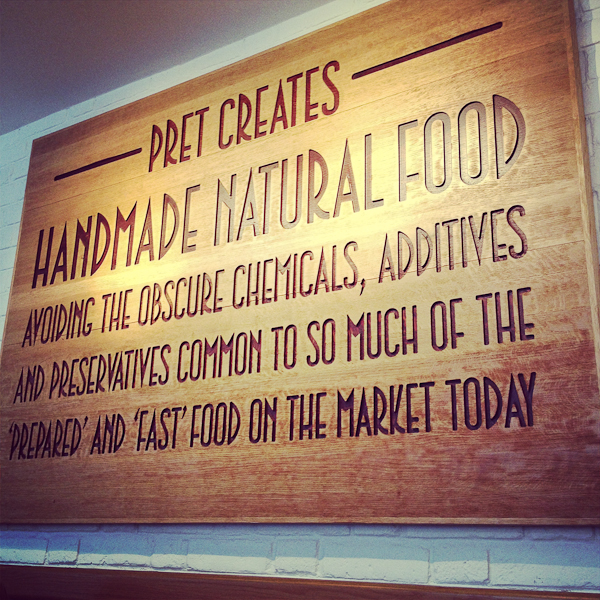
Chains
So apart from a half decent sandwich at Pret, is it possible to enjoy a good meal at one of the many chains of restaurants that are dotted around London?
Family friendly Leon (described as serving ‘naturally fast food) and Chiquito – a Mexican Bar and Grill – are the two new ones that stand out for Fiona, while Kat mentions Barbecoa (not a chain so much as part of the Jamie Oliver empire). Rachel rates Hawksmoor (steakhouse) Yalla Yalla (Beirut street food) and Frae (frozen yoghurt) and adds “Not so much a chain – but all the Renaissance pubs are lovely, and all the Russell Norman joints are generally fun (Polpo, Mishkins, Spuntino, also am a big fan of Brawn/Terroirs/Soif which are all run by the same people – as I think are Salt Yard/Opera Tavern. Urvashi likes Pho for Vietnamese, Wahaca for Mexican, The Real Greek for Greek and Spaghetti House for Italian.


Cafes
When seeing the sights of London, it’s so important to know where you can revive yourself at regular intervals. My personal choice is for a good cup of tea and a bowl of soup is in the basement of the National Portrait Gallery – so handy for Trafalgar Square. I also enjoyed the casual, relaxing atmosphere of Timberyard (the Old Street branch) which is very wifi and lap-top friendly.
Fiona says there are good cafes in or near most tourist hot spots now. Benugo is one example and Peyton and Byrne another; both offer really good ‘British’ food with a twist, in major galleries, museums and attractions.
For breakfast, if in need of a really good bacon sandwich, go to The English Restaurant in Spitalfields – thanks Kat. Whereas Jeanne finds it hard to resist the bowls of hot chocolate at Le Pain Quotidian and Regula votes for the Breakfast Club.
I can’t believe we’ve got this far without mentioning Ottolenghi – but it’s on Rachel’s cafe recommendations along with The Modern Pantry, Caravan, Climpson & Sons, Monmouth, and Rochelle Canteen. One day Urvashi’s Botanical Garden Cafe will be on this list but for now I she recommends Lock 7 Cycle Cafe on Regent’s Canal (and also Caravan).


Shopping and food hubs
Beginning with the famous shops, Harrods Food Halls and Fortnum & Mason are worth going just to ogle at the extravagant displays and Aladdin’s caves of culinary delights. Selfridges Food Hall is also worth a visit and Urvashi reckons the prices for some things (e.g. truffles) are very competitive.
Neal’s Yard Dairy, La Fromagerie (read more about founder Patricia here) and Ginger Pig butcher made nearly everyone’s list – the latter two have branches in Moxon Street just off Marylebone High Street, a little food hub in itself.
Rachel recommends The Whisky Exchange which gives me another reason to visit Vinopolis (it’s inside), also Books for Cooks (legendary book shop) The Japan Centre (for Japanese ingredients) and Turner & George Meat Merchants. Visit Wembley and Southall for Indian grocers says Urvashi, and Atari Ya in Finchley, Golders Green and Acton for Japanese groceries.
Markets are a must and I’d recommend Borough Market for the hustle and bustle and the restaurants that surround it. London residents have started to favour other markets as less expensive and not crammed with tourists – Broadway Market, Maltby Street Market, Spitalfields, Whitecross Street and Exmouth Market rank highly. Brockley Market gets a mention for nice villagey weekend market. For more market links visit my Borough post.
Some areas have become food destinations such as Northcote Road in Battersea, there’s masses to discover in East London (as Rachel has shown), also written about here by my glamorous friend Amanda. The area around Farringdon Road is well worth exploring, including the aforementioned Vinoteca, St John and more such as The Quality Chop House. Urvashi’s found Bermondsey High street is pretty cool to walk up and down for little cafes and two Jose Pizarro places, and Dean and Wardour street for the same reason with Gail’s Bakery, The Hummingbird Bakery, Paul A. Young chocolate shop and Princi on same road you are in cake and choc lane! Fiona Beckett delights in East Dulwich and for everything food-related about Peckham there is only one source worth visiting.


Websites and apps
I downloaded a couple of apps but there weren’t much help so would love to know if anyone has found a good one. If you are into burgers and pizza the Young and Foodish app looks useful although I haven’t tried it.
Rachel pointed me in the direction of these sites:
- Hot Dinners is great for restaurants,
- Diffordsguide for bars,
- Bar Chick also for bars
This is My Kingdom has a nice archive of good places to go in London too.
Contributors
A massive thank you to these lovely people. Consider your brains well and truly picked.

Anthony Davies Confessions of a Wine Geek, Fiona Maclean London Unattached, Jeanne Horak-Druiff Cooksister, Jeff Burrows FoodWineClick, Kat Wiggins The Wine Kat, Rachel Smith The Food I Eat, Regula Ysewijn Miss Foodwise and Urvashi Roe The Botanical Baker. Please do go and visit their blogs for even more great info on eating and drinking.
Of course we must have left something out. What’s your favourite place to eat or drink in London?
Related articles







 My Custard Pie