Let 15 wine writers entertain you: VOTE NOW – MWWC3
Like boys and girls locked away in same-sex prep schools, most wines yearn for a bit of flesh.
This line, which is part of an article about the difficulty of picking a wine for a vegetarian meal, epitomises why Jay McInerney is one of my favourites writers about wine and his books in permanent residence beside my bed. With food writing, if the prose doesn’t get your attention, you usually have the addition of drool-worthy images to stimulate the imagination and the salivary glands. Wine writing has a whole different set of challenges and usually appeals only to a very distinct group of readers. How do you pitch your information so that you keep the attention of people who know very little about wine as well as wine geeks? Conveying the experience of tasting a wine so that it resonates without tipping over into wine bore pomposity is an art. Yes, wine writing as fraught with potential pitfalls and hurdles as an overgrown vineyard.
But the lure of wine, its multi-faceted appeal, compels us to try to unravel its mystery or simply explore how it enriches our lives in one way or another. Bravo to The Drunken Cyclist for coming up with the Monthly Wine Writing Challenge and thanks to everyone who responded to my challenge of ‘possession’ as the theme (although many found it tricky). The submissions range from a short story to an article about rice wine with everything in between. Please take time to read and vote – there are some absolute crackers in this list, watch out Jay McInerney.
Voting rules – there have to be some
- Voting open to all – please help spread the word.
- Just choose your favourite post.
- If you wrote a post, you can’t vote for yourself.
- You can’t vote for the host (aka me).
- All votes are due by midnight Saturday 28th September 2013 (my time which is GMT+3)
- The “winner” will host the next monthly challenge, which includes selecting the topic.
For your reading pleasure
I’ve listed these posts in the order they were written. Read them all… please do, they are wonderful…. (and show your appreciation with comments on the blogs) and then scroll down to vote below. Choose your top favourite – this will not be easy:
Possession – a short story by The Wine Kat
Possession: A Confession by Wine Swap
I’m not a hoarder, I’m a collector by The Armchair Sommelier
The Possession Obsession by Duff’s Wines
‘He Who Knows He Has Enough is Rich’ -Lao Tzu by From Vinho Verde to Barolo with Love
How possessive are the wine lovers? by Talk-a-vino
A wine for a dreadfully awkward meal in A.S. Byatt’s Possession by Jameson Fink
Possession or Are German winemakers merely possessors? by The Winegetter
Possession: It’s Mine!!! by Red Wine Diva
Rice wine at the mid-Autumn festival by Saucy Gander
Possession by The Wine Raconteur
Who owns a name? Celebrating Robert Mondavi’s centenary by My Custard Pie (host so no vote for me)
Possession:Entry Denied by Foodwineclick
Monthly Wine Writing Challenge #3: Possession by The Drunken Cyclist
Depossessed drink: Wine on loan by Wayward Wine
VOTE NOW! CHOOSE YOUR TOP POST (oh so cruel)
Special mentions to:
Do in Dubai who was inspired to write about a visit to the Salcheto Vineyard in Montepulciano
The Food and Wine Hedonist who wrote about possession while drinking wine and watching a video of a monkey
and Twelve Dollar Tastebuds who has an original idea but briefest post 🙂


So get reading and voting 🙂 Such a high standard….how to choose?
PS UAE Saves week recipes will continue tomorrow. In the meantime, please visit Cashy
My store cupboard saviour – Tortilla or Spanish omelette


Like many Brits, the first place I ever went ‘abroad’ was Spain. A friend asked me to come with her to Menorca and when I mentioned that I didn’t have a passport she was gobsmacked. ‘Weston-super-mud’ was our nearest bit of beach (on the estuary of the Bristol channel hence our nickname for it) and the farthest place my cash-strapped family had ever visited was Guernsey by ferry.
I can remember being quite bewildered by the lack of a promenade or a pier. The beach was at the end of a narrow country lane which ended abruptly letting you enter miles of white sand fringing turquoise sea. There was a bar on the beach for cones of chips, ice creams served in hollowed out shells of fruit and long glasses of the local drink, gin and lemon.
On one evening we went to a fiesta – held by different towns throughout the summer. A brass band played rousing music and the square was filled with men and foolish English teenagers (that would be me). Women, children and old people looked down from crowded balconies. The mayor and the dignitaries of the town rode glossy black horses through the throng, they were adorned with coloured bridles and decorations. The crowd surged forward and tried to make the horses rear, including throwing firecrackers under their hooves. Utter madness but terribly exciting.
My own first taste of the Spanish classic tortilla de patatas was in a wooden panelled bar in Mahon. Small chunky slices as well as other morsels in little terracotta dishes were tapas with our drinks.

Tortilla or Spanish omelette has many things to recommend it. Only three ingredients are required (that you probably have in your kitchen right now). It’s really simple to make. It’s really economical – even if, like me, you use free-range eggs. And finally, it tastes even better at room temperature or cold than straight out of the pan.
Could this be the perfect packed lunch recipe? I certainly think so and make this at least once a fortnight for supper with a couple of slices left over for lunch the next day. This is the basic recipe, in Spain even the addition of onions is debated, but you can add other things to ring the changes (see below). If you’ve never tried it, make the original recipe first. It shows that you don’t need complicated ingredients or spices to make delicious food.


Tortilla or Spanish omelette
Ingredients
8 eggs, free range preferred
900g potatoes, waxy if possible, peeled
1 large onion, chopped medium dice
approx 150ml olive oil
sea salt and freshly ground pepper
Serves 4
Method
- Cut the potatoes into quarters and slice thinly into triangular pieces. Rinse the potatoes, drain and pat dry with kitchen towel.
- Heat most of the olive oil (reserve 1 tablespoon) in a large frying pan and put in the potatoes and onions. There should be enough oil to coat the ingredients thoroughly with a little left over. Lower the heat, stir occasionally and cook gently until the potatoes are soft and transparent.
- Meanwhile, beat the eggs and season with salt and pepper. *Turn up the heat, pour the eggs into the pan and stir gently to combine. Flatten the mixture with a spatula. Let the omelette cook for a minute or two, then reduce the heat and cook for a further 3-4 minutes until the omelette starts to set around the edges and on top.
- Run a knife or spatula round the edge of the pan to loosen, put a large plate over the frying pan and turn the whole thing upside down. Return the empty pan to the heat and add the remaining olive oil if necessary. When the oil is hot, slide the tortilla back into the pan, with the cooked side uppermost. Alternatively, you can put the whole pan under a preheated grill to cook the top (gives a drier texture).
- Cook until set all the way through but not too firm. Turn out, flipping it upside down once more. Leave to rest for a few minutes before cutting into wedges.
*You can cook the potatoes and onions ahead of time and, when slightly cooled, add to the egg mixture. This adds flavour to the egg.
Variations
Although not authentic, delicious variations can be made by adding additional ingredients with the egg. Try roasted red peppers with diced chorizo (use smoked salt too); peas and a little fresh mint; chopped fried pancetta and parmesan; or replace the onion with some thinly sliced leek and add some chopped chives plus a little Cheddar to the mix.
UAE Saves Week 2013
I’m posting recipes and ideas that are great for packed lunches this week – some are already up on the Cashy.me site if you want to plan ahead. If you can only spare one day to participate, make it today on Pack your lunch Monday. There are other non-food related, practical activities every single day, find out what’s on here and don’t forget to use #UAEsaves on your pics, posts and tweets.
Meet the blogger event
As someone who is much more at home behind a keyboard and screen, I mustered all my courage and demonstrated how to cook a Spanish omelette at Lafeyette Gourmet, Dubai. It was part of a ‘Meet the blogger’ event by Lootah Premium Foods and great fun. Massive thanks to Adrian the chef, the LG and LPF teams and everyone for coming along. Congratulations to all the Fooderati Arabia who took the plunge. These lovely pics are from Sarah of The Hedonista.
P.S. The last day to enter Monthly Wine Writing Challenge 3 is Monday 23rd September 2013; that’s TODAY!

I thought my memories might have been exaggerated, then I found this on privatemenorca.com
Ever made a Spanish omelette? What’s the first taste of travel you remember?
Related articles
- Pack your lunch and save a bunch (mycustardpie.com)
- How to cook the ultimate tortilla (metro.co.uk)
Take a packed lunch and save a bunch


Reading the latest Buffer blog post about the biggest mistakes entrepreneurs have made (and what they have learned from them) one comment really struck a chord. Tim Ferriss said “If you’re not 100% excited, say no”. As someone who hates confrontations and likes to be liked I have a very hard time saying no. I’m also an optimist and can often see a lot of potential in things that deep down I know I’m either really too busy for or will take me away from things I’d rather prioritise. As Tim’s post goes onto say:
If you’re not 100% excited, it should be a decline.
‘Kinda cool’ will fill up your calendar and leave you wondering where the last year – or 10 – went.
I’m printing off that bold sentence and pinning it above my desk to keep me on track, because of late I’ve made a real effort to say no to things that are not 100% exciting. But when Cashy.me approached me to contribute a week’s worth of packed lunch ideas for UAE Saves Week I knew I had to say yes. The whole initiative is well-organised, worthwhile and just that – 100% gets my pulse racing.
Most outsider views of Dubai give a very polarised snapshot – gleaming buildings, billionaires, fast cars, gold, shopping, and people paid a pittance to construct the place. There is a grain of truth in all of this but it’s so far from painting the whole picture. This bio from a Telegraph journalist and writer who lives here always puts a smile on my face:
Annabel Kantaria is a journalist who moved to Dubai long before most people knew where it was. She doesn’t ride a camel to work; has never seen a gold-plated golf buggy and only rarely has pink champagne for breakfast.
With local Emiratis making up less than 20% of the population this is a vibrant, multi-cultured and multi-faceted place feeling the influence of so many different expat cultures and income groups. While a very small elite group of the population may not have to budget, the majority of us have to watch our dirhams carefully. From the bag packer at the super market who gets paid 500 AED a month plus tips, to an expat like me reliant on my job and my husband’s small business to pay high rent for accommodation, school fees for two teens, healthcare and all the other expenses of life in Dubai.
Inevitably the first place to make savings is via the food bill. As my Mum always used to say “If we didn’t need to eat we’d be rich.”
An effective place to start is by cutting down ‘the latte effect’. If you add up how much you spend on drinks in one week while you are at work or on the move it can come as a surprise. Add in your expenditure on food and you can be looking at a sizeable amount. What other things could that money be used for? I’m sure you can think of many. So to get you inspired for UAE Saves week, here are: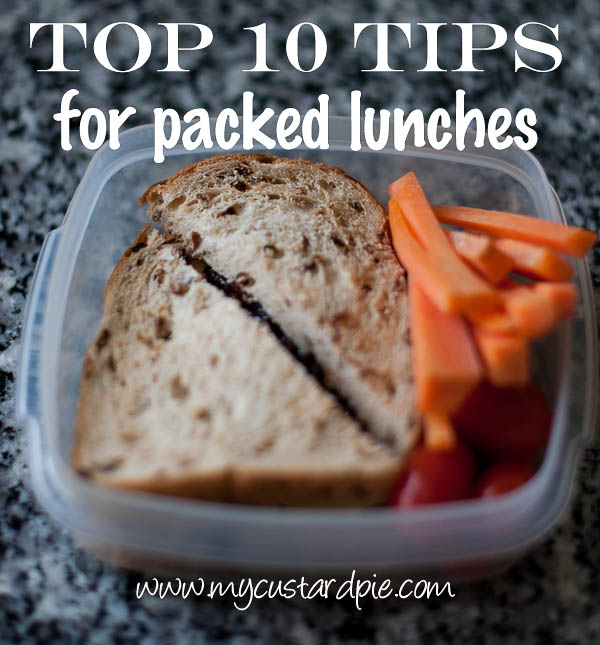
10 top tips for packed lunches
- Start the day with a good breakfast. If your tummy is rumbling and you are fading fast by 11am, you’ll soon start drifting to the vending machine or doughnut counter.
- Plan ahead. Every weekend, have an idea of what you are going to pack for lunch each day. If you have to scrabble around looking for things at 7am, you are more likely to give up. Always have some emergency items in the cupboard that you can grab when time is tight.
- Prepare as much as you can the night before. It’s then easy to grab and run – especially if you are not a morning person.
- Dedicate half a day every couple of weeks to make things specially for your lunch box that you can freeze.
- Use leftovers from your supper the night before as a tasty lunch. Or cook more than you need to eat and freeze the extra for later.
- Pack the kind of things you like to eat. If you eat a triple-pounder everyday you are not likely to be satisfied with a small salad and an apple. Make a lunch that’s similar, for instance try a roast beef sandwich with mustard instead.
- Invest in some nice containers to take your lunch to work in. Make it look attractive. Soon you won’t be envying everyone who is off to the takeaway; they’ll be looking longingly at your lunch.
- Get away from your desk. If you walk to the takeaway normally, spend that extra time walking to a shady place outside where you can eat your lunch (weather permitting). Or eat your lunch then go for a stroll with your headphones on and some favourite music, so you feel refreshed.
- Remember that it’s not just money you are saving. Budget and mid-range restaurants are notorious for using cheap ingredients with lots of hidden salt. You can make your lunches cheaper, better and healthier. Save money and you might lose weight too.
- Make use of your office microwave – this is where leftovers from the night before get a new lease of life. If you can, keep some useful items at work like cutlery, sauces (such as hot sauce), napkins, a sharp knife for cutting fruit, salt and pepper.
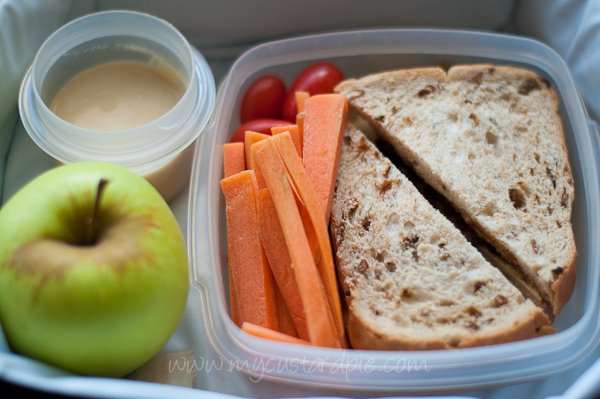
I’ll be posting recipes and ideas that are great for packed lunches this week – some are already up on the Cashy.me site if you want to plan ahead. If you can only spare one day to participate, Monday 23rd September in Pack your lunch Monday. There are other non-food related, practical activities every single day starting from tomorrow. Find out what’s on each day here and don’t forget to use #UAEsaves on your pics, posts and tweets.
Do you take lunches to work? Will you join me for the tastiest part of UAE Saves Week 2013?
Related articles
- Seven days, seven ways to save (gulfnews.com)
- Healthy Lunch Ideas For Kids (cookthestory.com)
Who owns a name? Celebrating Robert Mondavi’s centenary
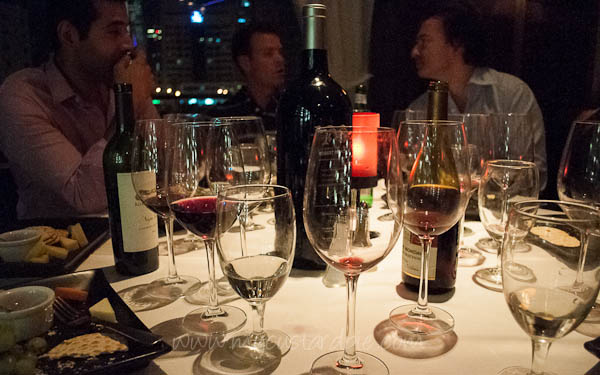 “Salut” Seven glasses of wine chinked together in the middle of the table for the third time that evening. We were celebrating the birthday of a man we’d never met who would have been 100 years old that day. A man who was the son of Italian immigrants to the US, from humble beginnings but who went to Stamford, who fell out spectacularly with most of his family and died in 2008 leaving a legacy that we were drinking today. A man who could be named responsible for the acceptance of ‘New World’ wine and certainly putting Californian fine wine not just firmly on the map, but Napa on the wine lists of some of the best restaurants in the world. We were toasting the life of Robert Mondavi.


Possession, the theme for the Monthly Wine Writing Challenge, got me thinking about Mondavi and how it ran like a thread through his personal history. He’d returned home from university in 1936, two years after the end of Prohibition, and was expected to pitch in and contribute to the family wine business. His father had recently invested in some wineries after building a successful grape shipping business based in Lodi, Central Valley, California. Although there was a boom in wine, the industry was in a pretty poor state after years of neglect. The Mondavis produced cheap ‘jug’ wine in the main but Robert could see that the grapes grown in Napa were better quality and this, combined with the pressure of lower production costs in Central Valley for bulk wine, made a good case for trying to produce much better quality wines in their Charles Krug vineyard in Napa.
Robert pursued his goal relentlessly, learning as much as he could about fine wine was made in Europe plus introducing his own improvements such as pioneering the use of sterile conditions to combat oxidation. He replanted the vineyard with a range of classic European varietals such as Cabernet Sauvignon, Pinot Noir, Chardonnay and Riesling, he engaged winemaker Andre Tchelistcheff, and in 1962, when he was nearing 50 years of age, he made an extensive trip through the vineyards of Europe. On his return, his renewed vigour and single-mindedness about making world-class wines in Napa didn’t go down well with his family. Culminating in a fist fight with his brother, he was told to leave the winery by his Mother.


This loss of possession was the turning point for Mondavi. Aged 52, he was on his own, adrift from the Mondavi family business. He borrowed $100,000 and focussed all his energies into making Napa Valley wine that would compete with the best in the world. Ten years later, as a result of a settlement when he sued his brother for his share of the family business, he ended up owning most of their key vineyards in the Oakville area. He set about changing the perception by Americans that Californian wines were only good for budget quaffing by comparative tastings. He’d book a table at a smart East Coast restaurant, order a bottle of top Bordeaux then invite the owner to taste it alongside one of his own wines that he’d brought along, such as the 1966 Mondavi Cabernet Sauvignon.
Mondavi’s obsession with creating world leading wines in Napa led him into some precarious financial situations – at one point he owned only 18% of the company that bore his name. However, his marketing innovations led to growth in both volume and reputation. Hard now to remember a time when Sauvignon Blanc was unloved by the consumer. Mondavi cleverly named his ‘Fume Blanc’ on the back of the appeal of Sancerre and Pouilly Fume; now it’s often used as a generic term for SB in California. His joint venture with Baron Philippe de Rothschild, Opus One, became America’s first ‘ultra-premium’ wine. Early this year, a very kind friend invited me round to open a prized bottle of Chateau Lafite and he chose a bottle of Opus One to taste alongside it which would have been inconceivable even a few decades ago.
Mondavi became a public company in 1993, to generate further capital for growth, but following the recession and the effects on consumer confidence after September 11th, in 2004 the board decided to sell the entire company to Constellation Brands after receiving a takeover bid. While Robert Mondavi was retained as an ambassador, he no longer possessed the company that bore his name.

So I was raising a glass to Mondavi at a dinner hosted by the current caretaker of his name and, with French wines still outnumbering those from the US by a long chalk here in the UAE, I was glad to accept and eager to taste. The bar was lively and crowded at Ruth’s Chris steakhouse at The Address, Dubai Marina; I felt a bit bewildered as I was on my own but I was introduced to brand ambassador Jose Hernandez who, in addition to knowing a lot about the wines, had the knack of making everyone feel at ease. A glass of chilled Robert Mondavi Private Selection Sauvignon Blanc in my hand was a great stress buster and oh so good with the appetiser – a Tsarskaya oyster followed by a shot of tomato coulis and quails egg yolk with a morsel of beef carpaccio with a tingly, mouth-watering salty, citrus dressing.
We were seated in the dining room, but with the bar and band still in view it was no stuffy wine dinner. This was a little Middle Eastern extension of events being held at more than 90 Ruth’s Chris steakhouses in the US but our menu had been designed by Chef Paul De Vissier here in Dubai.
French, Italian, American, Indian and British diners on our table were soon tasting the next Californian wine. With a beautiful light green golden colour, a tiny hint of vanilla on the nose, crisp and clean with a soft, slightly buttery palette, the Robert Mondavi 2008 Fume Blanc had me smitten. The starter of crisp prawns in a creamy sauce, although delicious, was perhaps too spicy to be a great match for the wine.


The Robert Mondavi Private Selection 2011 Pinot Noir was served far too cold and even when it warmed up it was a little sterile for my tastes. It had none of the vegetal, mushroomy notes that make Pinot so interesting to me. Smooth red berries, very easy drinking, a Pinot for non-Pinot lovers perhaps. Jose suggested we taste the Robert Mondavi Winery 2010 Cabernet Sauvignon Reserve, Oakville, Napa Valley and this was a much better match for the steak topped with a slice of mango and foie gras. My knife glided through the meat, the caramelised surface blending with the rich berry fruits of the wine. A velvet texture to the mix of taste sensations and it matched the cheese course perfectly too.
Can you really possess another person’s name? Mondavi certainly regretted losing control of his in later life, although his widow Magrit still has associations with the company. The family wine business interests were carried on by Continuum which Robert joined with his son and daughter at the age of 92.
Loss and possession, death and life are one, There falls no shadow where there shines no sun. Hilaire Belloc
Closing date for submissions for the Monthly Wine Writing Challenge is 23rd September 2013 – more details here. I’ve made a Pinterest board which links to all the articles so far, around the theme of Possession, here. Voting starts 24th so get reading.

Thanks to A+E for inviting me as a guest to the Ruth’s Chris Mondavi dinner.
Related articles
- If Robert Mondavi Were Alive Today (rickbakas.com)
- Monthly Wine Writing Challenge 3 (mycustardpie.com)
- Wine On the Rocks…with a twist. (winestylesblog.com)
Kept in the dark. A night of eating without seeing.
 The little red lights hovered and bobbed in a line signalling that something was about to happen. Pupils straining in the velvet blackness, the only thing that gave a visual clue that I had dinner companions was a faint rectangular glow from two of the men’s watches and the tiny red dots from the waiters’ night-vision goggles. My sense of sight was useless. I developed a system of placing my wine glass touching the top of my dish so I wouldn’t knock it over (sensibly the glass was made of plastic).
This was the launch of Noire at Spectrum on One; a dining in the dark experience which will be open for four nights a week at The Fairmont, Sheikh Zayed Road, Dubai. After some dignitaries, led by Sheikh Zayed Bin Sultan Bin Khalifa Al Nahyan, cut a ceremonial ribbon – in reception with light – and we were led, table by table, left hand on the person in front’s shoulder, into the restaurant. Immediately plunged into inky blackness, we wound right and left, light-blocking curtains brushing our cheeks. A sense of vulnerability kicked in immediately, I couldn’t shake off the feeling of claustrophobia or that I would suddenly meet stairs. I could hear each person in our group being guided to their place at the table one by one. At last, KP was led off and I was left totally alone. By the time my guide came back for me I was shaking and as I was led to the table my hand caught a small glass and tipped it over. I felt flustered, very disoriented, but excited with anticipation of a very different eating experience.


Feeling around my place setting, my fingers caught another small plastic glass which also went over. I felt the wetness on the table and panic that I couldn’t catch the eye of a waiter in the normal way. Other people on the table felt miles away, but when I introduced myself to the couple at my end we stretched our hands across the table we were actually quite near. Conversation was more difficult without visual clues. You’d start talking at the same time as someone else or they wouldn’t realise you were talking to them. I kept moving my head to try to tune in. With my friends I was confident to talk, but announcing things into thin air to strangers without even knowing if they were listening made every sentence I uttered ring in my ears foolishly.
The waitress refilled my cocktail, which was fruity and KP declared non-alcoholic (it wasn’t). Bread appeared on our side plates, then a dish was placed in front of each of us with instructions on where to find our cutlery (a fork and spoon). Bite sized chunks in a sauce were sweet like chicken in taste but not texture. With a crisp skin and melting middle, was it a mild fish? There was a butternuttiness to the sauce. All of us but KP were confused. He very positively identified it as offal and refused to eat more. We all pooh-poohed that suggestion.
Plates were cleared and the wait for the main course seemed like a long time although it was probably just average. Gales of raucous laughter rang out from some tables, it seemed very loud, it was easier to stay silent some of the time as interacting took an effort. A savoury aroma alerted us to the imminent arrival of the next course. Pin pricks of red lights from the waiters’ night-vision goggles made an appearance en masse and the main course was served, again with a fork and spoon to eat with.
Soft melting meat, but beef or lamb, we couldn’t decide. Lentils, cabbage and something crispy like fried onions. “It’s fish” declared KP, “Noooo” we chorused, “With tomatoes” he continued, “No way” was our emphatic reply. “You try it Sal” so I reached sideways into the darkness with my spoon and scooped up a little sauce with lentils. “Definitely the same as ours” I announced.


“We could do anything here in the dark” I whispered to KP, “except the staff are all wearing night-vision goggles” he replied. I forgot I was being watched. It was disconcerting – like when I sat opposite a row of ladies, all fully covered, in Saudi, knowing their eyes were upon me. Another ‘shot’ was placed before us – I was sure there was Amaretto in there somewhere.
We were orientated to our dessert “two Japanese spoons on either side and something in the middle”. There was no cutlery. Right hand spoon was unmistakable as popping candy, not a favourite of mine so I didn’t linger. Left hand spoon was jelly with a soft centre so it was an explosion of wobbly mango in your mouth. The middle was easily identified as raspberry meringue filled with ice cream – I ate this with my fingers. We’d predicted that the lights would suddenly flick on, but no, we were led away for coffee, leaving an air of mystery about our surroundings and companions.
I was ready to be liberated from my sightlessness, something that the Sightsavers charity does in reality by working to eliminate preventable blindness, for example with cataract operations. Part of the 325 AED charge per head for the experience is donated to this very worthwhile cause.
Our menu was revealed. The first course had been sweetbreads, mixed with cubes of apricot panna cotta. KP was jubilant.
Beef short ribs cooked for two days with shredded Brussel sprouts and lentils had been served to us. Bizarrely, KP had received fish on a bed of roasted tomatoes with lentils. He was almost cartwheeling with pride at his well-tuned taste bud skills.
Dessert was no surprise, although I hadn’t dug underneath the popping candy for the strawberry spaghetti. What I found interesting was how small the meringue appeared – I had struggled to eat it all. The menus are rotated so what you are given to eat will always be a surprise.
With sighs of relief, a group of us retired to the bar for a much-needed chill out.
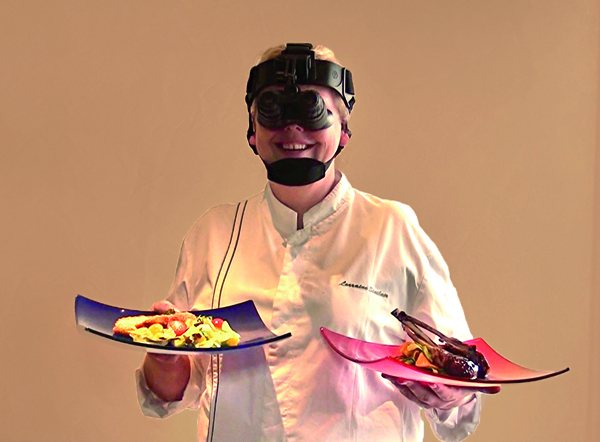
This was the most prolonged ‘blind’ dining experience for me – I had dined without sight by wearing a blindfold in the past due to my connection with Dubai-based non-profit organisation Foresight. We’d held ‘Dine for Sight’ in restaurants across the city once a year and encouraged people to try eating without the use of vision. I knew how exhausting it is to rely on your other senses, the amount of concentration needed and how small things are difficult. We’d even tried to set up our own Dine in the Dark with Chef Stephane from Tang based on ‘Blindekuh‘. This is a restaurant giving meaningful employment to the waiting staff who are visually impaired and also gives them an advantage over sighted diners. Night vision goggles were only allowed for military use in those days. Because of my experience with people who are losing or who have lost their sight, I consider, usually on almost a daily basis, of what it is like for your vision to fail. Spending such a long period of time without the use of this most precious of senses was extremely sobering.
I would certainly recommend dining at Noire, it would be a great place to take visitors and maybe even a special place for a first date. Could anything be improved? Less salt – I was more aware of the level of seasoning than usual. Better wine – focussing solely on taste revealed all the faults, a truly blind wine tasting would be brilliant though (I hear one is in the pipeline). I would swap the plastic glasses for heavy based tumblers or the Riedel stem-less type – again the texture of plastic when you are very focussed on touch is not the nicest experience. It was noisy too – but this was probably due to the launch party (extrovert media people!).
Bravo to The Fairmont for trying something really different in Dubai and to the excellent ‘sensory guides’.
Noire at Spectrum on One at The Fairmont, Dubai (Friday, Saturday, Sunday and Monday evening from 7:30pm – 10pm). AED 325 per head for this 1 ½ hour dinner including a three course menu with paired beverages. AED 27 of the proceeds from each dinner will be donated to Sightsavers. Tel: +971 4 311 8316
Have you ever dined without sight? What would be your biggest concern?
Disclosure: I was a guest of The Fairmont for the launch event of the restaurant.
QUICK REMINDER: Possession. What does this mean to you relating to wine? It’s the theme for the Monthly Wine Writing Challenge – Deadline for submission: Monday, September 23rd 2013. Just the thing to get your creative wine writing juices flowing – read more about it here. Use the #MWWC3 hashtag on Twitter and Facebook.
Excess baggage – new cookbooks and old
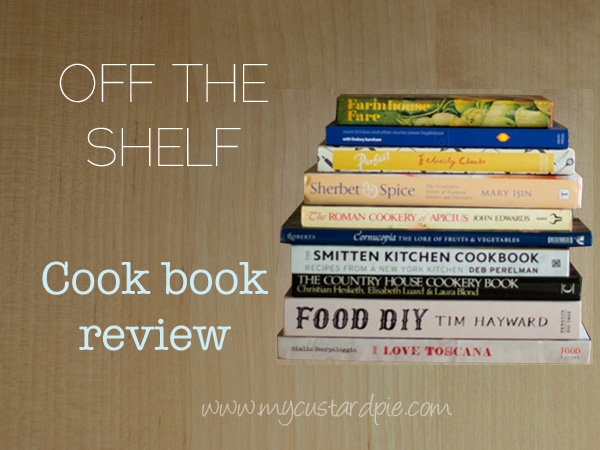 Are you the type of person who can never resist another cookbook? You are in good company. What is it about turning the pages of an unfamiliar book full of culinary inspiration? It’s often the jumping off point for me, rather than slavishly following a recipe it’s just the spark I need to get into the kitchen with a plan in my head. My cookbooks tend to be in three categories too: books I actually cook from (a core of about 15), books I refer to occasionally (specialist cuisines or techniques), books for reading and browsing only (fantasy feeds).
I brought a whole load back from the UK this summer. While I have a huge wish list on Amazon, I’m much more disciplined about buying brand new cookbooks these days so the ones I’ve chosen really have to earn their place on the shelves. Second-hand books are another story. Charity shops – especially Oxfam book shops – and book sales (I love the little stable with an honesty box at Saltram House, Devon) provide rich pickings. As promised earlier, here’s more about my new haul.


Perfect. 68 Essential Recipes for Every Cook’s Repertoire by Felicity Cloake
I was a keen follower of Felicity Cloake’s writing in the Guardian, but became an avid fan when I read her article about custard. It expressed exactly how I feel about the yellow stuff. I met her at Food Blogger Connect in 2012 and she was modest and very approachable. Her laid back persona cloaks a perfectionist in the kitchen. She is a meticulous recipe tester. The inspiration for her ‘How to make the perfect‘ column and this book was as follows. Gazing at the shelves of cookery books she owns, she wondered how to decide which recipe to turn to for the most delicious, authentic, perfect result – and she set out to find out. From how to boil an egg through to the perfect Ragù Bolognese, she has cooked, tasted and compared advice from ‘an embarrassment of choice’ including Jane Grigson, Nigel Slater, Elizabeth David, Julia Child, Angela Hartnett, Dan Lepard, Delia, Jamie, Hugh and Nigella. The result is a small, modest hardback book peppered with simple, charming illustrations, which wouldn’t have looked out of place in my Mum’s kitchen. It distills the best of each into the ultimate perfect recipe. I’m going to buy a copy for my teens for when they leave home.


Smitten Kitchen. Recipes from a New York Kitchen by Deb Perelman
And talking of perfectionism, Deb Perelman’s friendly, unassuming tone of voice on her blog Smitten Kitchen makes you feel like you are part of one continuous cosy chat in her tiny New York Kitchen. But don’t be fooled, a dedication to perfecting recipes and communicating them to pinpoint accuracy is an obsession – hundreds of thousands of readers don’t just happen by accident.
I read a fair few food blogs over the course of the week but only cook from a handful. Smitten Kitchen is one of them, despite pesky US volume measurements. The book, ordered in the UK, has been anglicised so it’s metric and things like biscuits become scones. Deb’s conversational style works as well on the page as it does online and the collection of recipes is just the kind of food I like to eat. My teens have been bookmarking things ever since it arrived, even salads. I expected great desserts and cakes, lemon bars, strawberry cheesecake fools and marshmallow layer cake for instance, but a real bonus is an excellent vegetarian section with leek fritters with garlic and lemon, and slow-cooked black bean ragout high on my ‘to cook’ list.


Food DIY – How to make your own everything: sausages to smoked salmon, sourdough to sloe gin, bacon to buns by Tim Hayward
This could have had the by-line – ‘follow up to the Dangerous book for boys’. It’s unashamedly macho (although he often gets his ten-year old daughter Liberty involved). Tim Hayward likes to get his hands dirty and smokes, butchers, makes cheese, kneads bread and pickles things. However, this book is not about how to survive in the outback, it’s about self-reliance. It’s the anti-thesis of the ready meal culture that half the population in the UK now calls cooking.
Tim’s an ex-ad man and entrepreneur who set up Fire and Knives magazine, appears often on BBC Radio 4 (Kitchen Cabinet and the Food Programme), took over and relaunched Fitzbillies in Cambridge. He’s quick-witted and energetic on air and in person (he was a speaker at FBC in 2011), is rather curmudgeonly on Twitter; this beautifully designed and illustrated tome is clearly a labour of love (although the rumoured 250k advance must have helped). Having lived as an expat for many years you get used to trying to make things you can’t obtain easily from scratch (ahem, including alcohol in the magic Kingdom). It’ll be a challenge to use this book to its full capacity here in Dubai but I’ll be trying out smoked fish, kimchi, crumpets and his DIY takeaway fried chicken for sure. Air dried salami or hog roast, hmmmm…. not in the UAE. And if anyone is coming to visit me, please bring Prague powder. Thanks to Maldon Salt – I was delighted to win this copy (with a tweet) as I was about to buy it. Very glad that KP didn’t see this enormous volume prior to packing as it probably cost me the cover price in extra baggage.


I Love Toscana. Colours, taste and flavours by Giulia Scarpaleggia
Giulia smiles, her eyes sparkle, she has dimples in her cheeks and the warmest manner you have ever encountered. She’s ingenuous, friendly and charming; no one meeting her could fail to be captivated. It’s the same with her new book, a simple concept – the story of the Tuscany where she lives and grew up through food. Many people have attempted this as outsiders, but there is a guilelessness about Jul’s first book that is avoids any pretension and takes you closer to this beautiful region.
I’d be content just to leaf through the pages of rustic photographs (several by Ellen Silverman but in the main taken by Juls herself). The stories about producers , the changing seasons, the landscape, the family rituals are entertaining enough by themselves and the layout and typography superb. The recipes are mostly simple, celebrating the best ingredients to hand often during straitened times, like wild herb omelette, crostoni with lard, tomato bread soup and green panzanella salad. The meat and fish dishes include sumptuous feasts such as stewed wild boar and roasted venison as well as more modest ones like black peppercorn beef stew and meatloaf. Whether you cook from it or use it as the inspiration for a trip to Tuscany, this is a lovely book to own (Juls brought me a copy from Italy to FBC 2013). She explains more on a video over on her blog Jul’s Kitchen (scroll to the bottom of the post) where she celebrates with rhubarb and berry custard slices. I approve heartily.


The Roman Cookery of Apicius. Translated and adapted for the modern kitchen by John Edwards.
You’d think that dishes from the time of Caesar might make you rush for the vomitorium. This is not the case at all, in fact the bulk of the recipes are quite familiar, green beans in mustard sauce, parsnips cooked in sweet wine sauce. It’s a wonderful introduction to the best of Roman and Greek cooking of the age and I suspect will spend equal time on my bedside table as a good historical read as in my kitchen as a source of inspiration.


The Country House Cookery Book by Christian Hesketh, Elisabeth Luard and Lara Blond
In buying this, I have no intention of pretending to be ‘to the manor born’. It was the mention of renowned food writer Elisabeth Luard that made me put my donation in the honesty box for this book. It’s like Country Life meets Upstairs and Downstairs – Mr’s Lott’s Pheasant Casserole anyone? An intriguing look at a life well on it’s way out in 1985 when this book was published and pretty much forgotten now (many country estates are now in the hands of Russian oligarchs aren’t they?). It appeals to me by capturing a very specific kind of English cooking, as this menu from Holker Hall in Lancashire illustrates well:
Tomato and bacon bisque, Roast leg of lamb, Damson cheese


Farmhouse Fare. Recipes from country housewives collected by Farmers Weekly
Published in 1973, this is a collection of recipes from real farmers’ wives. Amid practically extinct dishes such as savoury sheep’s heads and braised sheep’s tongues, the unappealing (meat rock cakes, mock goose – made of bull’s heart), there are many worth exploring especially in the cakes and preserving chapters. I’m eager to test many of them out and share them with you (but probably not the chapter entitled pig curing and by-products). That’s after the book has been aired for a while; patently the previous owner was a chain smoker. Where’s a clothes peg?


Cornucopia. The lore of fruits and vegetables by Annie Lise Roberts
What garlic is to salad, insanity is to art – Augustus Saint-Gaudens
How could I resist a book with beautiful illustrations peppered with quotes like that? Here’s another one:
Garlic is the catsup of intellectuals.
As a keen garlic eater, I can only agree.


Roast chicken and other stories by Simon Hopkinson
I seem to have lost my copy of this so was more than happy to find it second-hand for £1. The chapters are by ingredient, from anchovy to veal, with a very random collection in between. Eggs, garlic, brains, grouse, hake, parmesan and saffron to name a few. It’s regularly cited by chefs, cooks and food writers as a favourite tome and indeed listed as a source by Felicity Cloake (see above). Oh yes. There is a chapter on custard.


Sherbet & Spice. The complete story of Turkish sweets and desserts by Mary Isin
This didn’t come home in my suitcase but was sent to me as a review copy several months ago. I’ve been dipping into it constantly but still haven’t finished it so felt unable to give a comprehensive review. It’s a masterpiece of historical documentation and in-depth study of sweet things from the Ottomans, from how sugar was imported to the role of sweetmeats in charity to the poor. Reading the descriptions could give you a sugar rush without a morsel passing your lips. It’s the kind of book I’d like to take to the beach (yes really) if I still took those kind of holidays. It would reward constant concentration to draw you into the many layered stories and references, the way that these sweetmeats are interwoven into history, culture and religion. My daily five minutes before nodding off have not done it justice. I’m so glad that publishers are still investing in a book of this nature as without the kind of detailed research (over 40 years) and documentation that Mary Isin has dedicated, I suspect that much of the information would be lost forever. It is indeed a Turkish delight.
You are as refined as candy on a sweet tongue
In your sweet words are güllaç, made of honey and sugar – Däi c. 1421
Do you still buy physical cookbooks or do you download them on Kindle or ipad? Any new ones (or new old ones) to recommend?
 P.S. As part of a research thesis at Zayed University about “Social Bloggers vs. Social Journalists in the UAE: Perceptions of Credibility and Trust” I would be grateful if you would help out by taking this quick survey . It shouldn’t take longer than 3 minutes to complete http://questionpro.com/t/AKSnsZP8O5
 QUICK REMINDER: Possession. What does this mean to you relating to wine? It’s the theme for the Monthly Wine Writing Challenge – Deadline for submission: Monday, September 23rd 2013. Just the thing to get your creative wine writing juices flowing – read more about it here. Use the #MWWC3 hashtag on Twitter and Facebook.
 VOTE FOR YAEL: There are few visionaries in food here in the UAE and Yael Mejia has been a driving force in making fresh, local, organic food available for all at an affordable cost. Setting up the only restaurant chain, Baker & Spice, that truly sticks to its sustainable fish promises, she has an enviable palate and constantly strives to deliver good honest food. She’s earned my vote in the Emirates Woman of the Year awards; please give her yours. Vote here.
Related articles
- Room for a couple of classics among the new cookbooks (standard.co.uk)
- Read more cookbook reviews on My Custard Pie
- LIBRARY: The Smitten Kitchen Cookbook (thingsihavebrought.wordpress.com)
Unpacking the suitcases – in my kitchen
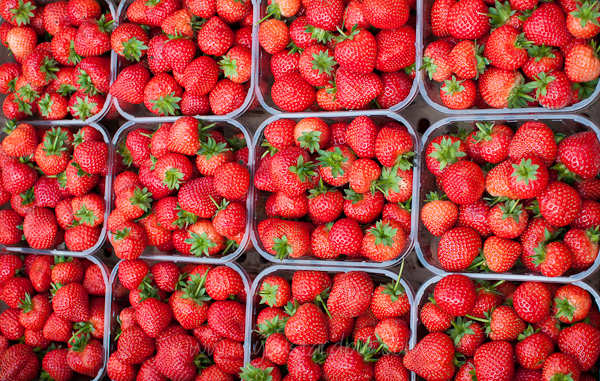
English strawberries at Tavistock Farmers’ Market
Unpacking at the end of two months in the UK is always a bit difficult. So having some treats to put away helps ease the sadness of leaving family, friends, rolling hills and – this year – an incredible amount of blissfully, clement weather.
Having forked out to British Airways for two extra bags, there was no way I could bring back many more of the food-related things that I began to accumulate over the summer. The contents of the Food Blogger Connect goodie bag and seasonal items from the Lidl Christmas preview (yes Christmas in July) were dispensed to food lovers who would appreciate them most.
KP gets incredibly twitchy about luggage; I think he regards himself as a lone wanderer with his napsack on his back. Good thing he travelled on a different flight and was not there to witness the final weight reckoning (thank goodness for those portable digital scale things that take away the nail biting suspense). I just hope he doesn’t read this post and realise just how many cook books I brought back. So as a foodie snapshot of my summer, in my kitchen this September:
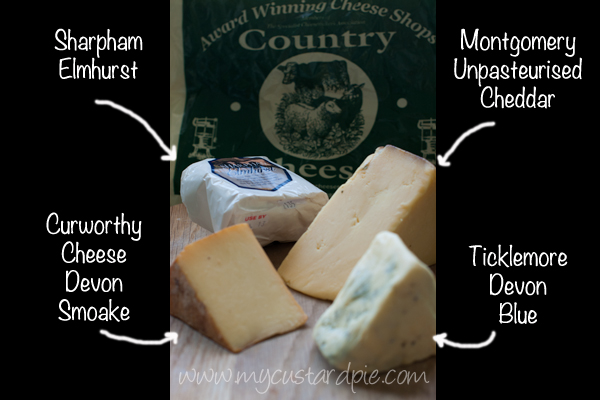
No prizes for guessing that a little haul from Country Cheeses would be nestled in my suitcase. We took friends to the Tavistock Real Cheese Fair this year and they loved it. Sharpham Elmhurst is a creamy, tangy Brie-style cheese and the teens picked the Devon Smoake from Curworthy. I usually choose Ticklemore‘s Harbourne Blue (goat’s cheese) but the Devon Blue (cow’s milk) took precedence this year. Montgomery‘s, Keen’s and Westcombe unpasteurised Cheddars are all made within ten miles of each other in the same way and from milk from the same type of cow. The different tastes are an expression of the atmosphere, pasture and the antithesis of standardised mass market production. As the man at the counter rightly said “the changing taste is something our Grandfathers took for granted.” Montgomery was my favourite this year, but the flavours can differ week to week.


Who needs to cook when you have ingredients like this?


The Bristol Foodies Festival was an exercise in self-restraint as I wanted to buy everything. Scorchio from Fat Man Chilli was chosen for KP and he’d doused his baked bean lunch in it before I had time to protest. He has a high heat tolerance. I couldn’t resist the chutney from Bath Food Company – seriously good.
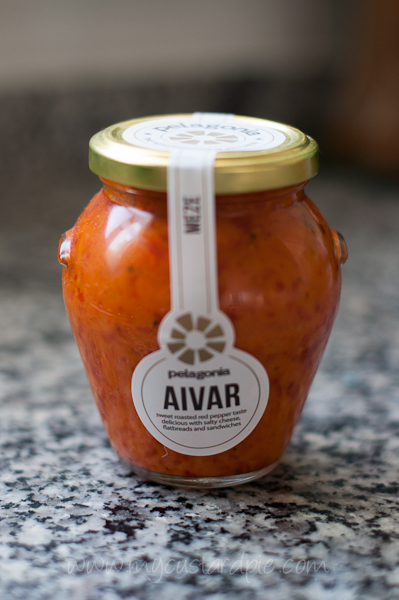 Phil from Pelagonia Foods works in partnership with a cooperative of 650 families to produce a range of traditional Macedonian mezze. He hopes that aivar, made of roasted peppers, will be the next hummus. Spinney’s stocks it in Dubai if you want to try some (because my jar of smooth, tangy, smokiness won’t be here for long).


A few things made it from my Food Blogger Connect goodie bag including kiskh (a fine, powdery cereal that is a mixture of burghul wheat that has been fermented with yoghurt) which Bethany’s brother brought all the way from Lebanon. I couldn’t leave my smoked Maldon salt behind or the aromatic peppercorns from Peppermongers – I will never look at pepper in the same way again.


This hand-harvested Piran salt and fleur de sel from Slovenia was given to me by Joe Gray from Slovely at Jamie Oliver’s Fifteen. It’s stocked at Fortnums and Selfridges ..and now my kitchen. You’ll see me doing my shopping with a Borough Market jute bag from now on. Pretentious….moi? The memory of a lovely morning there.
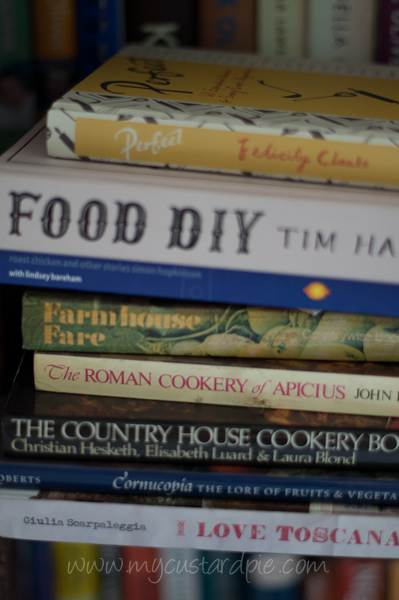 More about this stash of books to follow…
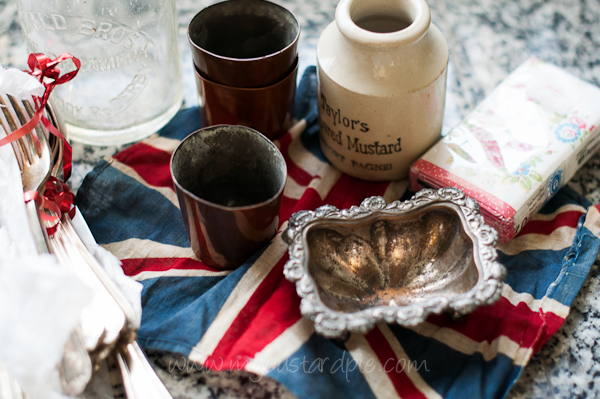 Keep your eyes peeled for these props in future pics…
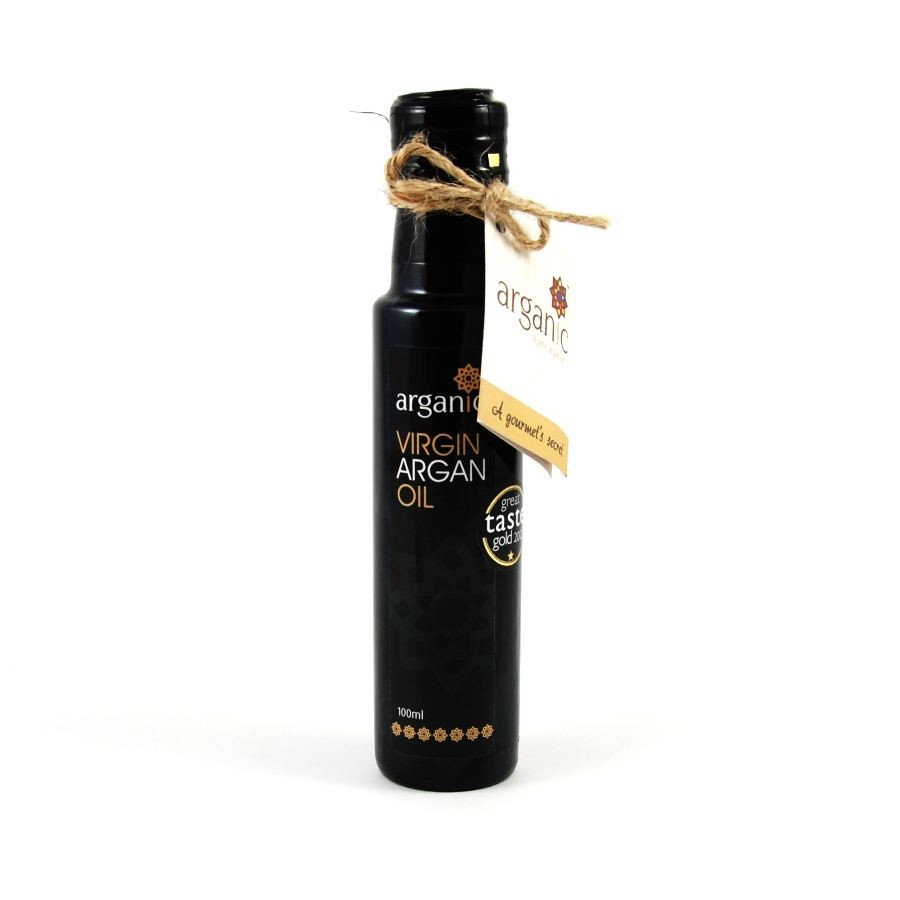 And this is a bit of a cheat as I didn’t have time to take a photo. Lovely Dana from Arganic put aside a bottle of her fantastic argan oil. You may have heard of this unique oil, but there are many adulterated imitations. Dana lives and breathes the stuff and works directly with Berbers in Morocco to source the freshest, organic and ethically sourced argan oil around. It’s now stocked in Jones the Grocer in Dubai or you can order from the website.
As usual, Celia from Fig Jam and Lime Cordial is sharing what’s in her kitchen (and it’s always awe inspiring, totally mouth watering and usually contains chocolate).
So what’s in your kitchen this month?
Related articles
- Harbourne Blue (ideasinfood.com)
Monthly Wine Writing Challenge #3
 Does word association free the unconscious mind? Try this one:
Dog, Cat, Fur, Coat, Enshroud, Night, Eye, Heart, Love, Hate, Dark, Red, Wine…
If you came up with the same conclusion this challenge is perfect for you. The Drunken Cyclist came up with the idea of a Monthly Wine Writing Challenge, The Armchair Sommelier set last month’s theme (both blog names are fantastic word associations in themselves) and it’s my turn to set the challenge for September 2013 – thanks to everyone who was kind enough to vote for me.
The theme is . . . POSSESSION.
What associations does that word conjure up for you and how does that relate to wine?
Here’s what you have to do to join in:
Deadline for submission: Monday, September 23rd 2013 (four weeks from now).
Voting Begins: Tuesday, September 24th
Voting Ends: Saturday, September 28th
Winner Announced: Sunday, September 29th (like The Armchair Sommelier, it takes me a while to do maths).
The rules are simple.
1. The Monthly Wine Writing Challenge is a work in progress. Any (or all) of the “rules” below can be amended or even changed. As long as you are the King/Queen of the Wine Writing Challenge.
2. Write a post/article/essay based on the month’s theme. It is up to you to determine how to interpret the theme, but there needs to be some connection to wine.
3. The post should be between 500-1000 words because it’s been proved that people nod off after this time. If you disagree and can keep them riveted, go ahead. If you search WordPress for the tag wplongform you’ll realise you are not alone.
4. The post has to include a connection to wine (it’s a wine writing challenge).
5. Post your article/essay on your own blog. Link back to this post, send me a link to your post, or include it as a comment here (or do all three). I will link to all the posts at the voting announcement (on 24th September).
6. Spread the word. Use the hashtag #MWWC3 on Twitter and Facebook and persuade, cajole, or bribe as many of your wine-centric blogger friends and connections to take the plunge. Who knows what sparkling writing and ideas could emerge from two little words (possession and wine that is!)
7. Once voting begins, vote for your top three favourite posts… but you can’t vote for yourself. The winner will get a huge virtual round of applause and will set the next month’s challenge (i.e. October 2013).
 8. Here’s an optional badge that can appear on your post. Feel free to download.
If you’ve never taken part in a writing challenge before, this is a great place to start. Who knows what your unconscious mind will reveal. Uncork your creativity (sorry) and enjoy writing and reading all the other interpretations. So are you up for this?
Related articles
- Monthly Wine Writing Challenge #1 (thedrunkencyclist.com)
- Monthly Wine Writing Challenge #2 (armchairsommelier.wordpress.com)
- Wine in the afternoon – how to survive a wine fair (mycustardpie.com)
My holiday hidden gem – Dartmoor
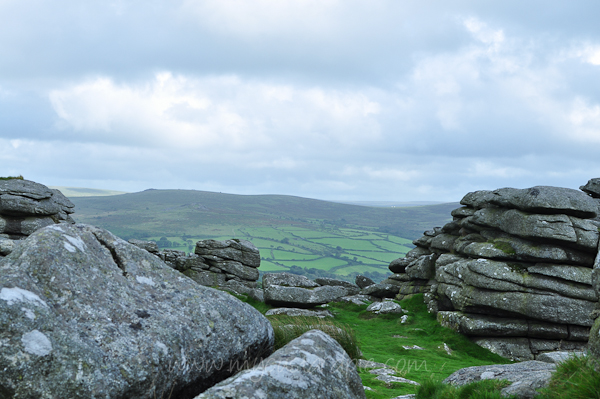
 A narrow road winds through cosy Devon villages full of white-washed cottages beside patchwork fields, then it starts to climb, there’s a sweep of a bend and suddenly you are on the top of the world. Dartmoor appears and – whether shrouded in mist, lashed by rain or crystal clear in green and gold when you can see for miles – it never fails to take my breath away.
My first encounter with a place I now treasure was when I was about ten years old travelling to Falmouth, in an old Ford Anglia, on a rare family holiday. As we rounded that bend in the road, my Dad said in a dramatic voice “This is Dartmoor”; my sister and I shivered in awe as we gazed silently out of the windows. The memory of the view was locked away until I re-encountered this primeval place two decades later.
It’s a corner of Devon more usually associated with a diabolical hound or escaping prisoners from Princetown prison but the untamed wildness is its appeal to me. The market town of Tavistock is a hidden gem and the surrounding countryside holds secret paths known to few. The church of St Michael stands like a beacon on the top of Brent Tor, watching over this area of West Dartmoor, visible for miles. Overcoming my reluctance to write about my favourite walks because I rarely encounter a single person on them, here are a few favourites:


Hidden walks
There’s Creason Wood where you clamber along the bank of the River Tavy, tip toeing on the slippery shelves of granite in parts, to reach a cascade and swimming pool. You return along a leet (small canal) where fish dart out of the shadows and sunlight catches the minerals in the water so it glows orange.
On High down, the majestic tors rise above the babbling River Lyd like hump-backed whales. The climb to Widgery Cross, made of granite and erected to commemorate the Golden Jubilee of Queen Victoria in 1887, is rewarded by a bucolic view across two counties to the sea.
Where the River Walkham meets the Tavy is named Double Waters and mossy woodland encloses ferocious, rushing white water and stony beaches (great for an impromptu barbecue to cook sausages).
Lydford Gorge is a crevasse carved out of granite and now looked after by the National Trust. At one end is the White Lady waterfall, a tall streak of cascading white water, and at the other is the Devil’s Cauldron. Reached by narrow stone steps you take your turn standing on a platform above thundering, pounding water forcing its way through a smooth, glistening opening in the rock. The spray nourishes verdant, green ferns that are delicate against the soaring black cliffs.

Secluded picnics
Devon air and exercise always gives me an equally ferocious appetite and there are plenty of places to buy picnic fare in Tavistock. Country Cheeses only stock cheese from the South West and favourites some from Sharpham, Westcombe unpasteurised Cheddar, Harborne blue and the delightfully creamy Miss Muffet. Try Creber’s, a delicatessen that has been in Tavistock since 1881, for locally sourced ham, apple juice and freshly ground coffee. Pick up some local fruit and veg at Roots and Vines, they also stock a great range of wines, cider and ale from local producers. There’s a farmers’ market every Saturday morning in Bedford Square.
No picnic would be complete without a pasty from the neighbouring county of Cornwall. Ellis the Baker, The Original Pasty House, The Oggy Oggy Pasty House in Tavistock all serve good ones, but we buy our favourites from the village shop in MaryTavy .


Covert country pubs
Inhaling the scent of woodsmoke in the air, propping up the bar with a pint of Jail Ale (made on Dartmoor), eating good homecooked food, all part of the experience in the best country pubs which can be discovered in this neck of the woods. Drive (or walk) to the Elephant’s Nest in Horndon, visit The Castle on a Wednesday and join in the quiz at the lively local’s bar or stay in town and dine at the Cornish Arms – I recommend the grilled pork chop with pork cheek and cider apple sauce.
Secret supplies
The Tavistock Pannier Market was was granted its Royal Charter in 1105 and has survived, without a break, for over 900 years. There are different stall holders every day from art and crafts to vintage goods and antiques. It’s a fantastic place to buy locally-made gifts as is InsideOut , a small shop packed with unusual things for the home, jewellery and locally made crafted items. Visit Dukes by the market or Cafe Liason near the church for a restorative cup of tea.
To borrow a well-used phrase, these are just ‘a few of my favourite things’ about this country town and its surrounding moors which seem to have stood still in time in many ways. Like a big cat, Dartmoor can lure you with its beauty but is fatal if you approach it unprepared. Like a lion-tamer, I keep returning to discover more of its hidden secrets. I return from every visit calmer, fitter, restored.


Do you have a favourite holiday hidden gem?
I’ve entered this post for the Tuscany Now ‘Hidden Gem’ competition.
Related articles
- A little piece of cheese heaven – Tavistock Cheese Festival (mycustardpie.com)
- Angela Rippon’s Tavistock (telegraph.co.uk)
- Dartmoor national park: a ranger’s guide (theguardian.com)
- My favourite Dartmoor Walks (devonwalker.wordpress.com)
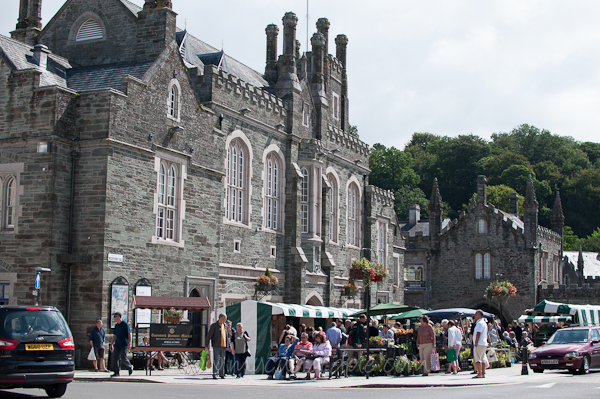
Tavistock – with Saturday Farmers’ Market
Wine in the afternoon – how to survive a wine fair


I knew I was in trouble as I stepped out onto the white sands flanked by turquoise sea and rolling white waves next to the Burj al Arab. The air was as bracing as it can be on a beach in Dubai on a late afternoon in March. Noticing a coffee stand to my right, I ordered a restorative double espresso and knocked it back in a few gulps.
Drinking at lunchtime was something I left behind in London and the ad industry world of the 1980’s and any drinking in the afternoon now focusses on the contents of a large teapot. But when faced with a whole room full of wines all ready to be tasted well it was like being a small child let loose in a sweet shop. Yes I was that small child, and as much as I tried to pace myself, bottle of water in hand, tasting the tiniest samples, by five o’clock things weren’t looking pretty. I realised I’d overdone it as much as any toddler faced with unlimited access to lollipops and marshmallows.
Soon, the coffee started to work its magic and as I looked out on the stunning location I thought about the whirlwind two hours of tasting I had just experienced. Ruefully regretting the other half of the wine list that remained unsampled i.e. the reds, I decided to call it a day. As the sun started to sink in the sky, on a table in front of me a man lined up a series of bottles and poured a round of Fernet Branca for his group, to prime their palates for some serious wine drinking. I taxied home, wondering at the stamina of those starting the evening session (and exactly how much I had slurred in some of my conversations).
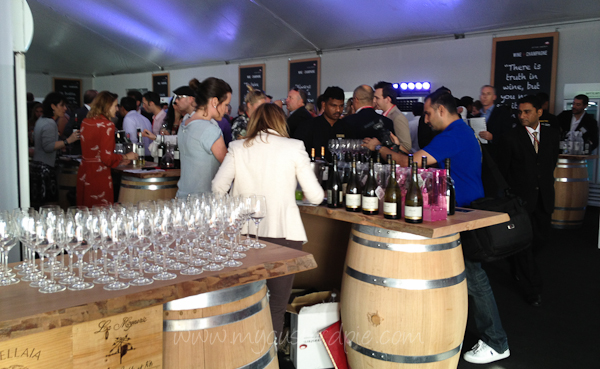
There are two major importers of alcohol in Dubai, MMI and A + E (African and Eastern) and this was a preview tasting of new wines and some more familiar from the list of the latter, with wine makers to introduce them in many cases. I arrived just after 3pm with Sarah of The Hedonista who had done this kind of thing before and is very decisive. “Let’s do whites first” she announced, and I was happy to trail after her gleaning crumbs of knowledge and comparing tasting experiences. She made use of the spittoon every time, unlike me which was my downfall. It was just such a rare opportunity to meet and chat with winemakers and sample such a diverse range of wine I got completely carried away with my enthusiasm.
The other downside of not spitting is that the memory becomes a little blurred. Taking detailed notes is futile at this sort of event when multi-tasking includes listening to the winemaker or pourer, concentrating on tasting the wine, taking a few photos, plus bumping into people you know (not literally). Grateful for this opportunity as it was a learning curve for me in more ways than one, I’ve put together a list of tips for future wine tastings of this size for next time (hoping for a return invitation!)
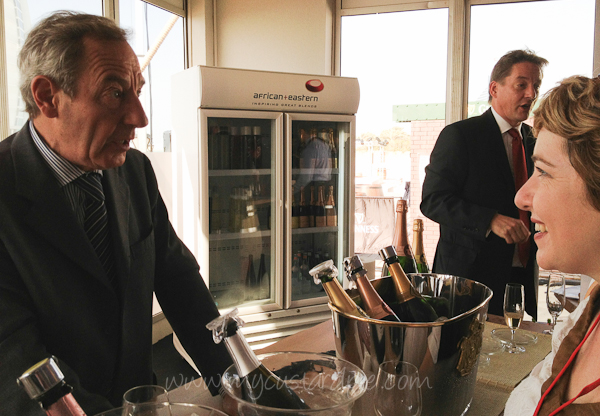
The charming Jean-Claude Fourmon talks to The Hedonista
Top 10 tips for visiting a wine fair or tasting (or how to stay out of trouble)
- If possible, try to get an idea of who will be exhibiting and plan some kind of strategy of tasting.
- Also keep an open mind. You may find some surprises.
- Leave your posh DSLR at home or if you really want some nice pics, do all your photography before you taste and then put your camera away. For an aide-memoire of wines, your smartphone camera is ideal.
- Sample as widely as you can and use the spittoon. Take the opportunity to sample a little of a lot (rather than the other way round). If you are tasting (and swallowing) you don’t have to finish the whole amount; no-one will be offended if you leave it or pour away. At the end of your tasting you can then go back and drink a couple of your very favourites if you still feel in the mood.
- Eat before the event and, if possible, sometime during the tasting. Drink water often.
- Focus on the wine and your experience of it – the aroma, the structure, the flavours, texture and balance (I find the WSET systematic approach very useful). A small voice recorder or the notes recorder on your phone to save your impressions can be more useful than juggling a pen and paper.
- Ask the pourer or wine maker about what makes the wine special or different and which wine they would personally recommend. You can discover a lot more about the background and character of the vineyard and wines than given in the promotional notes in the hand outs.
- Mix it up. While a comparative tasting of similar styles of wine (e.g. the same grape variety) can be interesting, envigorate your palate by ringing the changes. For instance, after trying a lot of fairly dry, restrained whites, we happened upon a Sicilian Moscato which made us both exclaim with pleasure. It wasn’t the most prepossessing wine but it was perfect for our slightly jaded taste buds.
- Be aware of those around you. It’s frustrating when you have to wait a long time to taste the most popular wines because others are hogging the pourer’s time and attention. So don’t be a hogger!
- Enjoy the whole experience and take the opportunity to learn as much as possible.
A few of my impressions from the afternoon:


Joseph Perrier
Jean-Claude Fourmon himself, the GM of this small and unconventional Champagne house, guided us through a tasting of Brut Non-Vintage (Cuveé Royale), Rosé Non-Vintage, Brut 1995, Vintage Brut 1995 and Blanc de Blancs 2004. It was the last one in this list, the elegant Blanc de Blancs that impressed; 100% Chardonnay and perfect for an aperitif or to match with a bowl of prawns, it charmed me with its delicate effervescence and balance. Or was that the winemaker?


Laurent Perrier
My first sip of an Ultra-Brut and I was hooked. This is the very driest style of Champagne and the Laurent Perrier was concentrated in fruit where it was Spartan in sweetness, with divine delicate but persistent bubbles. Tasting vintage Champagne which is as old as my teenage daughter was peachy in more ways than one. 1998 Laurent Perrier Grand Siecle Alexandra Brut Rose was velvet strawberry fields with orange peel and absolute heaven.


Canadian wine
Apart from ice wine, I had never tasted a wine from Canada and expected Le Clos Jordanne to be very special. The Chardonnay, from organically cultivated vineyards, was well-made but I regret not having tasted the highly rated Pinot Noir.
Californian wine
In my constant quest to taste as widely as I can I’m always drawn to wines from the US as not many find their way to the shores of the UAE. Robert Mondavi may be ubiquitous but the wines are always of a certain quality. The 2010 Private Selection Chardonnay had a creamy texture and smoky oak without being overwhelming. However, I wish I’d tried the reds. Zinfandel (of good quality) is a varietal that you don’t see a lot of in Dubai so I took a detour from the whites and leapt on a taste of 2009 Ravenswood Old Vine Zinfandel from Sonoma county. Luscious black berry fruit and vanilla made me want to explore further.
New Zealand whites
2011 Kim Crawford Marlborough Unoaked Chardonnay is bang on trend by offering a restrained expression of this grape variety, world’s apart from previous New World styles of wine making. Villa Maria 2013 Private Bin Sauvignon Blanc is entry-level for this wine maker and while fresh and vibrant it lacks more interesting structure. I’d like to taste something from their Single Vineyard range (they also produce a few organic wines). Dog Point 2009 Section 94 is made of Sauvignon Blanc although it doesn’t mention it on the label and this sets the tone for this unconventional wine in NZ SB terms. Oak aged and bone dry there’s not a trace of the astringent gooseberry that we are used to here in the UAE. Note to self to taste again.
French wines
Enjoyed some ethereal Provencal roses and the Domaine Laroche 2006 Chablis Grand Cru Les Blanchots was a really fine example of a modern Burgundian Chablis – apples, butter and minerals. I’m sure the very nice girl from Laroche told me the wines were made of organic fruit but can’t find any information to this end on their website.


Strange fruit
Vaguely depressing that there is a market for Voga; and does sticking crystals on a wine bottle and calling it Diadema really make it more appealing?
To quote Andrew Jefford “The problem with wine fairs, though, is that you know you’ve missed far more than you’ve found.” However I was very happy with my discoveries and hope I’ll get to put my ten tips into practise soon. Do you have any other advice for approaching a wine tasting? Has wine ever got you into trouble?
The Drunken Cyclist (Jeff) has started the Monthly Wine Writing Challenge and this month’s theme, chosen by The Armchair Sommelier, is “Trouble”. I couldn’t think how to link trouble and wine, but woke up the next morning thinking about this tasting which I have been meaning to write about for a long time.


Related articles
- Blind tasting and the Dubai Wine Club (mycustardpie.com)
- Women and wine (part one) – What to drink in 2013 (mycustardpie.com)
- Champagne on the brain (thehedonista.com)
- How to Throw a Wine Party (foxnews.com)






 My Custard Pie