Date and vanilla lassi

Date and vanilla lassi
We had a box of dates, once a year at Christmas, when I was growing up. They came in a long, thin, lidded, cardboard case with rounded corners, and were arranged along the sides of a plastic stem which doubled-up as a two-pronged fork to save your fingers from stickiness. They were always from Tunisia; I’m not sure who ate them.
As I wander along the aisle of my local supermarket now, the date section is mind-bogglingly with choice; shelves laden with a huge array of different types, shapes, sizes, descriptions and prices. There are more than 1,500 varieties of dates worldwide, and about 42 million date palms in the U.A.E. I’m writing this as steamy dusk falls (it’s 32 C) and the first Iftar of Ramadan is about to begin. It’s impossible to imagine how people survived here, before air conditioning, with just the breezes caught by tall vents made of palm fronds, called wind towers, to cool them. Resources were precious with dates, camel milk and coffee at the heart of life.
It’s traditional for Muslims to break their fast by eating three dates, as the Prophet Muhammed did. Dates are offered at communal Iftars, given as Ramadan gifts and as an ingredient of different pastries and sweets, which is why they abound on the supermarket shelves.
People who have grown up with dates (not just at Christmas) have a different attitude to them. They eat them at all stages of their growth: green and under-ripe, while still crunchy and fresh, ripened and juicy, and dried and sticky. Which country the best dates come from is hotly contested.


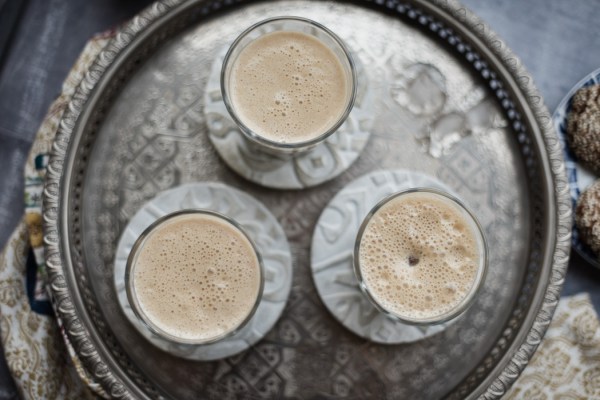 I’ve had a big tub of dates from Saudi Arabia in my kitchen, left over from a photography session, and they’ve started to creep into my cooking and food preparation – not just as a mid-afternoon snack. It got me thinking of how many ways to use them and perhaps a series of date recipes. Can I do thirty days of dates? Let’s see. It would be a challenge, and I respond to a challenge. Are you up for it?
My first recipe is a simple one, a cooling lassi to temper the heat of food and climate. The alchemy of the ingredients is magic though – like smooth caramel, vanilla ice cream in a glass.
It’s based on the Punjabi style lassi without the addition of water. I’ve used a mixture of milk and yoghurt but also tried it with 100% laban (a drinking yoghurt that’s readily available here). You could use plant-based milk products as well.
The level of sweetness depends on you. Indian sweets are tooth-achingly so – and some lassi recipes call for an amount of sugar, honey or dates which is way too sickly for my tastes. If you are pouring over ice you can get away with it being a little sweeter though. You need a powerful blender to make it (I use a Vitamix). Pour a little boiling water over the dates and leave them to soften overnight if your machine is a little on the wimpish side.
Please don’t use vanilla essence or flavouring; the taste will put a synthetic dampener on the whole thing. You can make your own vanilla extract (it’s not sold in supermarkets here in Dubai due to the alcohol base). Local Dubai kitchenware shop Tavola sells a real version which is alcohol-free.
A pinch of sea salt wouldn’t go amiss here either, for a salted caramel vibe.
Date and vanilla lassi

A cooling drink with a deep, caramel flavour. It's more of a dessert-style drink than a regular smoothie. Frothy, creamy and good served over lots of ice.
Ingredients
- 250ml Greek yoghurt (or plant-based alternative)
- 250ml milk (use full-fat regular milk or another of your choice e.g. almond milk)
- 7-10 dates (depending on how sweet the dates are and your taste)
- 1 teaspoon real vanilla extract (or seeds from a vanilla pod)
- Generous pinch of sea salt (optional)
Directions
- Measure the yoghurt and milk (or 500ml laban) into your blender.
- Remove the stones from the dates. This is easy (if sticky) to do with your hands – just pull the dates apart to reveal the stone, pick it out and discard. Put the dates into the blender (it’s important that the liquid goes in first for machines like a Vitamix).
- Add the vanilla extract (or seeds) and salt if using.
- Blend really well until the lassi is really smooth and frothy.
- Pour into 2 or 3 glasses over lots of ice. Drink immediately.

Pin this image for later
I used a very low aperture (blurry backgrounds) on these images and a Kim Klassen preset which is quite desaturated and moody. I really like the look but interested to know what you think.
Are you with me for the date marathon? Is a whole month (during Ramadan) of daily posts possible (or even desirable?!). Do you remember the date boxes (do they still exist?).
How to work with influencers more effectively

Brands are clamouring for influencers to help spread their message. Marketing budgets are fragmented to include digital content across a range of platforms. PRs have a tough job targeting traditional media and then this new group of opinion-formers comes along in a competitive landscape which shifts like sand.
When I started my blog eight years ago there was no such thing as an ‘influencer’. But over time, as brand collaborations became a way of generating income for content creators (and a new generation of influencers entered the sphere with this as their end goal). As a result, there’s a lot of advice directed at influencers on how to contact PRs and brands that result in a working relationship. But I’ve found less information from an influencer perspective.
So how do brands and PRs connect and collaborate with online influencers in a way that benefits both parties and leads to all end goals being met? This is my personal experience from a food and travel angle, plus I’ve asked some top content creators in the UAE what they think.
I’d love to hear from PRs, brands and influencers alike. Please share your perspective (in the comments) and add to the conversation.
If you came here for food and travel, I hope you’ll enjoy this window into an ever-changing new industry.

So how do you nurture a loyal band of collaborators who reply to every email, share content in a meaningful way and come to events with enthusiasm? Here are a few ideas…
9 ways to work with influencers more effectively:
1. Research
Take time (and it does take time) to look at what the person posts. By really getting to know them you can determine which influencers you should be working with.
Look at their engagement (not just the number of followers), read the comments, inspect their content. Is there is a repetitive list of the same followers with three word comments just saying how wonderful everything is, or are there real, invested conversations?
And look beyond the number of followers. Audience does not equal influence.
2. Build a relationship
PRs may talk to journalists, but influencers live in a digital world. Foster a relationship there. I don’t think a PR has ever left a comment on my blog and only one or two interact with me on Instagram.
Take time look at what they post. Engage with them on Twitter or Instagram build a relationship. Work for the long term, so when you do get in touch with a request they will already know you and are more likely to respond favourably.
Factor in the changing nature of the industry and approach influencers in a very different way to journalists…
3. Tailor
There are two strands to this one. Ask the influencer what they would like from the experience or collaboration. Contact your potential partners and find out what it is they’d really like in an ideal world. Target with things they actually want to do (for a better take up). If it’s too much you can meet somewhere in the middle.
To quote Kate Baxter of Be More Hive from a recent episode on the Blogtacular podcast, who often sees sign off on quite traditional PR strategy approaches that don’t work on an influencer level:
..something that is adapted from an approach that they might traditionally have used with print press which is not really the approach that you can take with influencers. Each influencer, whether that be a blogger, a vlogger, or someone who purely has an Instagram account with 100s of thousands of followers, they are their own person who retains complete editorial control over absolutely everything they do and so they are the person who makes the decision on every single aspect of the content they are creating and that also putting their own personal viewpoint across in that content in a way that traditional print media doesn’t.
The second aspect is that at events or on media trips there is often one amazing set up, view or experience – but you then get the same identical coverage from all the people there. By finding out what the influencer (and therefore their audience) would like you can tailor elements so they have bespoke, unique and more impactful content.


4. Personalise
No matter how enticing the offer or interesting the proposition, being addressed as ‘Dear Blogger’ is so off-putting and causes the hackles to rise. I’d rather someone just said Hello than get lumped into one homogenous influencer morass! (I’m sure the ‘Dear Editor’ press releases get short shrift across the board too).
I received a parcel the other day with my name handwritten on the outside, a mock-up of a passport containing stamps to all the countries I’ve visited in the last two years and a postcard with an image of me on it (yes they’d stalked me on Instagram). Not everyone has the time or budget to personalise an invite to this degree, but it definitely made me feel very special and almost duty bound to attend the event when it’s announced.
5. Don’t send press releases
Even for journalists, according to Janet Murray, press releases are generally ineffective. Even less so for influencers – most of whom share things from a personal perspective (and if the release is just reproduced online, I’d question the value to, or engagement of, any target audience). My inbox is inundated with so many emailed releases that I created a rule which puts them straight into one folder so I can scan the headlines and delete quickly. Sometimes they do contain something which I want to share but it’s in a format that makes it too time consuming and difficult so….
6. Send shareable content
Everyone wants useful, information, entertaining shareable content for their platforms. Often a press release will highlight something that my audience would be interested in. Two pages of detailed information in a release and a high res image that I have to download usually gets put straight into trash. To make it shareable I suggest one or two lines communicating the main point (less than the 250 characters that Twitter demands ideally), a lo res image that is in a format for social (in size and content – no line ups of executives in suits please) plus a link to the rest of the info so people can to find out more. Social tags and relevant hashtags would also help the client gain exposure. If I want to know more I’ll reply to the email.
7. Use one method of communication
You receive an invitation by email, check your Instagram messages* and there it is in duplicate, then the phone rings about the same event. Responding or even deleting takes time. It’s worth finding out the preferred method of communication from your list of influencers (you could do a quick survey and store in your database).
*For instance, I include my email in my Instagram profile as Instagram messages are time-consuming to manage (you can’t bulk delete and have to respond on your phone) – I presume influencers with a huge following have a VA to assist with this.
8. Interact
Likes and comments are the currency of the digital world. Brands, in the main, assume that the influencers will do all the work and completely miss the point of amplified reach through sharing user-generated content. It’s staggering the amount of times that a brand fails to respond to being tagged or using a hashtag (that they have asked you to use). Whether an official collaboration or not, you put out a post and it’s tumbleweed. Brands will benefit from being seen to be commenting on feeds, and joining the conversation. There’s a reason why it’s called ‘social’ media.
9. Manage expectations
Both parties should agree in writing everything that is expected before the initiative. A request after the event ‘can you just post this on your Instagram feed’ when this was not part of the agreement undervalues the time, effort and effectiveness of the influencer’s work. Again it’s about understanding what goes into the content creation. If unsolicited freebies are sent to an influencer, it is up to them whether they post anything (or nothing). If goods, trips, experiences are received with assent then a realistic amount of coverage should be agreed.

Three content creators share their personal viewpoint
I asked “What are the areas that frustrate you or could be much more effective when PRs approach you (and ultimately achieve a tangible benefit for the client)?” Here are the replies (unedited).
Samantha Wood, founder of impartial restaurant review website www.foodiva.net and curator of dine around experiences
“The list is endless but here are my top three pointers:
- The first golden rule of any type of media engagement is for the PR to understand the social media platforms of the person they are engaging with. Having been a PR for 17 years I know the value in building relationships. Read my website including pages that explain my editorial policy and advertising/ partnership activations – and review my social media channels. I get very frustrated when PRs pitch to me yet have no idea that my business is digital only, let alone having read it. For instance, a PR might invite me to review a new restaurant – yet not having read my site, they are unaware of my no freebies anon policy.
- Pitch suggestions in line with the type of content/ different sections of my website. Personally I prefer email correspondence and perhaps Twitter for short and sweet ideas. I don’t like being pitched on IG or FB – or even worse WhatsApp. If I have a good relationship with the PR, I am happy to take a phone call to discuss the pitch.
- Do NOT send me press releases or download links unless I have requested hi-res photos – PRs are wasting their time and mine. My inbox is flooded every day with PR requests, which I don’t have the time to read. A menu, plus two or three bullet points of the restaurant/ food concept’s USPs in the body of the email is all that I need – plus some good low-res images to help paint a picture.”

Samantha Wood
Rupal Bhatikar of Foodie n Fabulous food and travel blog
“My biggest pet peeve with PRs has always been the lack of research into the bloggers niche. It hugely benefits brands to work with people who would add value to a campaign if their audience/content is relevant to the brand. Being a food (recipe) & travel blogger, I get ridiculous number of restaurant/spa/lifestyle invites that are completely irrelevant to what I do. It is not enough to send a blanket email to anyone and everyone, due diligence is critical. It is also as important for them to expect transparency from the influencer side – sharing stats critical to study if campaigns have actually been effective. Similarly, using #sponsored and disclosures should be a given considering how much time and money is at stake and PR’s should be working only with legitimate influencers who actually follow these ethics/conduct. That is the only way going forward this industry can be regulated and work better for all parties involved.”

Rupal Bhatikar
Naomi D’Souza – Leading Instagrammer and blogger
“I personally think the first step is, empathy. PRs must know it takes a lot of time to blog – managing a website plus creating quality content, editing pictures after a review and most importantly being able to come up with a creative tactic to promote a specific brand every single time.
I understand it’s mostly the client and not the PR who come up with deadlines and requests, but I do feel it’s the PR’s responsibility to spread knowledge on what bloggers go through just to create one piece of content. If things are rushed up the quality gets compromised that further ruins the bloggers personal brand, this even ends up ruining future potential collaborations.
There are a few PR agencies that understand the effort taken by bloggers but I believe it must be talked about more.”
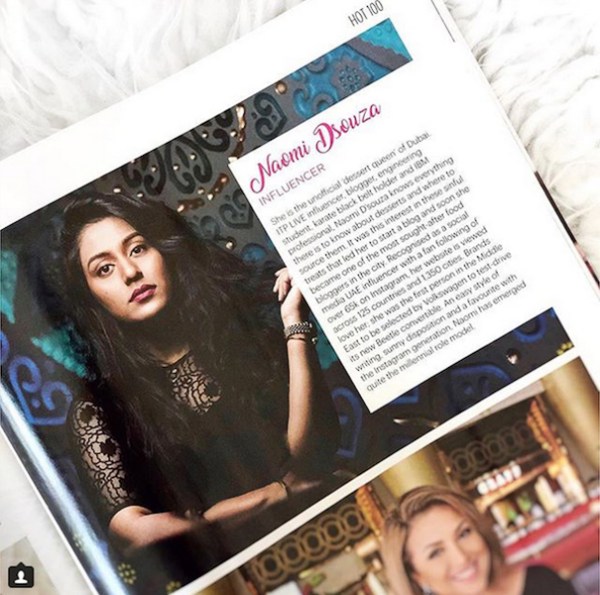
Naomi D’Souza
What’s next for PR and influencers?
My aim in writing this is as a constructive way to achieve greater results in a partnership together; I do not underestimate the hard work that goes into PR especially in a competitive and ever-changing business landscape (especially as, with a career in marketing communications, I see both sides of the fence). I’m sure that some PR and brands are shouting at the screen right now saying “but you have no idea about x”.
Recommend giving the Blogtacular podcast a listen. It’s about finding good examples, learning how to do it right and setting some industry standards.
How do we move closer together in collaboration to achieve the aims of both sides? Maybe we should have a huge meet-up where we all get together regardless of who or what company we work for. Let me know in the comments.

Found this useful? You might like 10 things learned from 5 years of food blogging, What is Blogtacular and why you should attend and How a photography challenge could improve your Instagram
What makes a good Hot Cross Bun and where to find one
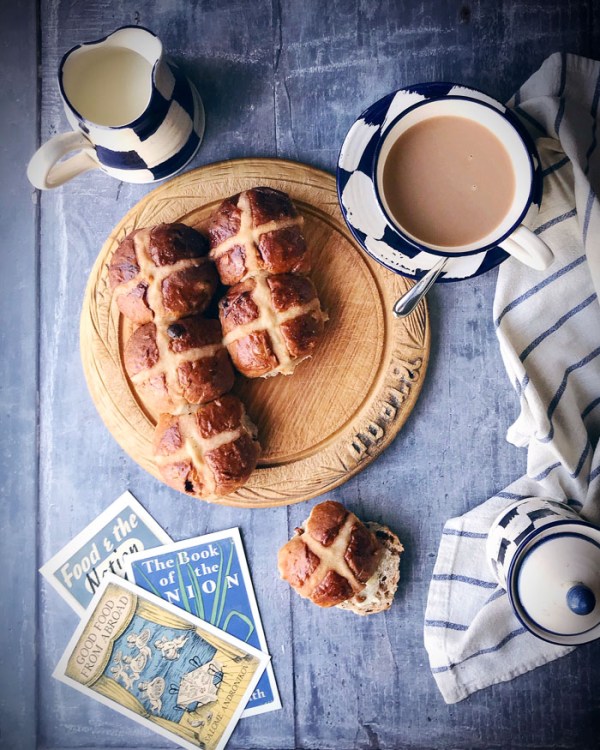
The French are very good at seasonal baking and cakes, with things like Galette des Rois and La Chandeleur. Apart from Christmas, the English staples seem to have fallen by the wayside, except for the Hot Cross Bun. In the UK they can be found all year round now apparently, but here in Dubai they make an appearance the week before Easter then disappear. This is just as it should be in my book!
Why are they called Hot Cross Buns? They used to be served warm from the oven on Good Friday and they have a cross on them.
The origin of Hot Cross Buns is shrouded in a bit of mystery and varying tales, but while they have been given Christian meaning in more recent times they are thought to have a pagan origin or even have roots with the Romans. Their popularity gained in the 1600s as sugar and spices transported from across the world became cheaper and more abundant. Crosses are now made of pastry but were probably just a mark made with a knife in olden days. Their consumption was regulated by Queen Elizabeth I who decreed that they could only be eaten on Good Friday and at burials or for Christmas. If you were caught baking them on any other day you had to donate the lot to the poor.

Marks and Spencer hot cross buns
There are various superstitions attributed to these spiced baked spheres too. From warding off evil spirit to keeping bread fresh and free from mould throughout the year if hung from the rafters of your kitchen. This was taken to extremes in some cases and there some Hot Cross Buns exist which are over 100 years old and have been passed down through generations.
So what makes a good Hot Cross Bun?
These are eaten on Good Friday as they mark the end of Lent where eggs, butter and sugar, have been given up as fast for forty days (or at least used to be). All of these things are packed into these spiced, fruited buns. A traditional Hot Cross bun should be topped with a slightly sticky glaze to make them glorious shiny and a cross. Some people pipe the cross, others roll out a little pastry to make a slightly thicker, neater one. It should be plain though, just flour and water (we will tackle the thorny problem of novelty shortly). The texture of the bun should be light, reasonably fluffy and rich from the egg and milk but plain enough not to be sickly when combined with fruit. Any added sweetness to the dough must be barely noticeable. Plump raisins and soft, tangy candied peel must be dotted through the bun evenly.


How to eat a Hot Cross Bun
When fresh from the oven, within a couple of hours, the buns should be soft enough to prise apart, spread with butter and eat plain. Any older than they are best toasted before anointing with your best butter – whether salted or unsalted is up to you but I favour the former. Traditionally additions like jam or marmalade should not be necessary, and I think the bun is sweet enough not to need it. Naturally, you should always accompany one with a cup of tea.
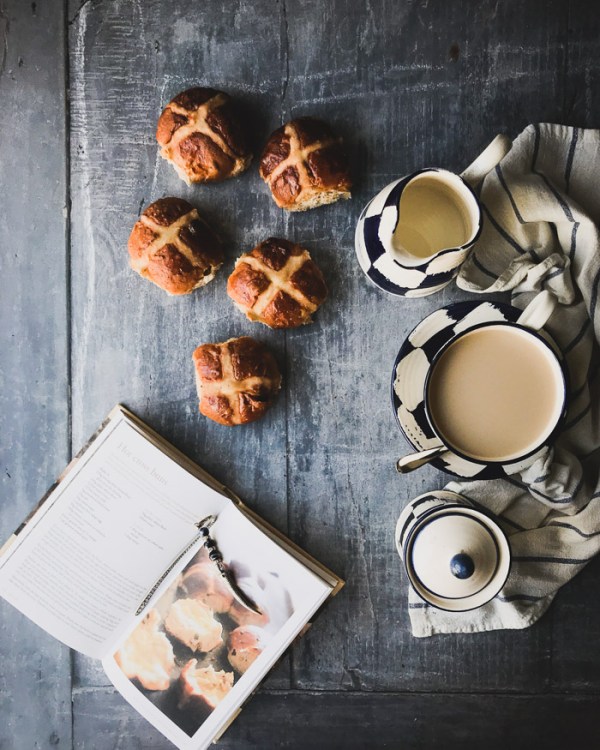
Baker and Spice hot cross buns
Three methods of making a Hot Cross Bun
Why do Hot Cross Buns differ in texture and taste? There are several bread making techniques (and these are a risen bready bun).
Slow-rise
This involves taking a starter made of dried yeast or natural yeasts from the atmosphere combined flour and water that froths into a ‘sponge’. The dough itself is left overnight in a cool place to slowly rise and let the gluten develop. It typically uses much less yeast in proportion to flour.
Yeasted
I have called this yeasted for want of a better term. These are the type of bun you are most likely to make in your home kitchen. You add yeast to the other ingredients, knead and leave to prove at room temperature for an hour or two, then you knead again, shape and leave for a second prove before baking.
Quick rise, Chorleywood process or activated dough development’ (ADD)
In the 1960s, a method was invented in the UK which enabled large units to manufacture cheap, fluffy bread, with little or no proving, using additives and enzymes. This how the buns, sold in packs, in the supermarkets are made. ‘The Shocking Truth about bread’ is an article with a good explanation.


Hot Cross Bun variations
No surprise here. I’m a traditionalist and like a classic bun made by hand with care and to the specifications described earlier on what makes a good one. Invention is not necessarily a bad thing if it improves on the original. This year I’ve seen replacements for the dried fruit, flavoured glazes, savoury buns with bacon crosses, additions of Marmite and seeds, and even some made in the shape of Miffy the rabbit. My friend Miss Foodwise adds a little grated carrot to the dough for a lighter crumb. The recipe I use is further down the page.

Lafayette Gourmet hot cross buns
The best Hot Cross bun in Dubai
This taste test all started when Marks and Spencer sent me a parcel of buns out of the blue. I decided to get my hands on as many as possible to see which I like best. Baker & Spice and Jones the Grocer sent some and Russell Impiazzi from Lafayette Gourmet delivered his personally on Good Friday. I bought some from Spinneys and Lime Tree Cafe.
Quick rise
Marks & Spencer
I was given five varieties of bun and was very intrigued by the flavours. The Luxury traditional were my favourite, not too sweet with a good proportion of sultanas, currants, orange and lemon peel. The cranberry and orange also worked well as the cranberries added a tangy sharpness. Surprisingly the dark chocolate and salted caramel fudge was not bad in flavour – a sort of riff on pain au chocolate. The blueberry buns were far too sweet with a strange cooked taste to the fruit, and the Bramley apple were like bottled apple sauce in a bun – just wrong. The texture of all was soft, light and a bit pappy as the production method dictates. They were much better toasted but not that satisfying. The glaze had soaked into the bun so none were shiny.
Spinneys
These are the Fine Fare brand made by Spinneys in the UAE. They had kept their shape and were reasonably shiny with the glaze. The texture was similar to the M&S ones, they had a nice smattering of plump fruit and a subtle spice. For my tastes, the dough was far too sweet and I struggled to finish one, even tempered with butter. They were the most economical of all tasted.


Yeasted
Lafayette Gourmet
Chef Russell Impiazzi delivered these himself having just finished a children’s Easter cookery class which he’d baked these for. He apologised that there was no peel and chocolate chips instead of fruit due to the demands of his children. The appearance was the best of all the buns I tested; regular in shape, neat crosses and a wonderful, glistening glaze on top. I took a quick picture and wolfed one down immediately. They were nicely spiced, the dough unsweetened (I think) giving a nice foil to the dark chocolate.
Lime Tree Cafe
These buns were part of the array of decorated Easter goods spread over tables in Lime Tree. They looked the part but were the most expensive of all the buns I tested as even take away comes with butter and jam (I declined but the price did not adjust). The texture was fluffy, open and soft enough to pull apart, but the spicing level way too intense – the dough itself looked light brown due to the amount used – the cinnamon and clove left a bitter aftertaste.


Jones the Grocer
Gleaming with a very sticky almost jammy glaze, these were a generous size with a very homemade looking cross (not a bad thing!). The texture was good – needed slightly more time to prove I think as the crumb was not as open as the LG ones. The spice was very subtle, more of a warm after taste. Sultanas and soft pink peel dotted through for tanginess rather than sweetness. On the edges some of the crosses had gone hard and chewy – but overall a good bun.
Slow rise
Baker & Spice
This was a much denser bun, fresh from the oven really excellent with just butter, and by the end of the day better toasted. The spice was spot on and the sweetness provided by the glaze not the dough. There was a really good sharp tang and soft citrus bits from chunky homemade orange jam that’s used instead of peel. I had another taste of these with the Dubai Eye team on radio where we sampled a chocolate version too. The traditional Hot Cross Bun met with enthusiastic approval but the chocolate bread studded with chocolate was thought not to be chocolatey enough. I think these would be nice with a sweetened cream, cinnamon butter or dunked in hot chocolate – all not really HCB territory.

Home made hot cross buns
Make your own Hot Cross Buns
As the name says, these are really best with the warmth of the oven still a memory. They are not difficult to bake and very satisfying when you pull them apart.
Traditional Hot Cross Buns
A seasonal bun enjoyed just before Easter, which is best homemade
Ingredients
Ingredients- 250g strong white bread flour, plus extra for dusting
- 250g plain white flour
- 125ml warm water
- 125ml warm milk
- 5g fast-action dried yeast
- 10g salt
- 50g caster sugar
- 1 medium free-range egg
- 50g butter
- 100g sultanas and currants (or a mixture of dried fruit)
- 1 dried apricot, cut into small pieces or 1 tsp homemade mixed peel
- finely grated zest of half an orange
- 1 tsp ground mixed spice
- 1/4 teaspoon freshly grated nutmeg
- pinch allspice
For the crosses:
- 50g strong plain white flour
- 1tbsp sunflower oil
- 2-3tbsp water (or enough to make the dough into piping consistency)
To finish:
- 1 egg yolk
- 1 tablespoon milk
- 100g caster sugar
- 50ml orange juice
Directions
- You can do this by hand but the dough is sticky so I recommend using a food processor or free-standing mixer with a dough hook. Warm the water, milk and butter together very gently until the butter melts and when it has cooled to blood temperature (i.e. feels barely warm when you stick your finger in it) mix in the yeast and leave for 5 minutes. Combine the flours, milk and yeast mixture, salt and sugar in the bowl of your mixer and fit with the dough hook. Add the egg and mix to a sticky dough. Now add the dried fruit, orange zest and spice and knead on a low-speed until silky and smooth.
- Cover the dough in the bowl with a tea cloth or cling film and leave to rise for about an hour, or until doubled in size.
- Knock back the dough and divide into 8 equal pieces. Shape into rounds and dust with flour. Place on a floured board and leave to prove, covered with a linen tea towel (or in a large plastic bag) for about 30 minutes until doubled in size. Transfer carefully to a floured baking tray.
- Preheat the oven to 200°C and make the paste for the crosses by beating the water and oil into the flour until smooth . Transfer the paste into a piping bag with a small nozzle. Beat the egg and milk together.
- Make a cross with a sharp knife across the top of the buns. Brush with the egg wash (the beaten egg and milk) and then pipe crosses onto the indentation. Bake for 15–20 minutes.
- Transfer to a wire rack. Dissolve the sugar in the orange juice (or water) in a small saucepan and bring to the boil. Brush the glaze over the buns. Cool to room temperature before pulling apart and eating plain or halved with butter.



Are you a traditionalist like me or do you fall on these different twists and flavours with gusto? Have you even eaten a Hot Cross Bun? Are there any different seasonal treats you like to make or eat? Let me know in the comments below.
Disclosure: As mentioned above, some of the bakers were kind enough to supply me with samples for testing. I know Chef Aaliya of B&S and Chef Russell of LG well – however this did not influence my appraisal and these are my honest opinions.
Two days in Riga – exploring the Latvian capital

Riga cathedral at twilight


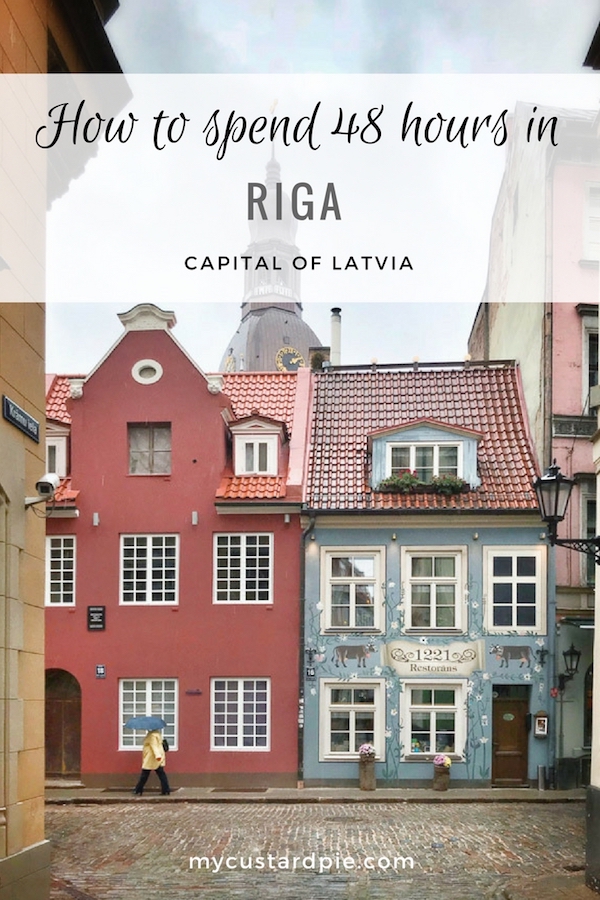
Our wind-buffered taxi scuttles over the bridge across the gleaming Daugava river that divides Riga in two; the city stretches out enticingly along its bank. We press our noses to the rain-spattered windows catching glimpses of elegant buildings through the branches of trees which are still just clinging onto the last of their leaves. Alighting in the heart of the city, I run across the square to take a picture of a golden, stone building, topped with a curlicue, then dash inside to be welcomed with a glass of Prosecco, slightly dazzled by brilliant chandelier. As one of the first guests of the Kempinski, there is a whiff of new plaster under the signature scent and we crane our necks to admire the historic reliefs of the old town high up near the ceiling, preserved after four years of renovation.
I long to sink into the huge bed with crisp white pillows but our tour bus is waiting, and as we huddle under smart hotel umbrellas, our delightful guide Gita gives us a rapid introduction to Riga and the Latvian people. There’s a general perception that Latvia is still part of Russian (it was behind the Iron Curtain but now a member of the EU for well over a decade), but although just a little pocket handkerchief of a country (of only 2 million inhabitants) it has its own distinct language, heritage and more in common with the Finns at a stretch.
Scurrying along cobbled streets juggling umbrella, gloves and hat…. plus my jaw on the pavement, I try to capture the organic lines carved into buildings, weathered wood and lowering skies while the muscular wind stretches my face and freezes my fingers. Despite the weather, this leafy Baltic city with a UNESCO world heritage historic centre, elegant Art Nouveau and centuries-old wooden architecture, has already wrapped me in its charm.
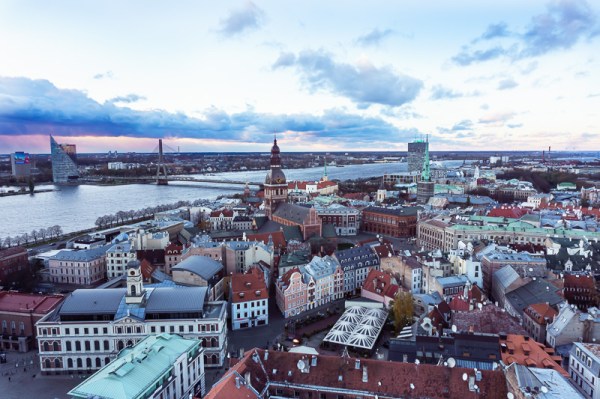
The view from St Peter’s church spire


Orthodox Cathedral
What to see and do in Riga
I leave my room to go down for breakfast but change my mind after taking a peak behind a curtain at the end of the corridor. Golden sunlight is catching the top of the curlicues and flooding the architectural details with light and shadow. In my excitement to get out on the streets I drop my glasses twice and almost leave my scarf behind. It’s needed as I emerge into the frosty morning, where rather cross looking women are sweeping leaves in the park. The small river through the park dances with fallen foliage drifting in the rays peeping round the corner of the Opera House.
Riga is a walker’s city, the old town a mass of intriguing alleyways that open out into squares lined with a jumble of historic architecture. Equipped with fake fur hat, warm coat and sturdy boots – blending seamlessly in with the locals – the short stroll beneath the underpass to Riga Central market is a doddle. The cobbles give way to parks in great swathes of the city and getting to the main art gallery and Art Nouveau area is around 25 minutes from our hotel, mainly via tree-lined paths (Bastion Hill or Bastejkalns and Kronvalda), taking in the gleaming gold domes of The Nativity of Christ Cathedral, the largest Russian orthodox church in the Baltics, en route.
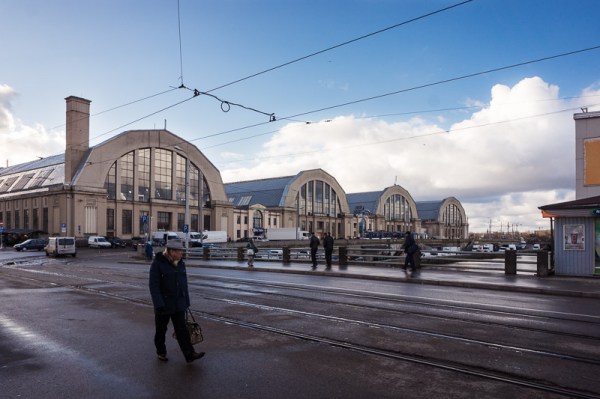
Domed pavilions of the central market in Riga (old zeppelin hangars)


Riga Central market
The domes of these former Zeppelin hangers can be glimpsed from any elevated position and this UNESCO world heritage site lures me, and my travelling companion T, there twice in as many days due to the edible treasures inside. Each hanger is dedicated to a theme and, after admiring piles of jewel-like cranberries on the stalls outside we dive into the meat area. Vegetarians or the slightly squeamish beware, the volume and variety of flesh is quite astounding. The cuts are arranged neatly in refrigerated cabinets on each sparklingly clean stall or in larger hunks from hooks. That Latvians are very keen on pork is evident, with nose to tail eating demonstrated by the produce available from conventional cuts to pig’s noses, livers and windpipes. The reaction to our cameras is very mixed with one man miming what he’ll do to us with a knife when we train our lenses on a pile of chops. It’s disconcerting but made up for by the friendliness of some other stall holders.
The dairy section is predominantly chiller cabinets of plastic wrapped cheeses but with a bit of searching we discover a more artisanal stall. We’re after the famous Latvian fresh cheese with caraway which used to be made specially for Jāņi, the summer solstice celebrations, but is now available all year round. There’s little hard cheese, but an abundance of pillowy yellow curd cheese, kefir and sour cream.


We inhale lungfuls of dill when walking into the pickle hanger while our eyes adjust to jar upon jar of colours and shapes suspended in brine or vinegar. The most prevalent are green knobbly cucumbers in all sizes, garlic – slightly pink and ghostly, substantial funghi and piles of sauerkraut, but the ingenious Latvian will pickle anything it seems.
We leave the fish hanger until last, with slight trepidation about what it might smell like, but this is foundless and instead we marvel at acres of roe, herring and a lot of river fish as well as those from the nearby sea including alarmingly spiky black sturgeon.
In the outside corridors the fruit and veg stalls are a joy to behold with rich pickings for people who love admiring very, fresh produce (both hands up here). Most of the goods are local or from the immediate region and cranberries, pomegranates and persimmons are all in abundance. There is so much that tempts me especially the foraged mushrooms and some interesting red berries that we later discover are hawthorn (or buckthorn). I have no room in my bag due to the 1 1/2 kilo loaf of rye bread I’m lugging with me, bought from a friendly stall holder in an apron who is immediately christened ‘bread man’.
There are warnings on the official website for the market to ‘beware of cut-purses’ and there have been darker days in the history of the place (including rats, which are very much long gone). The attitude to us as tourists is fairly disinterested. Many people are jovial, welcoming and offer us tastes of their produce. Others are astonishingly rude – which adds spice to our market going adventure.
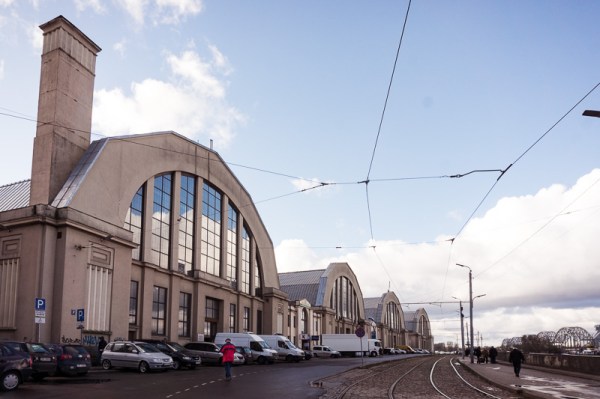
Central market
Spikeri Art District, Riga Ghetto and Latvian Holocaust Museum, and Stalin’s birthday cake
We wander on from the market, lured by some attractive brick buildings. The old warehouses in the Spikeri district have been restored with the help of a generous EU grant to foster the artistic community. Unfortunately artisanal businesses are thin on the ground, we spot a cafe and a theatre (closed in the morning) among the other rather random commercial concerns (hairdresser furniture supplies).
The Riga Ghetto and Latvian Holocaust museum is sited at the far end. Free to enter (donations encouraged) it documents the part that Riga played in the journey to the concentration camps while the city was under occupation by Nazi Germany. Synagogues were burned, and Jews from Latvia were forced by the occupiers into the ghetto, to be joined by transported Jews from other lands.
The focus in the courtyard is a single black railway truck, some photographs of the inhabitants and a vast wall of names (plus indoor exhibits such as a reconstructed flat from that period of history). We leave, sombre, at the enormity of man’s cruelty to man.
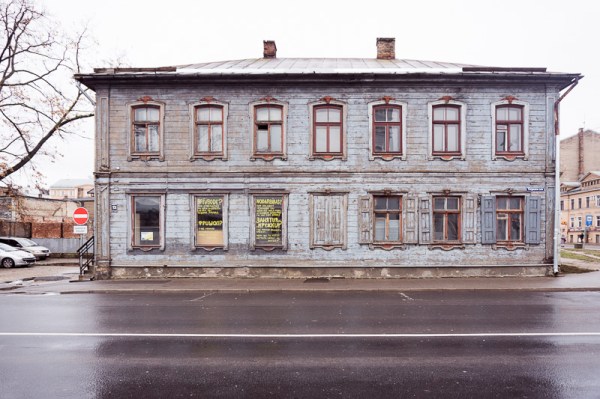
A passer by was astonished that we found this beautiful enough to photograph


A short walk round the corner, past some aesthetically distressed old wooden buildings with carved shutters, is the Latvian Academy of Sciences. Built in the 1950’s under the infamous former dictator, adorned with hammers and sickles and intended to empower the farming community he claimed to champion, it is nicknamed Stalin’s birthday cake. You can take a lift to the top to an observation deck for an alternative panoramic view – but unfortunately we have run out of Euros and they don’t take cards.
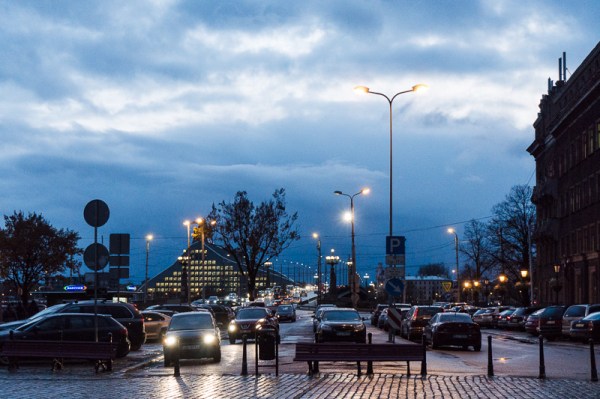
A view across the river to ‘The Castle of Light’ the national library
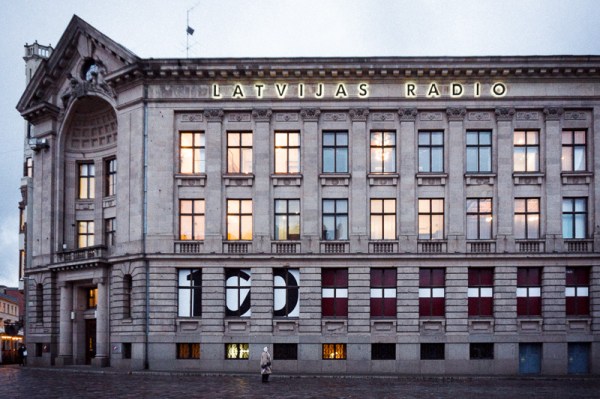
Latvijas Radio – the national radio station of Latvia in Riga
St Peters Church
The spire of St Peters church is a constant as our navigation point when winding through the streets of old Riga. Ducking inside and dwarfed by the towering atrium, we pass one of the six roosters that have been used as weather vanes over the centuries since the first construction in the 1500s. All have been blown down by high winds (there’s a clue here). Steps give way to a creaky old lift as the way to the top. The lift lady sits in her cosy cubby hole reading her book as we huddle around for our ascent. The cold wind, as we are disgorged onto the cage platform, is as breathtaking as the view over the river, sea and beyond. One of the meanings attributed to the name Riga is ‘river with curves and bends’. For most of its history Riga was on only one side of the river with the other bank used for summer homes and agriculture. The more modern side of the city is established there now and the focal point is the central library, a really beautiful triangular-shaped contemporary building, the Castle of Light, designed by Gunnar Birkerts. The former press centre, a derelict, asbestos-riddled concrete tower block is a blot on the landscape towards the sea and port; due to be torn down, some rare seagull nests prevent its demolition.
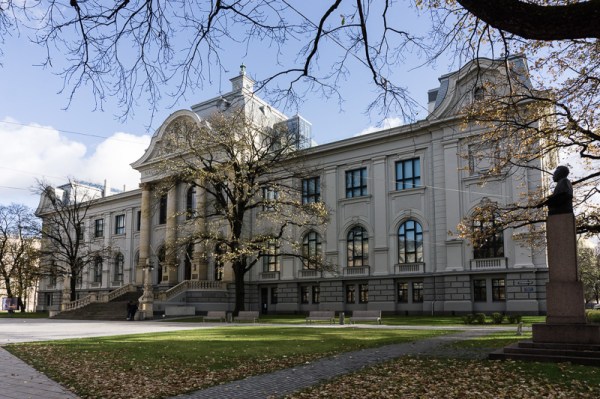
The Latvian National Museum of Art
Latvian National Museum of Art
This neo-classical building is elegant and imposing on the edge of the park and well worth a visit for the light filled atrium alone. There’s a group of school children, with their kindly looking teacher, filling in sheets of paper with enthusiasm as they explore the airy rooms, their feet soft on the floorboards. I take the lift to the top and make my way down.
The national collection was plundered and standardised during Soviet times, but the Latvians have reclaimed their own artistic integrity. Rather brilliantly curated, it tells the story of art under conflict and oppression, including some impressive post-Modernism, artists reinterpreting the brutal Soviet style after independence and experimental installations. My paths keep crossing with an old gentleman holding onto the hand of a very small girl dressed in red who I take to be his granddaughter.
The classical lines of the building are complimented by imaginative renovations – transparent floors, a bronze staircase and a polished concrete basement which treats the art storage area as an artwork in itself. I look up through the glass roof to see Grandfather and child peering down.

Upstairs in the beautiful entrance hall of the gallery


Art Nouveau area
As our first introduction was rather tornado-like, in all senses, we set off once more for the Art Nouveau district around Elizabetes iela (street) for a more leisurely look at structures adorned with romanticised women, mythical creatures and carvings inspired by natural forms. The concentration of more than 800 buildings in this style is due to an economic boom which coincided with the popularity of this school of design. There’s a coherent look which adds the beauty as about half of the buildings were designed by Russian architect Mikhail Eisenstein. The Riga Art Nouveau Museum is housed in an imposing corner property, encrusted with reliefs, topped with a terracotta tower and designed by Konstantīns Pēkšēns, a Latvian architect who was also a driving force (and lived there for a time).
The elegance and ingenuity of the designs lead to a crick in the neck and full camera. It transpires that late Autumn is the best time to visit as the full splendour of the facades are revealed through tree branches bare of their leaves. I challenge even the most staunch defender of modern architecture not to be a little nostalgic wandering these streets. If you only have time for one then Alberta iela is the most rewarding in a labyrinth of treasures.

On Elizabetes street. Designed by Eisenstein and then finished by Konstantīns Pēkšens


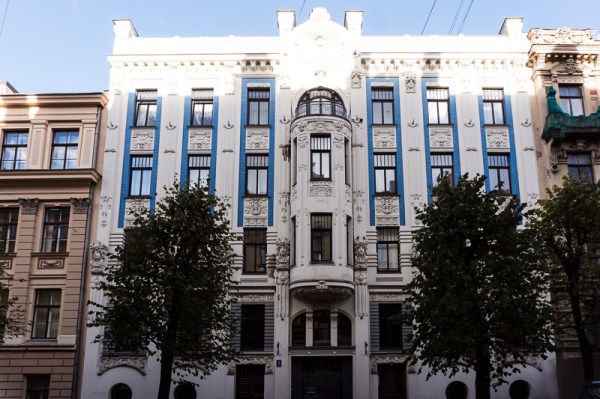
building designed by Mikhail Eisenstein


Freedom monument
Although statues and sculptures abound in this small city (640,000 inhabitants), the one we pass most often is The Freedom monument at its heart. The sheer scale of this slender structure draws the eye (at 42 metres high), plus the way it catches the light and changes mood, but also for its poignancy. It depicts many aspects of Latvian history and is topped with a copper figure of Liberty, her arms stretched above her head holding three gilded stars. Unveiled in 1935 as a memorial to the soldiers killed during the Latvian war of Independence, the symbolism was re-appropriated under Soviet rule and somehow escaped planned demolition. Reverence, such as the laying of flowers, was strictly forbidden during this time but it was a gathering point for national rallies which eventually led to national independence in 1990. Flowers are once more laid in the square.
We were unable to see Riga’s striking ‘House of the Black Heads‘ due to extensive renovations where scaffolding shrouded the exterior. Its history dates from 1344, it was completely demolished by the Soviets in the 1940s, and a replica built in the 1990s. Visitors have been admitted recently.


Eating and drinking in Riga
When we ask our guide about Latvian food she is a bit vague. Traditional carb and meat-heavy peasant food still gets the locals through the cold of the winter. Many of their dishes are common to the Baltics and a distinct food culture is hard to pin down. Added to this is the impressive way Latvians have embraced the new, and finding really excellent restaurants that would be at home in any European capital is a breeze.
Vegetarians might struggle in the traditional restaurants as the Latvians love their meat including bison, venison and, particularly, pork – served in satisfying stews and fashioned into meatballs. Don’t be put off by the name ‘grey peas‘. We pass up the opportunity to try this dish of slowly cooked pulses with bacon and herbs until our last night and enjoy every savoury, salty, comforting forkful.
Local beers are taken very seriously, and the colours of blond and dark ales gleam like jewels in a glass, brewed without commercial preservatives in nearby micro-breweries. Choose the ones on draft as natural brewing methods mean they won’t survive in a bottle for long.


Balsam (or Balzam) is a local, herbal spirit which has been endowed with miraculous restorative properties ever since Empress Catherine the Great of Russia was cured from illness after drinking it on a trip to Latvia. We step into a small shop dedicated to the stuff, but the recipe, which involves steeping scores of herbs, plants and natural ingredients in vodka housed in oak barrels, is a closely guarded secret. The popularity might be down to the warming effect produced after sipping it (I couldn’t take more than a small mouthful). Riga Black Balsam cherry is a new variety.
Deliciously dense rye bread with the flavour of caraway seeds is served at every meal we went to. It’s so delicious that my suitcase home contains a brick of a loaf from ‘bread man’ in the central market. At our hotel, Sklandrausis is offered at breakfast; a rye pastry tart filled with cooked carrot, honey and sour cream, it was given ‘Traditional Speciality Guaranteed’ status by the European Union.
As mentioned above, Kimenu siers, a soft cheese with caraway seeds is traditional at summer solstice and dairy produce a big part of the diet due to the abundant lush countryside. Keffir-making (kvass or fermented milk) is very much part of the culture. The Latvians are pickling mad and I brought back some fiery horseradish from a frankly mind-boggling range. Herring was part of our breakfast buffet every day. Fresh and cured fish from its coastline on the Baltic is a common staple as is fresh water fish from the 1200 rivers and 6000 lakes in Latvia. Local honey is prized, as are strawberries in season.


Village tea is a collection of herbs which varies according to the location. Often with chamomile or raspberry leaves, it’s calming and refreshing. I’m rationing the single packet I brought back wishing I had more.


Where to eat in Riga
Rocket Bean Coffee House – Seriously good coffee and a laid back (dare I say hipster) vibe with local, organic roots (there was veg for sale by the counter). Our lunch would not have been out of place in a much smarter place but served casually in a relaxed environment. Between us we had carrot, ginger and coconut soup with toasted black rice and mushroom purée with IBP beef ribs celery and carrot (there was parsnip too). This was my introduction to Latvian village tea – mix of herbs from rural villages – some of the most complex and refreshing herbal tea I’ve tasted, which I loved.


Amber Way Wild Game and Fish restaurant -Taverna pie Sena Dzintara Cela – this is a quirky little place down in a basement where a fish theme is taken to extremes. The waiting staff are dressed as sailors, there is a live goldfish in a bowl on each table and the bill is presented in the jaws of large fish head skeleton. It all sounds a bit Disney but it’s haphazard and rustic enough to feel comfortable not cartoon-like. The service was excellent, the food down to earth and tasty.


Black Magic – Chilly temperatures and a facade that looked straight out of Harry Potter led us into this wood panelled cafe for a drink prior to lunch. The hot chocolate is legendary so that’s what we ordered. Hot milk in a glass accompanied by real chocolate on a stick for stirring into it. Worth a visit for the interiors alone (and to buy Balsam).


Muusu – Proof that Riga has a sophisticated and contemporary dining scene. Diffused light glowed from the conservatory style windows into the modern, chic interior. I could have stuck a pin in the menu as everything was appealing but eventually ordered salad, duck breast, and a perfect pear tart for a long, relaxing lunch. The service was excellent; good wine served by the glass too. I’d return to eat at this light, airy restaurant at the drop of a hat.


Folkkluba ala pagrabs – Our last evening before heading home so we wandered along a few streets to one of the places famed for Latvian ale. Descending to the basement, the scene greeting us was a bit overwhelming with every table full and a crowd around the bar. “Just find a space” said the waiter, so spotting a bench at a table opposite a couple, all three of us sat side by side across from strangers. We all fancied the meatballs and at the last minute I ordered the traditional but unappealingly named “grey peas”. A type of pulse cooked with bacon, they were the star of the show. Reluctantly we tore ourselves away from the convivial atmosphere to go to the airport.


Bergs – We probably didn’t do the many courses of fine dining justice on our first night in Riga as we were all rather tired by then due to the time difference. If you like a more formal setting and beautifully plated food with fine wines this is for you. Impeccable service and a chef enthusiastically dedicated to his art. For my tastes, some of the flavour combinations were a little experimental. The restaurant is inside a boutique hotel based in an historic building which was home to Bergs Bazaar.


Staying in Riga
We stayed at The Kempinski which is ideally placed for forays around the old town. It’s the only 5 star hotel right in the centre and is adjacent to the splendid opera house. There’s an old world glamour, despite many reincarnations and its recent facelift. Think marble bathrooms, white fluffy bath robes, old-fashioned writing desks (with discreet power points), the most attentive, friendly staff and you get the picture. After a day pounding the cobbled streets we punch the brass fittings in the lift and descend to the basement to be restored by the spa. I alternate between a sauna (there are three), rain forest shower (I choose summer mist but the four seasons version is dramatic, complete with thunder and lightning) and the pool. There are heated beds, hammam and steam room, and a cascade of ice to dip your hands into for brisk refreshment.

Kempinski Riga Latvia

My bedroom – Kempinski Riga Latvia



The Kempinski Riga Latvia
Travelling to Riga
When I was invited to a ribbon cutting ceremony for the inaugural Air Baltic flight to Riga from Abu Dhabi my head was filled with the vision of a gleaming new plane wrapped in a huge ribbon. It would be severed by gigantic scissors with smiling air crew in serried rows (a bit of La la Land choreography creeps in here), so we could sashay into the cabin.
The reality was a ceremony inside the airport where the H.E. Astra Kurme, Latvian Ambassador to the UAE, and the UAE Ambassador to the Republic of Latvia, H.E. Hanan al Aleeli cut a somewhat smaller symbolic ribbon. It was no less exciting, and an honour, to be boarding the first direct Air Baltic flight to Riga and we were soon settled into our seats and airborne for the 6 hour 15 minute flight.


Air Baltic is a low-cost airline and even business class doesn’t have screens or sockets for charging phones etc. The staff are charming and the flight time just at the limit of what I’d consider for a short break. We stay for two nights and given the contrast with the still steamy temperatures in the UAE, it’s really restorative.
Useful links: Enjoy Latvia, Live Riga (ask for excellent guide Gita Vigule), Kempinski Riga, Air Baltic, Bergs restaurant, Black Magic, Rocket Bean Coffee House, Amber Way Wild Game and Fish restaurant, Muusu, Folkkluba ala pagrabs, Latvian National Museum of Art, Latvian National Costumes, guide to Latvian beer.
Reasons to visit Riga
In a nutshell Riga is a delightful city with lots of history and tradition, beautiful green spaces, clean streets and a wealth of excellent restaurants from hearty traditional to contemporary. It has embraced its place in Europe and, once the initial influx of stag party tourists moved on, transitioned to a welcoming place for visitors who like culture and comfort. It’s worth going for the Art Nouveau architecture alone. Visiting at the beginning of winter was a refreshing change from the temperatures of the UAE – it was fun to wrap up warm and see the buildings bathed in gentle, golden sunlight. The turbulent past seems to weigh less heavily than some other former Soviet Union states (like Bucharest) and, apart from the odd very grumpy market traders, the Latvians we met were very genial. It’s a walker’s city, compact enough to explore most places on foot and stroll pleasantly through the many parks. In addition, there are many beautiful places in the countryside that you can drive to on a longer visit. I’d love to return when the weather is balmy and taste their famous summer strawberries.
I travelled to Riga at the end of October 2017 as a guest of Air Baltic in partnership with Riga and the Kempinski.
My eight year blog anniversary, popular posts and what’s next

My blog posts are like buses these days; you wait for ever and then two come at once. And the thing I hear ALL the time about the key to a successful blog is consistency. To keep turning up.
So I’m going to forgive myself for being a bit haphazard in my posting schedule and pat myself on the back for creating and publishing in this little space for eight whole years today. Eight years I kept turning up (if sometimes a bit erratically).
And to say thank you to you. For turning up too.
How it started
Eight years ago I was at a crossroads, between jobs, reassessing my career, and training for a charity challenge, blogging about it, loving it. On a whim, inspired by other food blogs I was reading, I hurriedly set up another wordpress.com blog and My Custard Pie winged its way into the blogosphere.
Rewind even further, my first venture online was to create a ‘family website’ on the, now defunct, Yahoo Geocities (circa 2003?). There were some the girls’ paintings (I was a proud Mum), some travel stories and a few recipes. I had to learn html in those days and resizing images was a real faff. I posted a gif of a cracking egg thinking I was so cool. When I shared the link with friends and family, one person’s response was “Sally, you need to get a life”!
Little did I know that this would become such a key part of my life and the journey I’ve followed due to my adventures online was something I could never have imagined.
And back then, I entered the world of blogging to share my passions to a few people somewhere out there in the ether. No Facebook pages, no Instagram, no Pinterest, no monetisation, no sponsorship, no distractions! The new bloggers of today have the promise of so much potential it must feel daunting at the same time, it’s a privilege to have started in such simple times.

With Georgio – always a great chat about food provenance
How this blog has changed my life
Community: You! I’ve met some incredible people all over the world both online and off – and the friends I’ve made in Dubai have changed how I view and live in this city irrevocably.
The food and drink I’ve tasted: from a vile worm that lives in bark in the Philippines, sheep’s brains, the finest caviar, a £300 cocktail, raviolo filled with a soft egg yolk, incredible sushi, phenomenal feasts (Georgian supras being the pinnacle) and so much more. My taste buds have been blown and my food knowledge expanded (to the same degree as my waistline).
Exploring the world: I’ve been called an enthusiastic traveller on more than one occasion and this blog has enabled me to be just that. It started my love affair with Georgia too…
Meeting the famous: while this isn’t something I ever wished for or sought out, I seem to have met (and sometimes cooked with) a rather long list of well-known chefs including Nobu, Jason Atherton, Tom Aikens, Gary Rhodes, Ed Bains, Madhur Jaffrey, Athul Kochar and Thomas Keller to name a few. Diana Henry, the acclaimed food writer and Georgio Locatelli are the ones I value most for their integrity, charm and skill as well as their wonderful food, of course.
Learning from the best: I’ve honed the craft of writing and photography (and I’m still on that journey) with workshops from people at the pinnacle of their game including Dianne Jacob, Ellen Silverman and Matt Armendariz to name just a few.
My career: while I don’t earn an income from this blog or my social media channels, it’s acted as my shop window. It demonstrates that I understand the strategy and implementation of digital in a way that my marketing communications CV couldn’t achieve alone, giving my clients confidence that I can advise and create content for their platforms. It’s also opened the door to writing for other sites and publications. Keeping updated on the ever-changing online world benefits my blog, my clients and my own personal development.

The next step for My Custard Pie
So what next? Blogging and all the things that go with it takes a huge commitment in terms of time and energy, especially that hungry monster Instagram. Over the last year, I feel that I’ve not spent enough time here, connecting with you my precious audience. I’d like to shake things up and share the gazillions of ideas, recipes, stories, images, experiences and learnings that are in my head (and unpublished in my drafts) especially on topics you have particularly requested or responded to.
What would you like?
I’d love to know where to put my energies in the coming year and appreciate your feedback. Would you spare 3 minutes of your time to fill in a survey?
Fill in the mycustardpie blog survey here.
The comments section is also a great place to have a conversation with too if you’d like to raise something.
A regular serving of custard
I still subscribe to a whole range of newsletters and email updates even though my inbox is a bit (OK a lot) overwhelmed. There’s some wonderful information, writing, tips, stories and inspiration out there and an email makes sure I don’t miss it. I’d love to do the same for you with a regular update in your inbox.
Based on my ideas and your feedback they’ll be some things I only send to my email list that are a bit special which I think you’ll enjoy.
Subscribe here (and unsubscribe at any point). Sign up for a slice of my custard pie.
Note: you will continue to receive every blog post in your inbox if you already do so via WordPress.


Most popular posts
These are consistently the top most visited posts. If I followed a lot of blog advice, I’d niche down and become a ‘guide to Dubai’ blog. However, there’s no chance of that with so many other interesting things in the world!
Where to take visitors to eat in Dubai – on a budget
Visiting the Sulphur Baths in Tbilisi
Visiting Dubai? Top tips on what to do before you travel
My most popular recipe is:
Tomato, lentil and spinach lasagne
Thank you
And that’s it really. A diving board back into these uncharted waters that change constantly. A journey of life and the internet; I’m so glad to have you with me.
Here’s to 2018 and beyond.
What is Blogtacular and why you should attend

When I step out of my front door, Hazel on lead, and check the podcast app, my heart gives a little leap of excitement when I see a new Blogtacular episode. I’m not sure how I discovered it but from first listen I was hooked and worked my way through the whole back catalogue. Kat Molesworth is a generous and informed interviewer who keeps a cool head and really drills down into the things I want to know. There’s no fluff or preamble, each interview is absolutely packed with learning and inspiration about this ever-changing new industry that is the blogosphere and digital world.
It was too late to plan for last year’s Blogtacular conference in London, but I followed it vicariously online. This year I literally counted the days until tickets were released and pounced on one immediately.
So why, as blogger of eight year’s standing (longer if you count other online manifestations) do I want to go to another blogging conference? Surely I should be so seasoned by now that this is superfluous?
Not at all and my view is that it’s more important than ever in this fluid sector/industry – call it what you like – to keep evolving, current and informed.
But more than that… it’s always been about community to me. Digital is not outbound, it’s about truly connecting with people whether you have a readership of 100 or 100,000. If you can strike a chord, that’s what brings rewards (however you measure this) and you have to get to know who you are connecting with to have longevity and relevance. I’m sure we can all spot influencers who just broadcast into a void with ‘look at me, look at me’. Many have big followings, often artificially inflated and their Instagram and blog comments sections feel like a wasteland.


When I first tentatively put a few words and pictures onto a page and press publish I couldn’t have predicted the journey ahead. The way it’s changed my life is through the connections I’ve made and a big part of that was meeting people in real life too. Food Blogger Connect played a huge part in this and I made so many wonderful friends there who I still meet up with now (in UK or as they stop over in Dubai).
In the past two years I’ve looked to other accounts, particularly on Instagram, to inspire and stretch my creativity and provide a meaningful focus. I’ve likened it to an online artists’ support group and I’ve reveled in following the evolution and journey of some or just looked up to those who carve out their place in the online world with wisdom and beauty.
So what is Blogtacular?
Blogtacular is a conference in the UK designed for the creative blog community, but anyone who blogs is welcome. There are a range of workshops focussed on delivering the skills and advice needed to develop your blog, whether you blog for business or fun. It’s also known for being the place to meet innovative companies who want to work with bloggers.
A friend from FBC days attended Blogtacular last year, almost by accident, and shared how impressed she was by the quality of the speakers and the community. The conference pays their speakers so it attracts a really stellar line up and values their content.
The person behind Blogtacular is a wise, informed, intelligent and erudite woman called Kat Molesworth. She combines a high level of professionalism with warmth, generosity and – very importantly – integrity. I can’t wait to meet her there (although I’m sure she’ll be mobbed!).
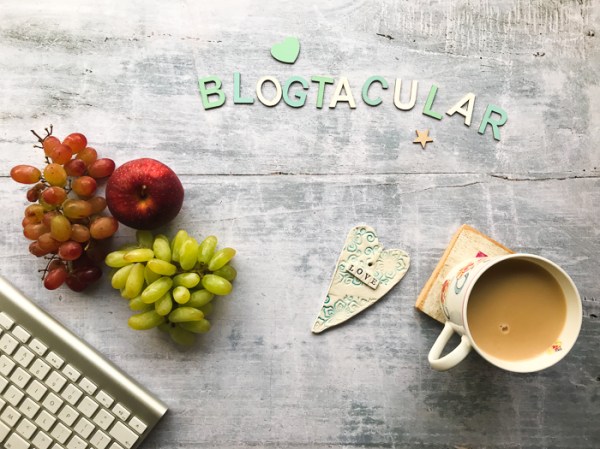
Fancy joining me at Blogtacular? Here’s the link – and if you book through it I receive a small reward (i.e. it’s an affiliate link). I’d love that to happen but would have shared this anyway. Can you tell that I’m rather excited?!! If you are reading this in the UAE or wider Middle East, it would be great to get together a posse from the region.
If you want to know more, as well as exploring the Blogtacular website, I recommend you listen to the podcast and this latest episode with Supal Desai is a great place to start as I’m guessing it will resonate and inspire many of you (as it did me).

Have you been to a blog conference? Does stepping out from behind your screen terrify you (it did me at first)? If you’re a blogger what does community mean to you? As a non-blogger does this baffle or intrigue? I’d love to hear your thoughts.
Why are 80 million people in the world still going hungry?

It’s a very unequal world we live in, where 80 million people go hungry everyday while the rest have so much food it costs an enormous sum to throw away what they don’t eat. In fact the money that it costs to dispose of unwanted food, or produce that is not able to get to people in time for them to eat it, is enough to solve the entire problem and ensure there is sufficient for everyone.
In my comfortable world of excess I thought I knew the scale of this problem. When the World Food Programme asked me to support them by posting an image of plate illustrated by a calligraphy artist on my Instagram account I didn’t hesitate – it’s a tiny gesture. But once they started to send me the information it made me realise that this is a huge issue that I know very little about.
How are they tackling this?
I’ll admit I might have been a tiny bit sceptical beforehand too. Large organisations can be very political, and the GM lobby has (inaccurately) hijacked many parts of the ‘Feed the World’ message (in other words ‘feed the bottom line’). However, once I delved deeper I realised that the World Food Programme is tackling the causes of this inequality and malnutrition on many levels with 17 Global Goals for sustainable development to improve people’s lives by 2030. Goal 2 – Zero Hunger – pledges to end hunger, achieve food security, improve nutrition and promote sustainable agriculture, and is the priority of the World Food Programme.
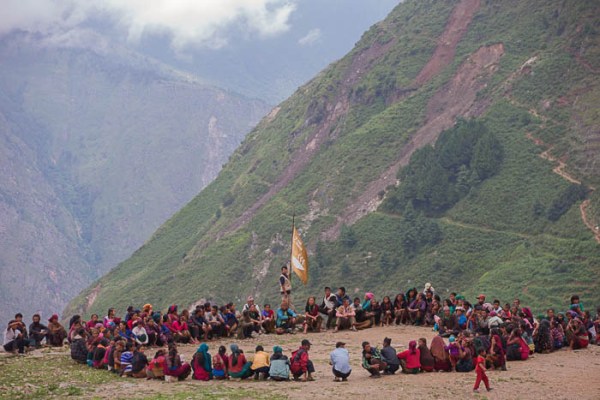
WFP officer Nimdoma Sherpa, raised a flag to represent Goal 2, Zero Hunger, in a remote mountain village in North-West Nepal. Credit: WFP/Samir Jung…
That’s my summing up but here are the words of the World Food Programme which have really hit home:
Five steps to Zero Hunger
Step 1 – Put the furthest behind first – The SDGs recognize that our world is only as strong as its weakest member and commit to leave no one behind. WFP works each and every day to save the lives of those furthest behind. Raising the purchasing power and resilience of the poorest two billion people through social protection schemes will create new demand and new jobs, and jump start local economies – thus changing those lives.
Step 2- Pave the road from farm to market – Access to affordable, nutritious food for everyone is vital. A plate of bean stew can cost a woman in South Sudan 155 percent of her daily income – the equivalent of paying hundreds of dollars in New York. By innovating and investing in supply chains, while supporting durable market development, we can make food systems work for the poorest of the poor.
Step 3 – Reduce food waste – Of the 4 billion metric tons of food we produce each year, one-third is wasted costing the global economy US$750 billion annually. In developed countries, food is wasted on the plate, while in developing countries it is wasted before it reaches the plate, when crops go unused or unprocessed because of poor storage or because farmers can’t get their produce to market.
Step 4 – Encourage a sustainable variety of crops – Today over 60 percent of all kilocalories consumed are from four staples: wheat, maize, rice and potatoes – overlooking the vast majority of the world’s quarter of a million or more edible plants. Dependence on these four crops not only puts great pressure on the planet’s resources but also dominates local markets and the nutritional value of our diets. We must support farmers in the cultivation of these crops and build the necessary consumer markets by educating communities about the importance of eating a wide range of foods.
Step 5 – Make nutrition a priority – starting with the first 1,000 days. To prevent stunting and to promote healthy development we must ensure children, pregnant women and nursing mothers have access to the foods that will enable them to eat a balanced diet, with the nutrients required to help children grow to their full potential.
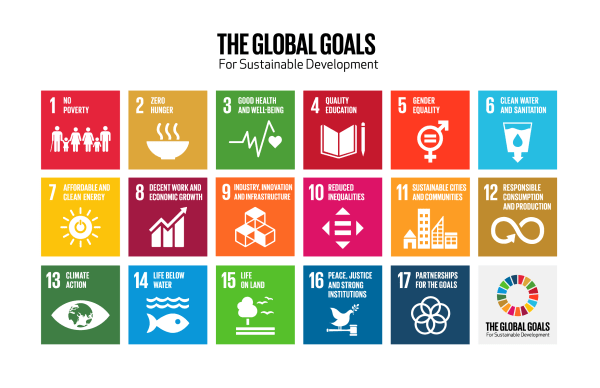
The Global Goals
The United Nations World Food Programme
The World Food Programme (WFP) is the leading humanitarian organization fighting hunger worldwide, delivering food assistance in emergencies and working with communities to improve nutrition and build resilience. Every year, they provide food assistance to 80 million people in around 80 countries.
WFP’s efforts focus on emergency assistance, relief and rehabilitation, development aid and special operations. Two-thirds of their work is in conflict-affected countries where people are three times more likely to be undernourished than those living in countries without conflict.
Their work is 100% voluntarily funded, and 93% of every contribution gets to people in need.
Ending hunger by 2030
Hunger kills more people each year than AIDS, malaria and tuberculosis combined. In a world where we produce enough food to feed everyone, 815 million people across the globe still go to bed hungry every night. To eradicate hunger by 2030 means we have to rethink how we grow, share and consume our food.
How can we help?
I’m now looking at ways to do more to help including by doing my own small bit to spread the word and cut down on food waste.
Find out what you can to on the World Food Programme website.
Please also support the awareness campaign by liking, commenting and sharing on social. Go and check out the different plates on other Instagrammer’s feeds.
Follow @WFP_MENA (on Instagram) and these hashtags #WorldFoodProgramme #WFP
Were you as shocked as I was in reading this?
Slow cooked onion tart


The problem with all the cookery shows on TV (and yes I’ll admit to being glued to every season of Masterchef) is the constant striving for reinvention and novelty. In the last series of the aforementioned cookery competition, one chef who had cooked really inviting food that you would be very happy to eat as a customer in his restaurant, was often criticised for not being adventurous or inventive enough. And don’t even get me started on Great British Bake Off (who wants to eat those things?).
What’s wrong with cooking really simple things well? When you have really good ingredients often you hardly need to do much with them anyway.
Rant over and onto the start of the year and comforting food. Even in the desert where our winters aren’t really all that cold (it was 25 C today) there’s a feeling of hunkering down and getting cosy – even if it’s after you’ve just come home from the beach. KP and I have chosen to be vegetarian during January. Actually I chose and as I do most of the cooking, that’s what we’re eating!


This onion tart is all about the simple – in cooking and in taste. Putting a few things that go well together inside a case of buttery pastry.
You’ll note that the onions take a long, long, long time to cook but they don’t need much supervising. I wrote this recipe before I read this rant about onion cooking time by the way!
You can add your own twist – the bitter, melancholy flavours of rosemary or thyme go beautifully with the sweetness of the onions, whereas bright fresh herbs add a different vibe. Stir, into the uncooked filling, a handful of grated cheddar or a softer milder cheese. Fragments of crisp bacon or spicy chorizo are other head-turners. But honestly, I take a purist line here of savouring the humble onion cooked slowly into sweet, melting submission then married with the best dairy in a crumbly case that reminds you of childhood.
A crisp, green salad is the perfect partner.


Onion tart
A simple, comforting tart made with store cupboard ingredients.
Ingredients
- 50g unsalted butter, cut into small pieces
- 100g plain flour
- pinch of sea salt
- 2 egg yolks
- 1 tablespoon water (ice cold)
- 1 tablespoon olive oil
- 4 large onions, peeled
- 4 egg yolks
- 300ml double cream
- sea salt and black pepper
Directions
- Make the pastry. Put the flour, salt and butter into a food processor and whizz to the texture of fine breadcrumbs. Add the egg yolks (I actually used 3 yolks as my eggs were very small if you have a very large egg you may only need one) and pulse the processor until the pastry starts to come together. Add the iced water through the tube while it is pulsing and process lightly until the dough starts to come together. Stop the processor and form the pastry into a ball. Wrap (in cling or cover in a bowl) and rest in the fridge for at least 30 minutes for the gluten to expand.
- Meanwhile, slice the onions finely and sauté very gently in a cast iron (or non stick) frying pan. Start them off on a higher heat and use a spatula to fold them into the oil so they are all coated and start to lose their firmness. Then turn to the lowest heat possible, stirring occasionally and until the onions are transparent and very soft. Do not let them turn darker than a very pale fawn in colour. This can take up to an hour (I often do this ahead of time in two batches).
- Grease a deep 20-21cm flan tin. Roll out the pastry very thinly and line the tin, gently folding it into the edge without stretching it. Prick the base with a fork and bake blind in an oven preheated to 180C for 15 minutes (or until lightly cooked through).
- Remove from the oven and when the tart shell has cooled a little, spread the cooked onions over the base.
- Measure the cream into a jug, add the eggs and beat together with a generous pinch of sea salt and lots of freshly ground black pepper. Pour the cream mixture over the onions, moving them a little with a fork to enable the liquid to sink right to the bottom.
- Cook in the oven for 30-40 minute, protecting the exposed edges of pastry with some strips of silver foil if they start to get too brown. Remove when the filling is lightly set and the top is starting to turn golden brown. Leave to cool a little before slicing. Serve slightly warm or at room temperature.
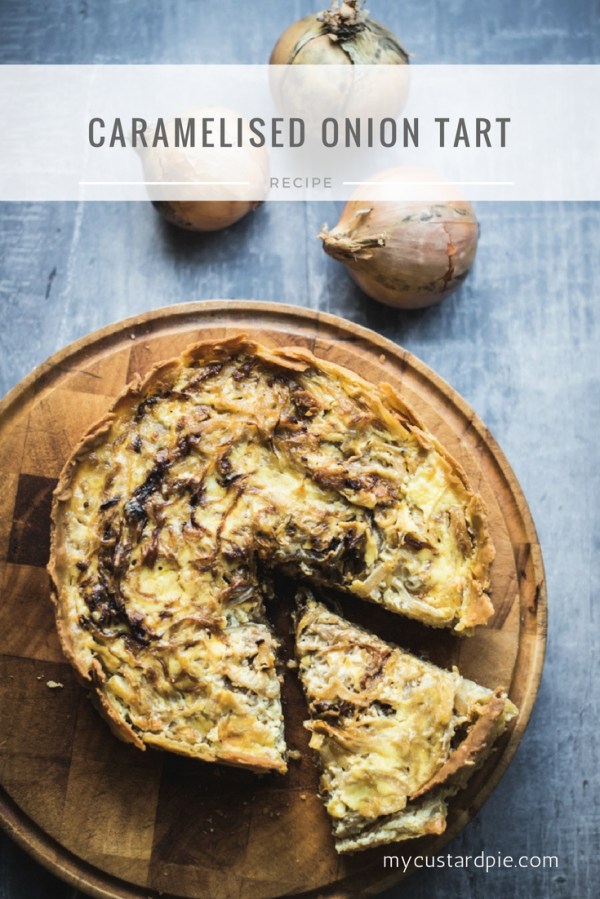
Caramelised onion tart
What simple comfort food to you turn to during the Winter?
How a photography challenge could improve your Instagram
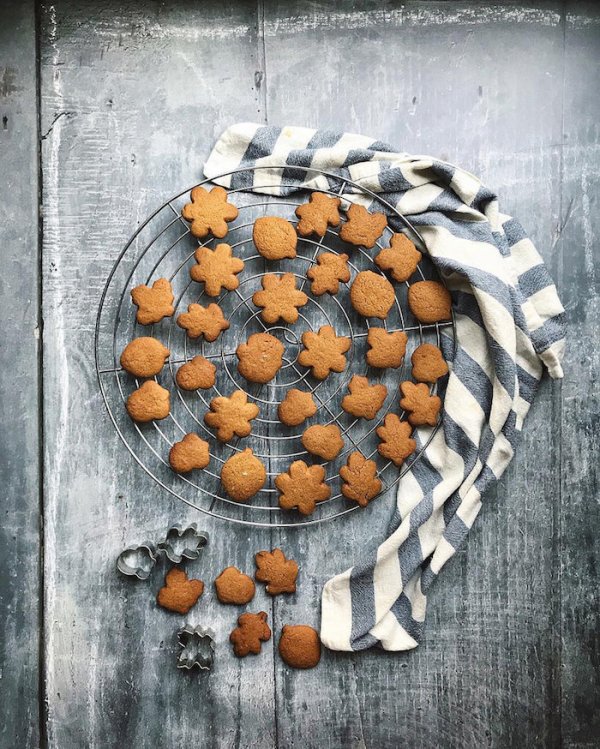
Happy New Year. Do your resolutions include ‘improving your photography’ or ‘growing your Instagram’? In fact, the two are linked. Read on for some practical advice that’s helped me this year.
I lived in Saudi Arabia for almost five years. It was a huge change in my life – newly married, quitting a high-powered job in UK, having my first baby, leaving all my friends to be behind the walls of a compound in a place where I couldn’t drive or even eat out with my husband’s colleagues if they were not with their wives and we sat in the ‘family section’. It wasn’t all bad but I did struggle a bit until I joined a drawing group led by an inspirational teacher. It eventually became an artist’s support group where we would be given a topic or a theme one week and then critique each other’s work at the following session. The focus in knowing someone else would be looking at your work, marvelling everyone else’s very different interpretation, the spur to explore more, stretch yourself, attain greater things creatively was hugely motivating. Just writing this brings back how excited I was each week at the beginning and the end of each session. A couple of the paintings I produced during that time are framed on my wall even now.


Finding creative inspiration
Staring at a blank canvas without purpose is hard. And this can apply across all creative media including when taking photographs. It can be especially tricky for Instagram. The pressures of getting your grid looking right, attracting likes and engagement can leave you like a rabbit in the headlights sometimes.
Sometimes, I’ll be on a roll and then, out of the blue, the feeling that nothing is good enough hits. It doesn’t have a point. It’s just a pretty picture.
This is where joining some sort of group or challenge comes in. Like the artists support group, it gives you a focus, a germ of idea, interaction with like-minded people who stretch your ideas of what’s possible, encourage you to stretch yourself and, hopefully, appreciate what you do.


Here are a few that have worked for me with suggestions how you can find something that works for you:
Instagram Photography Challenge by A Little Plantation
What is it?
This is a seasonal challenge run by Kimberly of A Little Plantation blog and all the images you see in this post are taken when I took part this Autumn.
How to join
You sign up on Kimberly’s blog and she will email you at the start of each week with a theme and three topics. She gives examples of some of the directions you might think of (both food and non-food). There are three dates to post on and a hashtag so you can see what everyone else creates. You also need to tag Kimberly on the image to make sure she sees it.
How it inspires
You create nine images over three weeks so that you give real consideration to how your Instagram grid looks as a cohesive whole. Once a week, Kimberly does a live Instagram session and chooses a favourite image for each prompt. She explains in detail why she thinks the image worked so well and what she liked about it. There is definitely an element of trying hard to impress your favourite teacher here! I gave a lot more thought to the planning when taking the images and considered different elements which I might not have before. I always resolved to watch the replay (as my time zone is ahead of UK) but ended up watching live several times as I just couldn’t wait to see which ones were selected. Sadly I didn’t make the hallowed few but will definitely be joining in again this January.
There is no reason why you couldn’t use the prompts if you are not on Instagram, just for general photography although you won’t get the feedback.
Things to consider
This is a free challenge with a really engaged community around it. There are a few spaces to pay for an upgrade for a one to one feedback from Kimberly (I didn’t). I found some beautiful new accounts and Instagram friends who I’ve kept in touch with. Inevitably, as Kimberly has a very definite look, it attracts a certain style of photographer, but not exclusively – and she featured some images which were totally different. You won’t see much architecture or whimsy here, but will see flatlays, dark images and whole and healthy foods. Find out more on The Little Plantation


Weekend Hashtag Project on Instagram
What is it?
A theme issued every weekend by Instagram using the #WHP hashtag.
How to join
Visit the Instagram account from Friday evening when the new Weekend Hashtag Project theme is announced. Take a photo or video over the weekend linked to the theme and add the particular WHP hashtag. As I’m writing this it is #WHPstripes . Instagram asks that people only tag photos and videos taken over that weekend to keep it original and timely and only submit your own visuals to the project. Any tagged photo or video taken over the weekend is eligible to be featured next week. If this happens you are in for a huge rush of Instagram traffic and new followers.
How it inspires
Having the discipline of coming up with a really original, striking or evocative image each week is a great place to spark new ideas and exercise your brain. Even if I don’t participate every week, I love seeing the other interpretations from people I follow (such as allthatisshe and sarah_louise_ferg) plus those around the world. It’s very interesting to see who Instagram features too as some of the images make you gasp with wonder or tug the heart-strings.
Things to consider
Like all these challenges it’s important to use the theme as a conduit for your own creativity and not be sucked into a comparison trap. The theme of this challenge gives a framework without limitations and is as much about telling a story as taking a picture.


Alphabet Challenge by Rosie Hardy
What is it?
A challenge that Rosie Hardy – sets herself by exploring a theme from each letter of the alphabet. Her whimsical images push into the realms of imagination and fantasy.
How to join?
Follow @GeorgiaRoseHardy on Instagram for her latest theme and use #rosiehardychallenge tag to join in.
How it inspires
The images are highly edited using the free software Gimp to manipulate reality. A for Adventure showed her sticking enormous map pins in a larger than life-sized wall map while her cat looked on; B for butterflies was set on a window sill with them flying over her head and perched on her hand.
If you want to learn these techniques yourself she publishes a before and after pic on her website with a detailed tutorial (15 GBP to download) for each image.
Things to consider
It’s not essential to use editing software to join in the challenge but the spirit of the themes is to stretch the imagination. I became aware of this challenge via @sarah_louise_ferg who used the things she learned from the tutorial to make her own original image to submit to WHP


Bloom and Grow (and Gloom and Glow) by Sara Tasker
What is it?
Bloom and Grow is a paid for Instagram course which lasts for four weeks with a focus on flowers but is a whole lot more. Run by Sara Tasker of meandorla.com who brings her forensic examination of why things work to the appeal of blooms and nature. She sets projects and homework through the course, and feedback within the walls of a dedicated Facebook community. She has also launched a new course called Gloom and Glow to inspire people through the gloomy, light-starved months of winter (not something I wrestle with here in Dubai).
How to join
Information and sign up on Sara’s website. It’s only open at certain times of the year (so that everyone starts the course at the same time).
How it inspires
If the course is good, I always find my commitment is unwavering if I’ve forked out some cash. Sara has a real gift for explaining how an image connects, giving you the tools through detailed information, then setting the spark for you to create your own. I found I was thinking on a different level while doing this course – and it’s something that has stayed with me. I’ve witnessed the transformative effect it had on several people’s accounts too.
Things to consider
This is a course with challenges. Don’t assume it’s a clichéd and formulaic prescriptive about flatlays and peonies; instead it’s a catalyst to harness the magic appeal of flowers and nature. As Sara says “whether you’re all-white and minimal, moody and journalistic, entirely travel-based or anything else, we’ll look at ways to weave a little floral magic into your photographs.” However, you will inevitably find some people on the course who do fall into the flowery flatlay camp. There is plenty of room for additional inspiration though.
How to join
Sign up on Sara’s website. If you want a taste of her style of teaching, you can sign up for her 7 day free course before you commit. Read my review of her ‘tell-all’ course The Insta Retreat


Hashtag challenges and themes
Instagram is awash with these, from a new theme every day to ongoing tags to unite like-minded people. The trick is to find ones that work for you, where you find something to truly inspire among a tribe of people who will root for you. Here are a few of my favourites:
- itsmyweek A new theme every week and a stunning collection of little scenes from everyday life. This is a new find for me and I love what they are doing here. Four accounts are featured at the end of each week on @itsmyweek
- #adoremycupofcoffee Elegantly inspiring for coffee devotees. Simple, restrained and Scandinavian in tone via Britt from @remainsoftheday_ who features her favourites now and again.
- #mybeautifulsimplicity This hashtag is about beautifully simple images which are full of space – it’s not about the subject matter but a certain style. They should feel calm and be free from clutter and detail according to @zoepower who features her favourites every few weeks on her feed and round ups on her blog, Beautiful Simplicity, too.
I hope these may have given you a starting point for the year if you are feeling a bit lacking in direction. Of course there are hundreds of others out there. In fact if you find something you think me and other readers might enjoy please drop me a line by email or in the comments section. Is there anything that you’ve resolved to do in 2018 to take the next step with your photography and Instagram?
What’s in season in the UAE? October guide
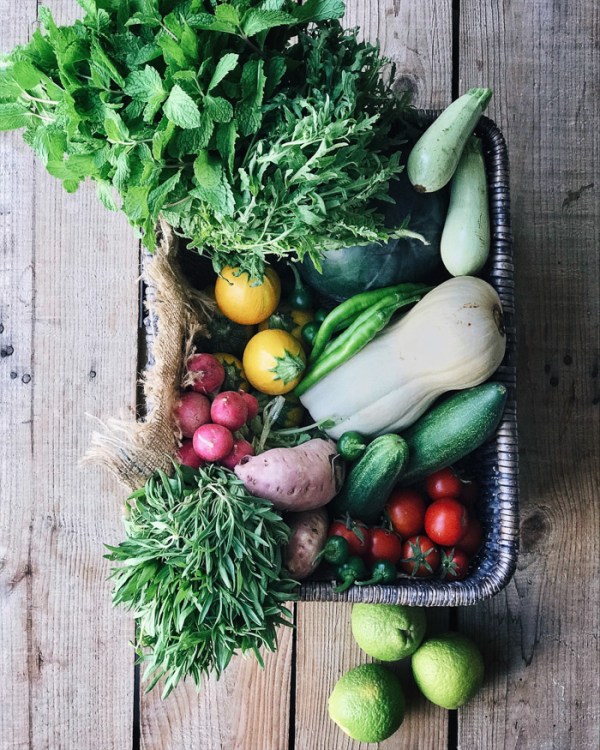
My market haul from 13th October 2017 – the first day of the new season
I do most of my weekly shop during the growing season by buying my organic vegetables direct from local farmers. Browsing each stall to see who has what, choosing the best, trying to buy a little from as many farmers as possible, striking up a conversation with the growers and other shoppers, makes the whole process a joy. Then there’s the scent of the vegetables (it’s mainly veg – just a tiny bit of local fruit), buying roots with leaves rather than a trimmed down anonymous looking balls, it’s knowing that everything was picked just a few hours earlier.
Cooking is different too – it’s helped me to be more intuitive, adaptable and adventurous in the kitchen. Cook books are there for inspiration not prescription.
The Farmers’ Market, here in Dubai, started a good six weeks earlier this year. It’s down to an increase in the number of farms growing organic produce, even though the range is a little more limited, the volume was enough to set up stalls (the temperatures were a little steamy to say the least!).
So I’ve put together a monthly guide to what’s available. It will become a memory jogger in the fallow months about what’s up coming and when. Plus I can collect together recipe suggestions to help us all when inspiration gets a little thin – including LOTS of courgette recipes!
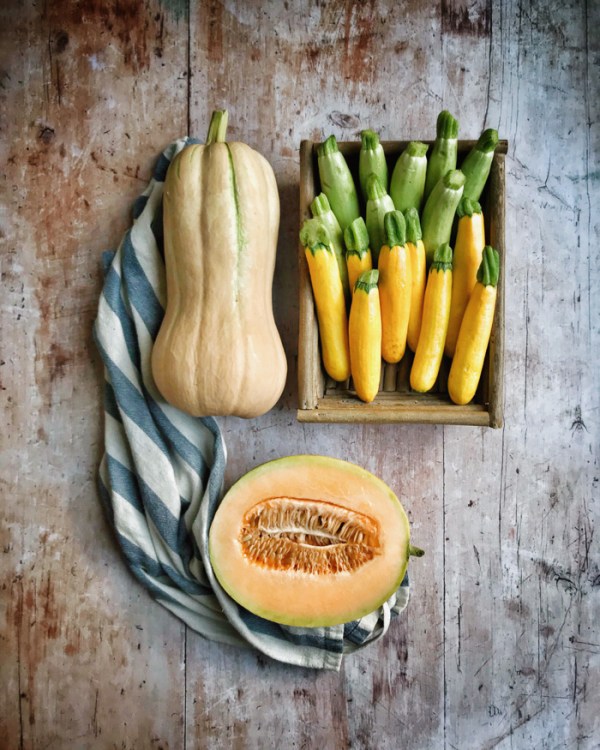
Restrained market shopping due to travel. My basket from 27th October 2017
During the early days of my blog (in 2010 can you believe?) I used to look longingly at people who were doing seasonal round-ups in their part of the world. I never imagined that it would be possible here in the United Arab Emirates.
My research for this guide has been based on the organic, local produce available at The Farmers’ Market on the Terrace in 2017 (and into 2018). You may also find some additional or different things at Greenheart as they collect seed to grow their own varieties of vegetables. For a preview, you can see what I bought for a whole season during 2014 to 2015 on this post.
Farming in the desert has immense challenges and seasonal often means protecting things from nature as well as working in harmony. Being able to buy organic produce that has been picked a few hours before is a huge privilege. If you are reading this from another part of the world you might be surprised at what is grown and pick up some ideas for your own local produce too.
Vegetables and fruit in season in the UAE during October
Click on an image to enlarge and browse the gallery. All taken during October 2017.


Vegetables in bold link to recipes
- Amaranth – used throughout Asia and parts of Africa, good for stir frying
- Aubergine – or eggplant. Not abundant during this month and only purple available.
- Basil – strongly scented variety with thick stalks
- Beetroot – the first beetroot of the month has tough skin, not abundant
- Broccoli – very little broccoli available and fairly dry in texture (wait until November)
- Butternut squash – beautiful butternut squash with very fragrant, sweet flesh available
- Chillies – from small, round and green to a few long and red. Chillies are abundant and fiery
- Chinese red spinach – you may spot this variety of spinach with attractive red splashes on the leaves
- Coriander – fresh coriander is abundant by the end of the month
- Courgette – available in small green, long yellow, dark green (probably a variety of summer squash rather than a true courgette) and round yellow and green which are great for stuffing. Also called kousa
- Cucumber – two different types available, one with a speckled thick peel and juicy pale flesh
- Dates – dried dates from the farms are on many stalls
- Dill – bunches of leafy dill are there from the beginning. Good for pickling seasoning
- Fenugreek – such pretty leaves, good in curries (also known as methi)
- Kale – starts to become more abundant by the end of the month
- Limes – small limes are more like lemons in taste. Not overly juicy but very fresh tasting
- Melon – orange and white fleshed melons available. Not extremely sweet but refreshing. Good with a touch of raw honey (from the Balqees stall)
- Mint – vigorous and fragrant from the first market. Stems can be tough at this time of year
- Moringa – leafy branches on some stalls, fresh and green (used in curries)
- Molokhia – very seasonal, it disappears by November. Used a bit like spinach and adored by many for its slimy quality when cooked.
- Okra – green okra available
- Oranges – a few local ones on the stalls, green peel mainly
- Parsley – local flat leafed variety fairly abundant
- Peppers – a few green and the odd red one. Not peak season
- Pumpkin – one or two stalls had green skinned, sizeable pumpkins
- Radish – good crunchy peppery bunches on several stalls
- Rocket/ Roka (salad or garden rocket, arugula, rucola, gerger) – the flat-leaved, salad-type is abundant
- Spinach – very similar in look to the rocket. Make sure you ask the farmer or look for pointy leaves
- Spring onions – a couple of stalls have nice, fresh crunchy bunches
- Sweetcorn – a few make an appearance in the last week in October
- Sweet potato – a few early ones both pink and white on one or two stalls
- Tarragon – a few stalls have beautiful bunches throughout the month
- Tomatoes – a scant few with little flavour in October
- Watermelon – not particularly sweet but refreshing
- Wild rocket – one or two stalls have this but it’s a bit wiry at this time of year


My Arabian Almanakh
Another thing I brought home from the market was a beautiful gardening resource and planner, My Arabian Almanakh. It acts as a guide to the unique growing conditions in this country and wider region, and has a wealth of tips and information to help people work with nature to grow a whole range of edible plants. There are spaces for notes and planting records for every month plus a guide to each season. There are delightful illustrations throughout. Whether you have a window box or a large patch this is a resource to treasure and will act as a record for years. The people behind it are Laura Allais Maré who founded Slow Food Dubai, Cherida Fernandez who illustrated the book, Leilani Coughlan and Prachiti Talathi Gandhi. Their ethos is to work with nature, not against it, and they published the book to teach and share knowledge about regenerative gardening.
Available at the market – more info on My Arabian Almanakh Facebook page
Delighted to be quoted in The National in their article about markets in Dubai.
Do let me know if you found this useful. If you shopped locally this month, what were the highlights and what did you cook with it?






 My Custard Pie