Three days in Syria

Streets of old Damascus
“Where are you from?” This question was put to us again and again during our three days in Syria in 2007. It finally got a little wearing but we couldn’t get annoyed as it was asked by people in a spirit appreciation that we had visited their country mixed with national pride. Three women over a certain age traveling alone did elicit curiosity. Were we teachers or nurses? Where were we from? – that question again! We did get a sense that our journey was being monitored through odd things that happened; our hotel booking was denied completely in Palmyra and then after rapid phone calls and shifty looks we were suddenly whisked off to rooms that had never been used before; I was detained in a back room at the airport for in-depth passport inspection; sometimes you couldn’t put your finger on it but the sense of authority was there. But throughout our time the warmth of the welcome was genuine from the people on the street and we felt safe at all times, even when walking late at night through small unlit lanes in old Damascus and encountering large groups of young men.

Friday night at the souk in Damascus
We had arrived on a Friday afternoon and drove from the airport past ramshackle modern buildings, crumbling French period architecture and finally into dark narrow lanes, barely wide enough for a car, to the restored old Damascene house, Dar al-Yasmin, now a boutique hotel, which was our resting place for the night.
As we stumbled out into the old city, the sun was lowering, the narrow streets thronging with people all intent on visiting the souk on a Friday night – its busiest evening. Power cables, like vines in the jungle, drooped in twisted arcs above our heads; apart from these and the electric light it felt like little had changed since Medieval times. I had an attack of the giggles as instructed to don shapeless brown robes with hoods before entering the Umayyad mosque, I thought of the mad monk from the Da Vinci Code. On our return to the souk we had glimpses into steamy tiled hammams and ducked into courtyards at random, exploring a wood-paneled library and getting a fantastic view of the illuminated mosque. Back to the market – an area for wooden kitchen implements gave way to shops with piles of knobbly hand-made soaps, then a street entirely devoted to perfume. Dried fruit, wedding attire, a lane of bras and masses of jewellery – we lost all sense of direction and wandered with the crowd through tiny alleyways until stalls packed up, shops closed their shutters and the streets became dark and still.

Palmyra
After a breakfast of labneh, olives, fruit and bread in the tiled courtyard of our hotel we met our driver. A trip to Palmyra had been a dream ever since reading A Scandalous Life: the biography of Jane Digby by Mary Lovell. As the only car for miles on a lonely road through barren desert fringed with hills, the vulnerability of people taking the journey of old became vividly clear. The courage and endurance needed by Lady Jane Digby was incredible as she led caravans of camels and travellers for seven days through this bleak landscape where marauding bandits were both real and probable. Luckily for us, it took just over two hours by car and, bypassing the huge tourist hotel on the outskirts, and negotiating the slightly strange reception at our the Hotel Villa Palmyra (including someone using a pneumatic drill in the middle of the foyer floor) we set off for the Roman ruins. The desert haze could not mar the beauty of these golden stones and splendour of the extensive site – one of the most important cultural centres of the ancient world during the 1st and 2nd centuries.

Krak des Chevaliers
Leaving the heat of the desert the next day, we drove through miles of fields and small holdings, every inch planted with fruit and vegetables. The road climbed, the clouds drew in and we were nearly knocked off our feet by the strong, cold wind as we entered Krak des Chevaliers, a crusader fort overlooking the border into Lebanon. A large party of school children and women plus the odd camel were milling around the entrance and they seemed to find our appearance incredibly amusing indicated by much pointing and laughing. It’s extraordinary how this vast medieval castle is so well-preserved as it dates from around 1140 and has survived a succession of different occupiers and an earthquake. As I admired the framed view across into Northern Lebanon through a Medieval window frame, I didn’t imagine that a few years later I would be gazing in the other direction while on my charity trek.

Maalula
My traveling companions both started dozing during the next leg of the journey and I was tempted to shake them awake as the modern highway flanked mountains that a geologist would have loved, barren, layered and multi-coloured. Maalula was nestled on a high plateau between two peaks, a small town with a monastery where the inhabitants still speak Aramaic (the language Jesus spoke). The church of St Sergius was a small, still, peaceful jewel filled with very old icons (and thought to be the oldest chapel in the world).
Completing the triangle we drove back to Damascus and luxuriated in the crisp, white sheets and the most comfortable beds in the world at the Four Seasons (not budget but a considerably lower rate than in other cities) before flying home the next day. Syrian currency is not allowed out of the country so I suggested that we make the taxi driver’s day by giving him a huge tip with the rest of our money. The unexpected departure tax was therefore a very annoying thing to encounter!
Piecing this trip together from my memory and recording it after five years has been motivated by recent shocking and heart-rending events in Syria.
New wines for old…
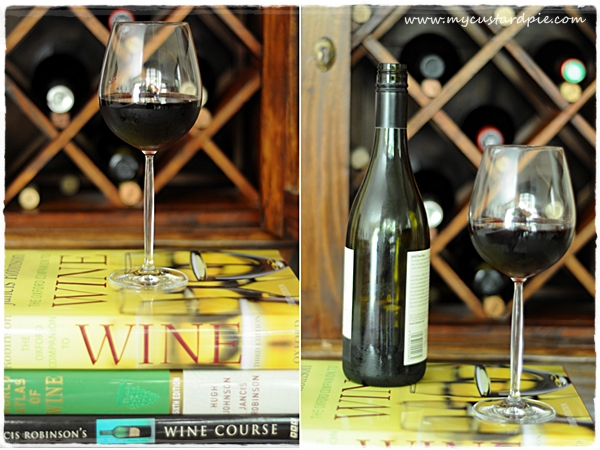 What’s all the fuss about buying wine ‘en primeur’? What is ‘en primeur’ anyway and why would you buy it? Can you buy it in Dubai?
For several years, KP and I have bought wine this way; it means buying wine of a particular vintage (wine made from grapes harvested in a single year) while it’s still in the barrel. It usually applies to premium red wines from the Bordeaux region of France but not exclusively so. It generates cash-flow for the wine-makers; they sell some of their product at least one year before it is bottled, and it provides an opportunity for buyers to secure sought-after names and buy high quality vintages cost-effectively as the prices have tended to rise as the wines get nearer to maturity (i.e. ready for drinking).
During the economic boom, fine wine became popular for investment, pushing up prices en primeur as demand (including new buyers from China) especially of the finest ‘growths’, outstripped supply. The Bordeaux climate means very variable vintages, but great grape-growing weather led to a couple of stellar years with prices reaching an all-time high for the 2010 vintage.
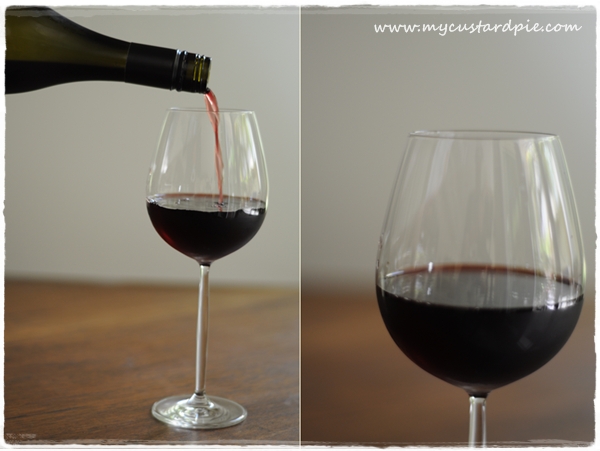
The bubble had to burst and although 2011 has been declared a good year (not as good as 2009 and 2010 but certainly equal to 2008 ) prices have adjusted with some wines on sale en primeur at 50% at less than last year. Château Latour will discontinue selling en primeur completely in 2012.
Every year wine merchants flock to Bordeaux to taste the different offerings from the Bordelais winemakers straight from the barrel, making their assessments and recommendations accordingly.
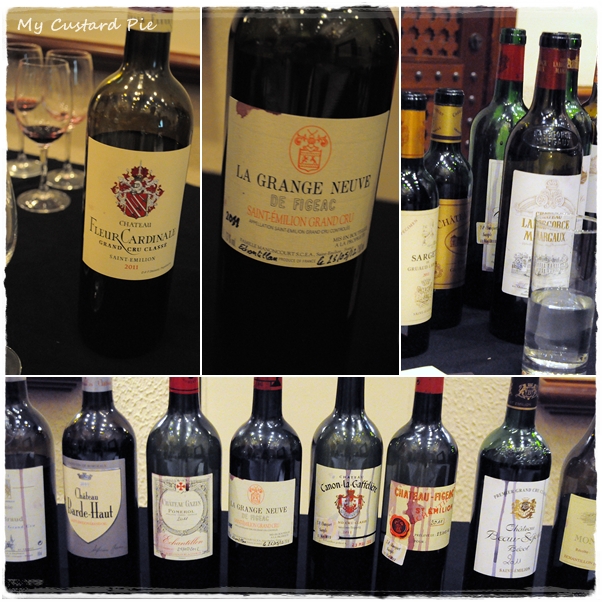
A few of the 2011s at the end of the tasting (love the wine stained labels)
KP and I buy a few cases ‘en primeur’ and it is fun to monitor the experts’ views and prices as they are released. We buy and store it through a reputable and long-established UK wine merchant, Lay and Wheeler; important as at least fifty wine investment companies have failed during the last four years. It also means we know the provenance of the wine (in light of recent wine fraud). We’ve also bought Bordeaux en primeur in Dubai through Le Clos (the MMI-owned fine wine and luxury spirits shop in Dubai International Airport).
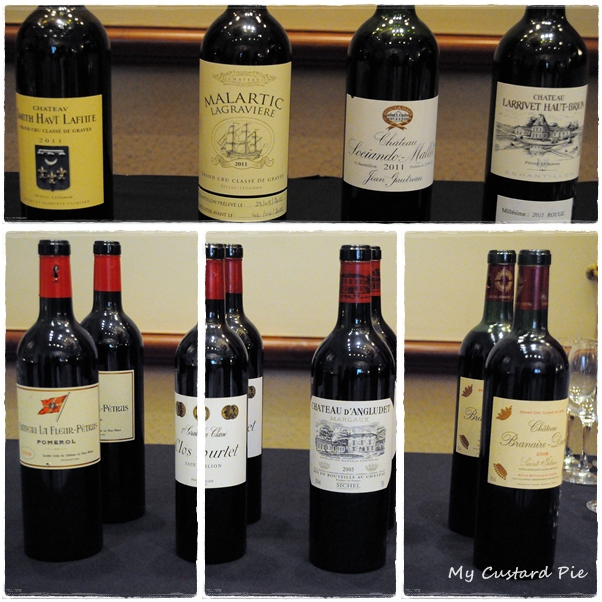
Some more 2011s plus some ready for drinking
As previous purchasers, we were invited to the annual ‘en primeur’ evening at The Royal Mirage for a presentation and to taste some older vintages. However this year was a bit different; some barrel samples of the 2011 vintage had been shipped over specially. We had the opportunity to form our opinion of these brand new releases – something that usually only happens in Bordeaux. Wow!
Having recently completed my Wine & Spirits Education Trust Advanced level exams I was ridiculously excited about this. A friend from the course compared notes with me after we’d tasted a couple of the wines. He voiced what I was thinking ‘I don’t think the sort of tasting we’ve done really applies to this’. We were frankly a bit at sea. On the nose the wines were very closed, not much aroma at all. Made for aging, many had harsh tannins (the stuff that makes your cheeks pucker and your gums feel dry) which will eventually soften and form part of the complexity of the flavour if stored correctly and bottle aged.
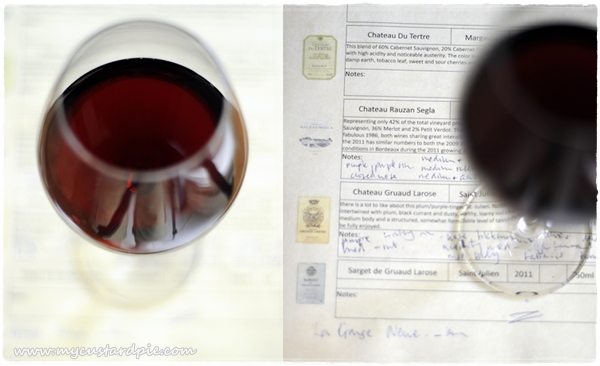
The room was very warm, not ideal wine tasting conditions, but it did mean the wines started to open up a bit, or maybe I was getting used to tasting them. I didn’t look at the tasting notes that Le Clos had given to us (to be honest I didn’t have my glasses) and I tried to ignore the Robert Parker scores. Parker is a highly influential wine critic whose scores out of a hundred can almost make or break a wine. However, taste is subjective and many think that his preference for a full-bodied, powerful wine has impacted on winemaking and made wine-styles, especially in Bordeaux, more uniform.
As I was drinking (rather than spitting) I only sampled about a third of the wines. I looked at KP – his teeth and tongue were dark purple so I knew mine must be the same! Tasting some mature Bordeaux wines after those young, tannic liquids was divine.
My favourites (the most well-balanced) out of the 2011s (although please note this should in no way be used as a guide!): Château Rauzan Ségla; Château Gruaud Larose; Château Beau-Séjour Bécot; Chateau Monbousquet and Clos de L’Oratoire. There’s an excellent summary of tasting notes by leading experts on Farr Vintners (click on each appelation).
Of the other vintages (deciphering scribbled tasting notes which became more illegible as the evening wore on):
- Chateau Le Fleur Petrus 2006 – a velvet texture with black cherries, plums and a hint of spice
- Chateau Angludet 2005 – graphite and blackcurrant leaves on the nose, textured mouthfeel with deep black cherry fruit
- Chateau Branaire Ducru 2006 – pencil shavings and dark, soft, ripe black fruit
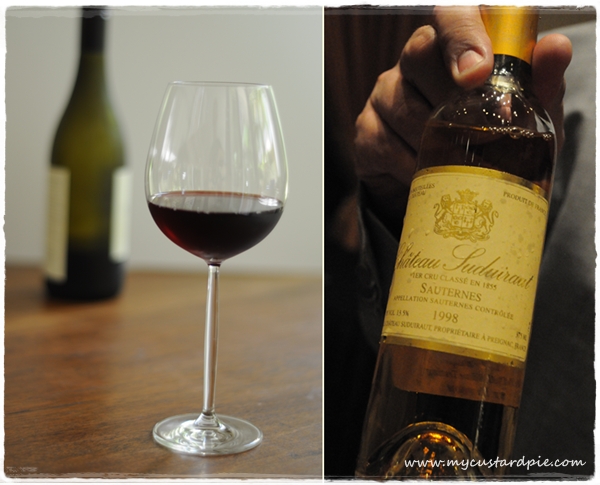
This Sauternes rounded off the evening
If you buy en primeur, the wines are eventually bottled and delivered ‘in bond’ to your merchant’s warehouse where you can store them (for a fee of course) until they are ready to drink or you sell them on. You have to pay the duty once they are taken out of bond (for drinking). This is how it works in the UK.
Le Clos is a good option in Dubai because of the buying power of the Emirates group; this means the allocation of wines available is considerable. Wines that sell out immediately in other markets are usually still available for order at a more leisurely pace. En primeur prices include delivery to the UK, insurance and warehouse receiving charges but the purchaser must then pay to store in bond as above. I believe that once ready for drinking they could be shipped to the UAE and collected from Ras Al Khaimah but this should be checked with Le Clos.
And, in case you are interested, but for no other reason…this is what we bought this year: Château Clinet 2011; Château Gruaud-Larose 2011; Château Leoville-Poyferré 2011 and Vieux Château Certan 2011 (which, even in the unlikely event that the value goes through the roof, I want to drink this one).

In terms of investment, Terrance Conrad once said that you should invest in wine and paintings because even if they go down in value you can look at the paintings and drink the wine. Sounds good to me.
Note: eagle-eyed wine experts among you will notice that the wine in the glass is not from Bordeaux. It is, in fact, a Pinot Noir, but you can also buy this en primeur from Burgundy. That’s my excuse anyway!
So do you dream of drinking Château Lafite and love the ritual surrounding en primeur? Or has fine Bordeaux wine become too homogenized and inaccessible – labels for rich customers to drink with lemonade (no joke)? Is your favourite a tenth of the price? Cheers.
Eyes on the stars, feet on the ground

Chef Yannick Alleno and manager Michael Payne at STAY in the One & Only, The Palm, Dubai
In a recent Masterchef episode, a Michelin-starred chef was talking about his inspiration for a dish. “I always walk on the beach in the morning and I looked around me and created this” he said. ‘This‘ included ‘sand’ and little jelly things cut into the shape of crabs. It looked like a children’s tray garden project resembling a rock pool. Everyone fawned about how clever this was but no-one seemed to mention the taste of the food. This, for me, is foodie pseudery (and presumably is part of the inspiration for this brilliantly funny pastiche review Four Restaurants Where You’ll Never Ever Get a Table). I hate all this food as art nonsense – there is no place on my plate for a ‘pea’ (or a sea-creature) of some flavoured gel. Of course chefs should innovate but constant reinvention and novelty puts the ‘experience’ over the food in my opinion.

The menu in bite-sized pieces. Black peppered wagyu beef and pommes frites, foie gras with pear, slow cooked John Dory with avocado and Laurent Perrier Champagne
Given the choice of eating new season asparagus drizzled with Hollandaise, from the Vale of Evesham, in a Gloucestershire pub or dining in a Michelin-starred restaurant I would probably opt for the former (and my wallet dictates that too). However, when invited to meet Yannick Alleno, a three-Michelin-starred chef, at STAY at One and Only, The Palm, I accepted (especially as they graciously allowed me to bring my sister who had left the bleak coastline of Roker, Tyne and Wear, for a trip to sunny Dubai). Who wouldn’t?
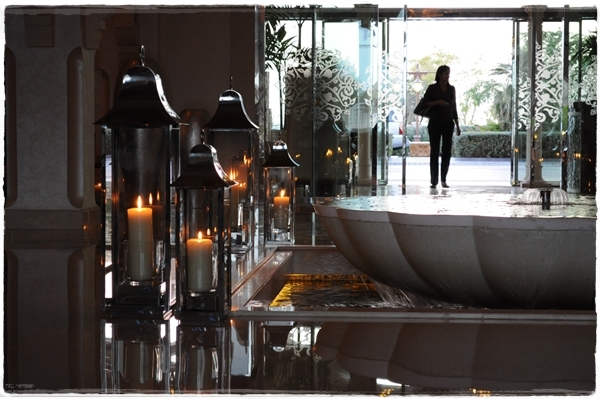
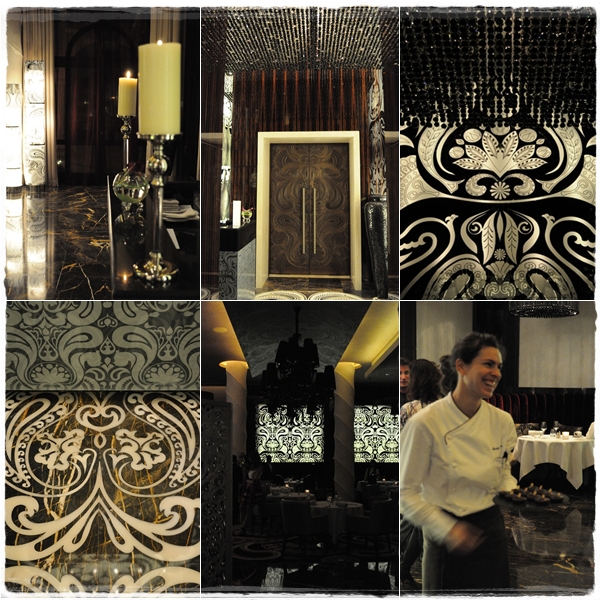
To get to The One & Only you take a left at the top of the trunk of the Palm Jumeirah and keep going as it curves back on itself ending in a spectacular view of the Dubai coastline and Dubai Marina. The hotel is a pretty Moorish-inspired style with the rather less splendid views of the water in between the fronds tempered by a series of lovely water features. The interior of STAY is striking, managing to be dramatic, elegant and cosy at the same time. Yannick and the hotel manager Michael Payne were charming and the staff proceeded to serve the entire a la carte menu in bite-sized but perfectly formed morsels (while keeping our glasses of Louis Roederer Champagne topped up). Not a gel capsule or a puff of dry-ice in sight.

The pastry library
The ‘pastry library’ fills one wall of the restaurant, the book shelves refrigerated to hold a range of delicate desserts. The dedicated pastry chef Marie Wucher (who obviously loves her job as she didn’t stop smiling) makes little confections to order including exquisite raspberry choux with vanilla cream and chestnut Mont Blanc with eglantine cream.

It’s easy to give a favourable report when you are the guest of an establishment, especially when treated like a VIP and plied with excellent Champagne but the evening did make me think differently about Michelin-starred food. Mainly inspired by classic French dishes there was enough innovation to be exciting while the combinations of flavours were relevant and in harmony. The pigeon wrapped in cabbage may have looked like a small, green brain but it tasted superb (I managed to eat quite a few of these). The waiting staff were friendly, professional and showed great attention to detail.
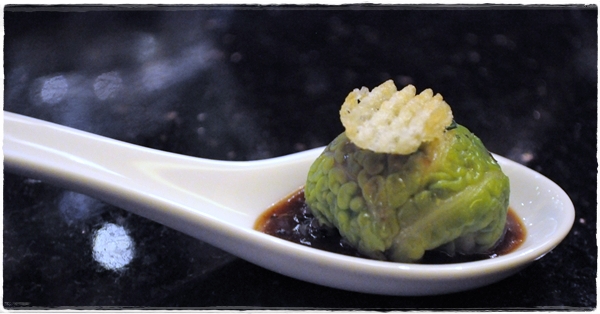
Have I mentioned my favourite? Wild pigeon chartreuse with foie gras, savoy cabbage and perigourdine sauce
A few other highlights from the menu were: foie gras with mulled wine jelly and pear on toasted brioche, soya bean risotto with almond, parsley and chives and black peppered Wagyu beef fillet ‘Cafe de Paris’ with pommes frites (ok – excellent steak and chips). At time of writing prices range from 70 AED for Tofu veloute (from the vegetarian section of the menu – quite rare in a classic French restaurant) to 330 AED for the lobster fricasse with beetroot and chestnut confit. My favourite wild pigeon chartreuse with foie gras, cabbage and perigourdine sauce is 310 AED so I’ll have to save up.
The alternative route to the hotel is to arrive by boat departing from The One and Only Royal Mirage. This takes you into the private marina where 101 Dining Lounge and Bar is situated (great tapas I hear).

The view across to Dubai Marina
The lighting was extremely challenging for photography – for very beautiful professional pics and more information visit the hotel’s website.
There’s a short interview in The National Bites if you want to know more about Yannick Alleno. I like the fact that he eats perfectly roasted chicken and a salad at home.
 P.S. My sister loved the evening but her favourite event of the holiday was a tour of the ethnic restaurants of Bur Dubai.
So given the choice when dining are you five-star all the way or an ‘eat with your fingers’ fan?
Britain loves…
Britain loves an extra day off, thank you Ma’am, no peeking. Britain loves a choir. And we love people with funny names. We love kebabs…no salad for me please. Hey, naked boy, don’t you know there’s a hose pipe ban? …and feeding the ducks…
There’s a lot of fuss about the new T-Mobile ad. It’s themed around the Queen’s Diamond Jubilee celebrations and what Britain loves. A stream of characters come out onto the famous balcony at Buckingham Palace including jockeys, a choir, a charity parachutist, and a very camp ‘queen’. The negative comments are mainly that it’s a bit trashy and I suspect because it doesn’t show Britain as people think it should be. Perhaps this is due to a nostalgia for Britain at the time of the Queen’s coronation with red double-decker buses, bowler hats, red letter boxes, the crown jewels, Beefeaters and fish and chips. Indeed those symbols sum up the UK for many people outside Britain.
But I like the T-Mobile ad as it celebrates Britain and British people today in all our quirky, haphazardness and often slightly tacky enthusiasms and how we like to send ourselves up. For me it shows how much we embrace the new and absorb it into our culture, for better or for worse. Nowhere is this more evident than in our food and it’s well documented that ‘British curry’ (actually brought to the UK by Bangladeshis) has eclipsed fish and chips as our most popular take-away. I would add ‘Britain loves spicy’ to the list.

Some of the dishes served at the Mango Tree, Dubai. Bak choi, Tom Yum Goog (spicy soup with prawns), Yum Talay Ceviche, Nua Yang Nam Tok (char-grilled rib eye beef with rocket and chilli salad), Goong Monkorn Prik Pow (stir-fried lobster with chilli paste sauce), Chicken Satay.
Invited to the Mango Tree (for a ‘meet and tweet’!) the other evening, I met British chef Paul Kennedy who has taken to a Thai style of cooking with gusto, spending months in Bangkok and shaping a modern Thai menu which has evolved over the past year – getting a bit spicier too (no bad thing). We were treated to a range of dishes from the menu for tasting (and tweeting) while the top of the Dubai Mall fountains shot up past the windows. Favourites for me were yum talay cerviche (marinated mixed seafood salad with spicy lime dressing), gaeng kiew wan goong (prawns with aubergine and sweet basil in a Thai green curry sauce) and khoa niew ma muang (fresh mango served with sweet sticky rice topped with coconut milk).
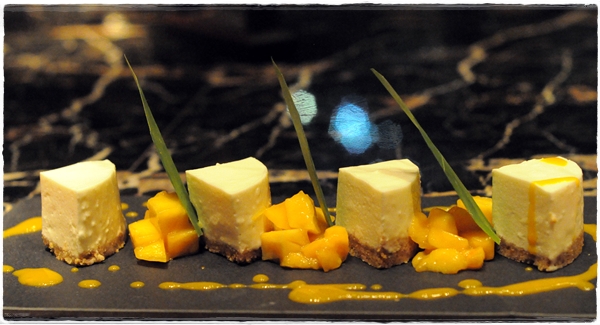
Mango cheesecake – Mango Tree Dubai
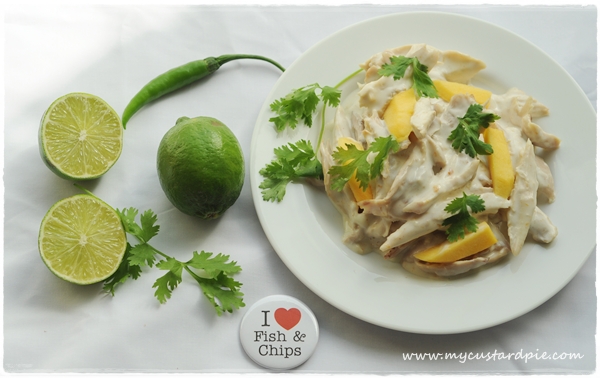
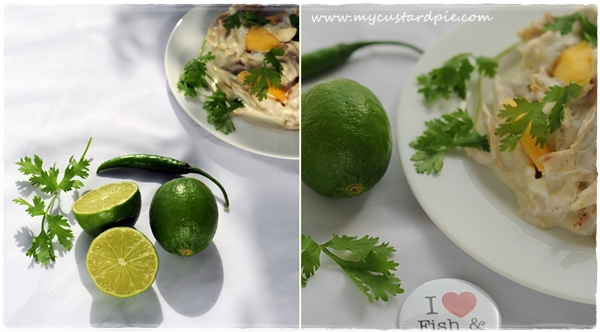
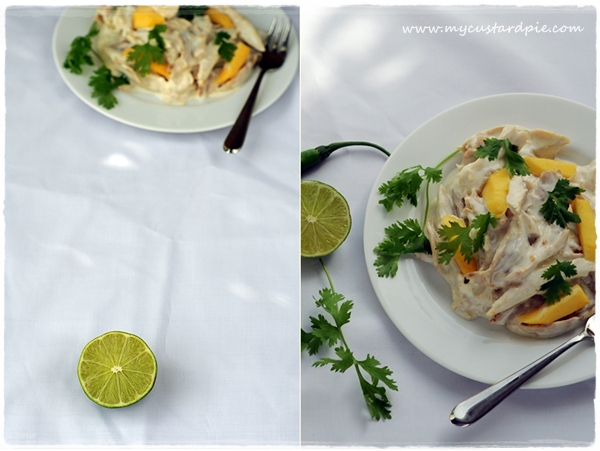
Paul said he was going on Studio One TV to do a special dish for the Jubilee; Thai-inspired Coronation chicken. Now there’s an idea! I must point out that this isn’t Paul’s recipe but one I made up at home and very nice it was too. He was kind enough to give us all a jar of freshly made green curry sauce (which was significantly nicer than my usual curry-in-a-hurry). So whether you are draping yourself in a red, white and blue flag this weekend and having a street party or firmly anti-monarchist (or somewhere in between), I hope this passes muster.

Thai-style Coronation chicken – serves 4 – Download printable version
Ingredients
1 whole chicken approx 1.4 kg
4 stalks of lemongrass
6 kaffir lime leaves or a strip of pared lime zest (optional)
a thumb-sized piece of fresh ginger (peel on)
1 onion
1/2 teaspoon sea salt
8 whole black (or green) peppercorns
I tablespoon of vegetable cooking oil
2-3 teaspoons Thai green curry paste
150 ml mayonnaise (or coconut cream)
150 ml yoghurt
2 tablespoons hot mango chutney
2-3 limes, juiced
1 ripe mango, peeled and thinly sliced
small bunch of fresh coriander
 Method
- Put the chicken, lemongrass stalks, ginger, onion, salt and peppercorns in a pan and cover with water until the thighs are covered. Bring to the boil, partially cover the pan and simmer for an hour until the chicken is cooked. If you can’t get lemongrass or kaffir lime leaves, use the rind of a couple of limes with all white pith removed.
- Take the chicken out of the stock and allow to cool slightly. Strain the stock and reserve the liquid. Remove the skin from the chicken and take all the meat off the bones, tearing the flesh into strips. Discard the bones. Refrigerate the stock. You can do this part in advance.
- Scrape the fat from the top of the stock. Heat the oil in a small frying pan and lightly toast the green curry paste (add more if you like spicy food), add 200 ml of stock and simmer for about 5 minutes. Remove from heat.
- Lightly whisk together the mayonnaise, yoghurt, curried stock, mango chutney and lime juice. Taste and add more lime juice to taste. Use coconut cream instead of the mayonnaise for a different taste. Mix with the chicken and mango and scatter with coriander leaves.
- Serve with rice or as part of a salad. Put on your socks with sandals, get out your deck chair and Union Jack bunting and make a large pot of tea (optional).
So what do you cook for a celebration?Are you celebrating the Jubilee? What sums up Britain to you? Love or hate the T-Mobile ad? I appreciate your comments.
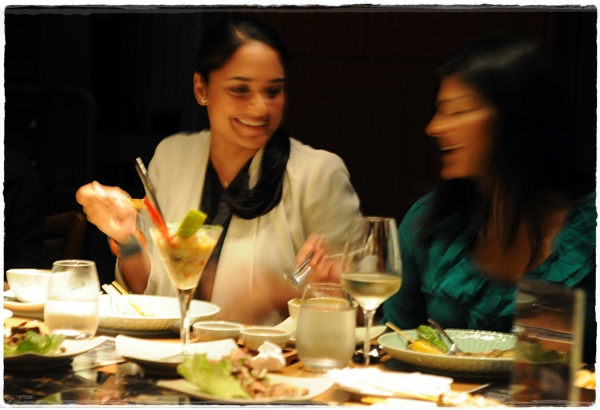
Meeting, tweeting and eating a sumptuous Thai feast at the Mango Tree, Dubai
Disclosure: I was a guest of the Mango Tree
Tour the Middle East via your tastebuds
 So, dear readers, we left our heroine teetering on the edge of the Metro platform having explored the myriad lanes and alleyways of Meena Bazaar, Cosmos Lane and the lesser known restaurants of Bur Dubai. She’d faced salty, smokey, sour, smooth, spicy and sweet under the guidance of ethnic eats explorer extraordinaire, Arva from I Live in a Frying Pan and lived to tell the tale. She was ready for another adventure.
Actually no heroine; that eager eater was me – willing guinea pig for the prototype outing being road-tested for Frying Pan Food Tours. But I was ready for more, so piled into a Mini driven by the intrepid Foodiva, accompanied by The Hedonista and headed for one of the oldest parts of Dubai called Deira. Using Shrek-style-Puss-in-Boots-eyes on a policeman (and it actually working) to avoid being given a traffic fine (long story) we met Arva, our dear tour leader, at our first restaurant.
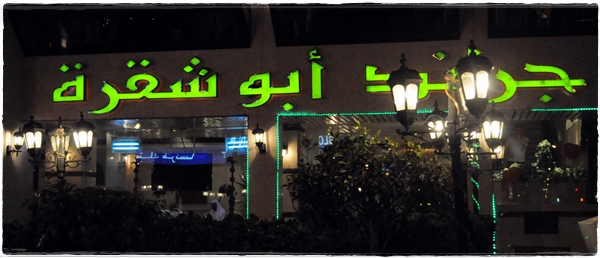
Of the diaspora of the Middle East, the Lebanese have travelled furthest and widest, and like many emigrants, they often used food to make their living, setting up restaurants and catering firms. This is probably why Lebanese-style dishes have become widely recognised as ‘Middle Eastern’ food, but it’s only part of the picture in this large and varied region.
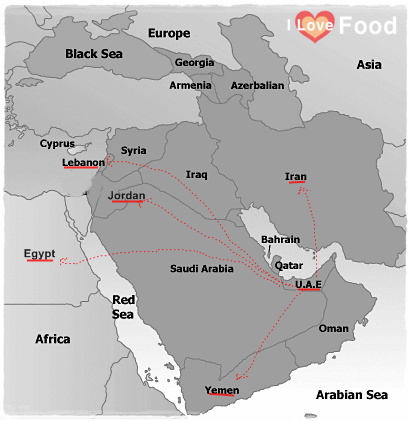
Jump on my magic carpet for a taste of the Middle East…in one small part of Dubai.
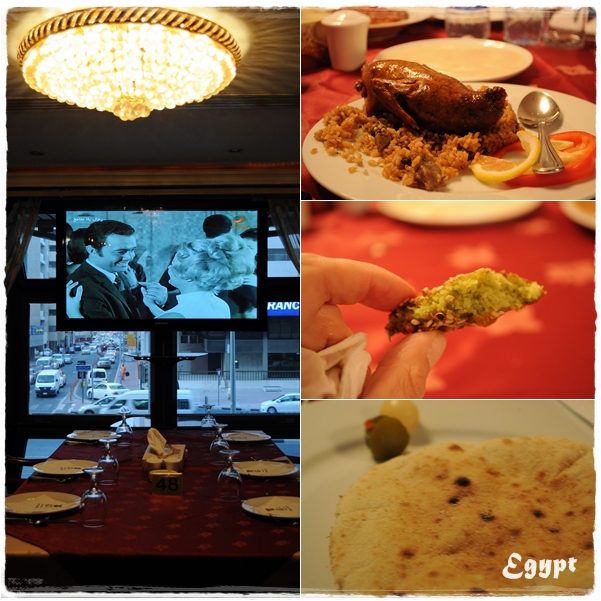
EGYPT Say the word koshari, an assembly of rice, pasta, lentils, fried onions usually served with tomato sauce, to an Egyptian and their eyes usually light up. The faded grandeur of this restaurant combined with huge TVs showing Egyptian soap operas in black and white and the few patrons smoking sheesha took me instantly to Cairo. But the promised koshari didn’t materialize – this was a test tour after all and I could see Arva make a mental note “never trust the manager when he states categorically that they serve koshari on a Wednesday”. There were authentic goodies to be had though;small fluffy, slightly grainy breads fresh from the oven, piquant pickles and ful medames which is another dish that Egyptians have a passion for, made of fava beans (which I call dried broad beans) cooked with onion, garlic, parsley and lemon juice. Tammiya (Egyptian falafel) made of broad (fava) beans rather than the usual chick peas were a lovely shade of green inside with a fresh taste. A bronze pigeon resting on a bed of rice and chicken livers was delivered and looked rather grand but we all paused not sure how to deconstruct the bird for sharing. Perhaps a Frying Pan 101 to eating a pigeon should be part of the tour? Two things to note 1. there is not much meat but it’s quite rich and gamey 2. be careful when ordering hamam ma’shi or you could end up asking for a stuffed bathroom (hammam).
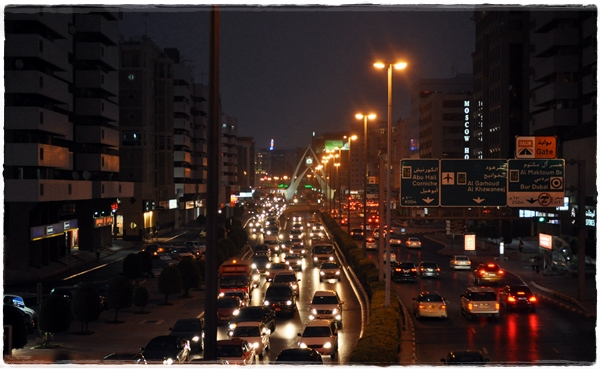
With the sun setting, the roads filled with cars ferrying people home at the end of the day and passing pavement cafés where sheesha-smokers were relaxing we crossed the road to:
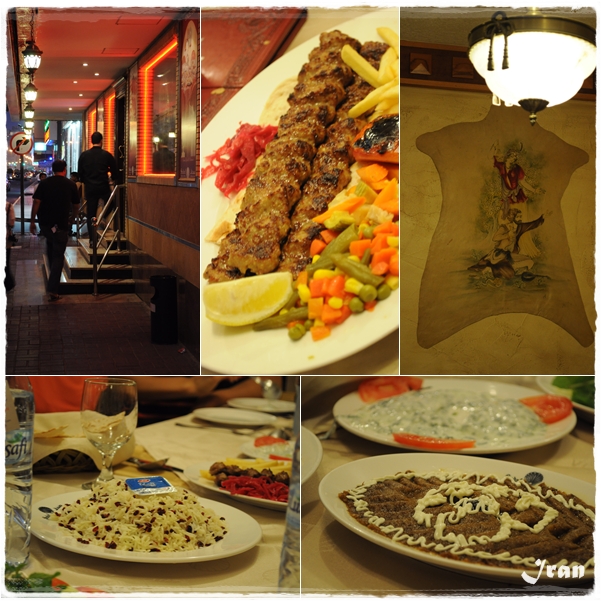
IRAN I love the contradictory pairing of things (and there were lots on this tour). The outside of this restaurant was ablaze with coloured lights framing a heavy wooden door, Medieval-style lighting hung from the ceiling, parchment illustrations hung on the walls, all to the backdrop of a large fish tank. I’m new to Iranian food and the unani principles of hot and cold that are applied to ingredients, but learning fast (thanks to Ariana Bundy). I was glad to see mast o khiar placed on the table, a cooling dip of yoghurt mint and cucumber, with some crispy bread, nan-e lavash, some aubergine dip made with tahini, garlic, fried onion and mint – kashk badmejan – plus the usual salad that graces most Middle Eastern tables. What is it with men and meat? The look on the faces of the males at our table when an enormous chelo kabab arrived! The mixed veg and chips were superfluous but the mound of rice and barberries – zereshk polo – (complete with butter portion resting on top) completed the feast.
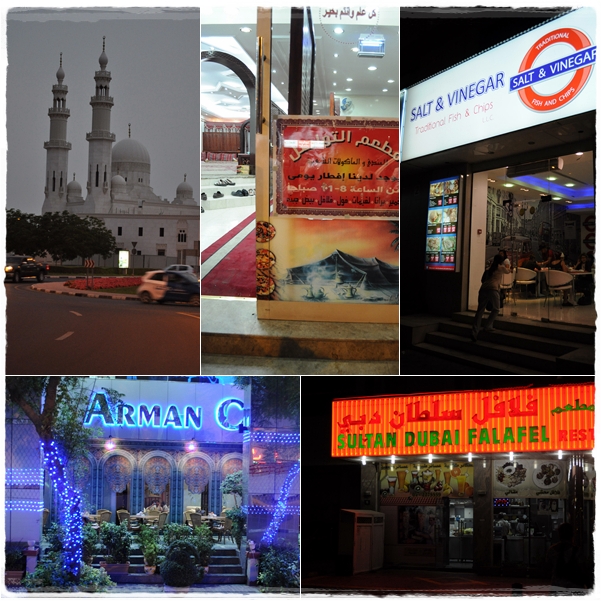
Taking time to view this part of Dubai from pavement level was so rewarding and made me remember outings when my girls were small to ‘Dubai Summer Surprises’ events. Our steps led us past a stray cat staring into a fish and chip shop and into a brightly-lit joint with a bread oven to experience just one of the foodie delights from:

LEBANON When I lived in Saudi Arabia, the highlight of supermarket shopping (and the fact my husband had to drive me there!) was the bread oven in the centre where fresh manakeesh was made. My favourite was spread with za’atar, a paste of herbs (usually thyme), sesame seeds, sumac and olive oil. After trekking in the mountains of Lebanon, and returning to Beirut, our coach was forced to halt as one trekker deemed it impossible not to stop by his favourite bakery; the Lebanese love their bread.
Here in Deira, chefs were doing an efficient job at baking breads and pizzas at speed, the long-handled peel darting in and out of the oven. With bread on the table of the last two restaurants, did we have room for more? The gusto with which the steaming hot manakeesh was torn apart, cheese strings trailing from table to mouth, proved that no one can resist good, simple fresh bread especially stuffed with moreish fillings. The sujuk filling was new to me, an alluring purple shade due to the use of sumac in this salty, spicy, slightly dry, beef sausage. Arva cleared up something that had bothered me for years. ‘Why do some people call it manousheh?’ This is the singular she explained, manakeesh (pronounced man-eye-eesh) is plural. The walking food encyclopedia does it again.
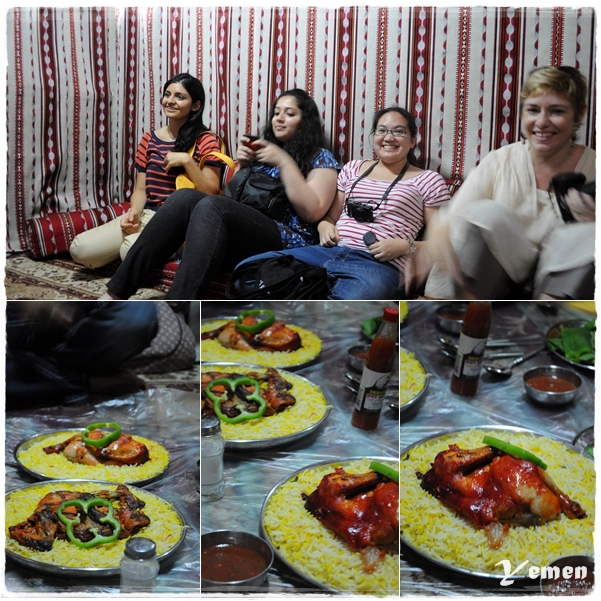
YEMEN There are two countries in the Middle East that I regret not visiting when I had the opportunity and Yemen is one of them. All the Yemenis I’ve met outside the country have been kind, genuine and generous to a fault, from the man who comes to my door to try to sell me carpets (“you want to sell your car? I buy it. I pay you in cash and carpets.”!) to the charming PRO who told me jokes to distract me from my blood tests (extreme needle phobia). Apart from zhoug and Yemen’s role in the discovery of coffee, I know absolutely nothing about the food. The entrance to this restaurant was intriguing, we passed by a large cushion-lined platform surrounded by discarded shoes – it reminded me of the outside of a mosque. Through twists and turns there were glimpses into curtained rooms and then we were slipping off our shoes and being guided into our own private tent (complete with air conditioning). Our waiter knelt, flicked his wrists and suddenly the floor was covered with a thin plastic sheeting where he started to place dishes of salad and fresh herbs. We were all grinning; it was a bit like being a child playing house under a table covered with a sheet. The mandi arrived – meat cooked to succulence in an underground oven (tandoor or tanoor) thought to have originated in the Hadhramaut province of Yemen- served with spicy tomato sauce and rice and eaten with our fingers. We also had chicken mazbi – cooked over coals rather than in the oven. We could have stayed in that cosy tent for the rest of the evening, tearing off spicy morsels to eat and lounging on cushions. However, we were on a food tour fact-finding mission, road-testing for the perfect culinary adventure, and had one more destination.

JORDAN There’s a special place in my heart for Jordan as it’s the first country I visited in the Middle East when I started to explore the region. The people were welcoming, the natural landscape varied and magical, the breadth of historic sites jaw-dropping. I caught the Roman-ruins bug in Jerash. I can’t really remember eating anything different from the usual Arabic food there (hummus, tabouleh, fattoush, mixed grill). I certainly didn’t taste goat cooked in fermented yoghurt otherwise known as mansaf. Strong-tasting and unusual and I liked it a lot especially as a few rain-drops fell while I was eating it (apologies for the confusion caused to people who live in the UK by this last statement).
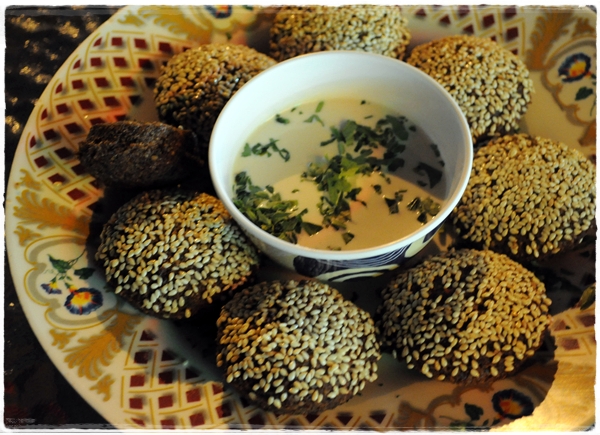
The Egyptians claim falafel as their invention but they are now ubiquitous. The fava-bean tomato-filled ones we had here were top of the falafel charts. I think some baklava was served but I was too busy sticking my lens into large dishes of it and missed the boat. Not so with the kunafa. My very English culinary upbringing means that milk puddings are part of my DNA and the Middle East yields many delights in that area. We all dug our spoons into a portion of kunafa bil jibn, a creamy concoction of fine pasta, ground semolina and soft cheese. I took the dainty malmoul home in a napkin as there was no way I could eat another thing, not even these pretty date filled pastries.
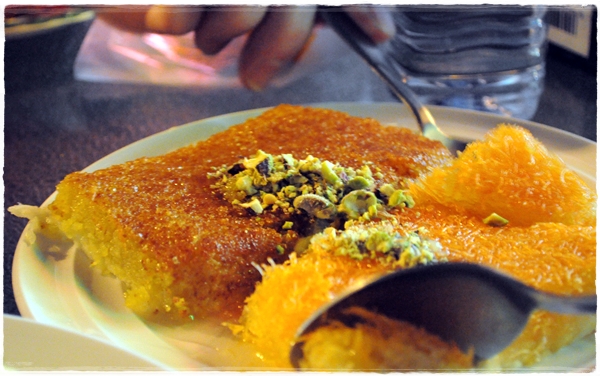
Kunafa
Other foods we gave a passing nod to were the inevitable (but potentially brilliant) shawarma stands and masgouf – fish cooked Iraqi style by spicing and skewering then roasting over wood and charcoal. With road-signs in English, international brands lining the shopping malls, and the colonisation of some parts by other cultures, Dubai sometimes doesn’t feel very Middle Eastern but strolling round this part of Deira tasting our way round the region was as though the carpet had indeed been magic.
Frying Pan Food Adventures will officially commence sometime this Autumn so get yourself in line here and keep in touch via Facebook and Twitter.
Thanks to my fellow guinea pigs Foodiva, Sarah, Didi, Dee and wonderful tour leader, the Frying Pan herself, Arva.
What’s your favourite dish from the Middle East (please don’t all say hummous!)?
A tour of North India without leaving Dubai
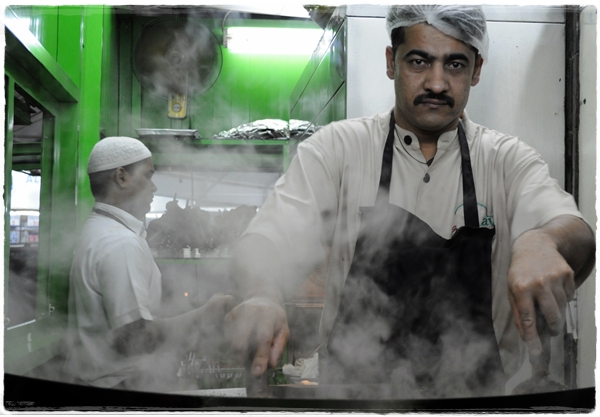
The kitchen faces the street at a well-known restaurant in Bur Dubai
Have you ever tasted a kulcha? Do you know how to eat pani puri? What’s the name of Nepal’s most famous dish? What would you get if you ordered smoked chaas? Are you still in the dark? Well so was I until I went on a Frying Pan food tour – not in India – in the old part of Dubai…
Another question. Did you know that when guinea pigs get excited they make a high-pitched whistling noise? When my friend Arva from I Live in a Frying Pan asked me to be a guinea pig for her embryonic food tours and I nearly ran round going ‘wheeeb, wheeb, wheeb’ with excitement. Poor girl, I was so enthusiastic that I browbeat her into arranging it to coincide with my sister’s visit to Dubai.
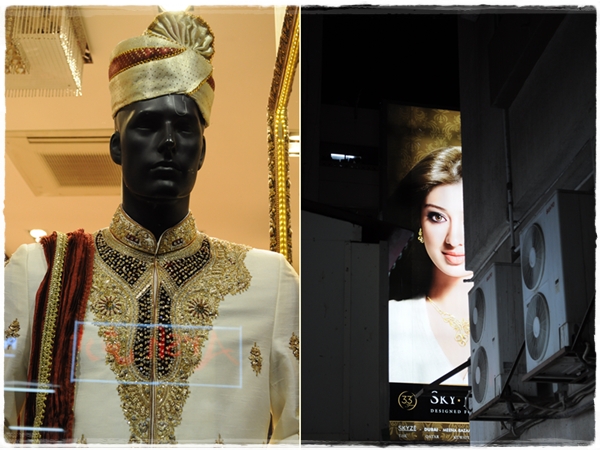
Bur Dubai is not known for its plethora of parking spaces so sis and I hopped on the Metro. It was the first time I had taken a journey that involved changing lines and took us to the Khalid Bin Al Waleed station which is like Neptune’s palace. It wouldn’t look out of place in Disney’s Little Mermaid – check the pics here.
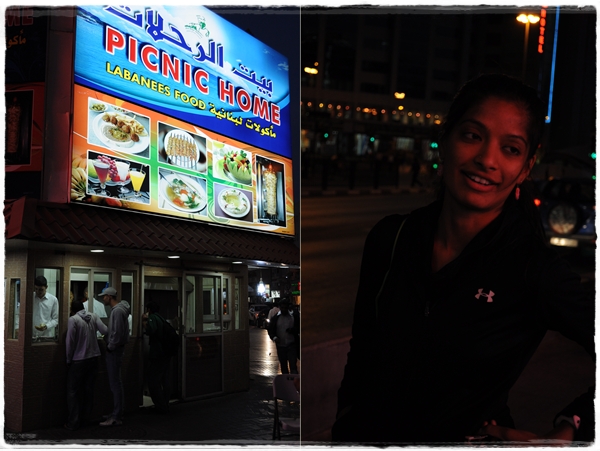
Creative spelling amuses me. Our fabulous Frying Pan food tour leader.
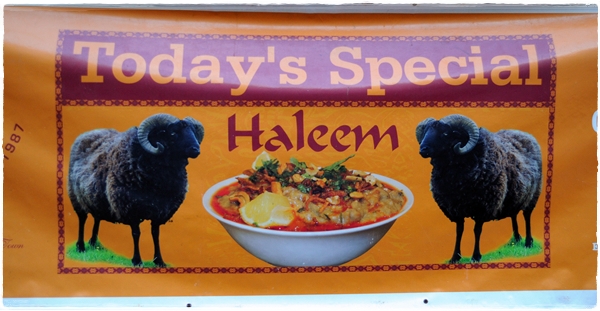
Soon a merry band of fellow guinea pigs were trailing after Arva through the back streets of old Dubai. Life in the UAE is very car-centric so it’s a real novelty to take a relaxing stroll and observe at pavement level. This instantly led to a close encounter with a coffee shop – a wholesaler not a cafe – the aroma was so inviting we just had to open the door and get them to show us what they were doing (weighing and bagging coffee). We also passed this sign:
I’ve lived in the UAE for 12 years but had only eaten one of the foods on the tour before – it truly was a trip for the tastebuds and every other sense. In no particular order here they are – the words in capitals show the city or region where that style of food originates:

AMRITSAR, PUNJAB The six chefs in the kitchen belie the size of this tiny restaurant, Kulcha King, the dining area reached up a flight of rickety stairs. The kulchas are hand-rolled and baked to order. While a paratha is fried (usually in ghee) these aloo kulchas are breads filled with potato then fired in the oven. For me, they beat their fried cousins hands down. We ate them with chana masala (chickpea gravy), sweet chutney and drank cool meethi lassi (sweet yoghurt drink).

GUJARAT Not just the discovery of a new dish but an initiation into a whole new ritual. Rangoli is, apparently, extremely famous for pani puri. These are delicate little balls, hollow with a thin, crispy shell. The chef makes a small hole in the top and carefully adds a mixture of sprouts and pours in something that was described as spicy water. The trick is to eat it as quickly as it is filled (or the shell will go soggy) and pop it into your mouth in one go. Arva’s Mum coached us from the sidelines, telling us exactly what to do. We also tasted dhokla (yellow gram flour cake) with tamarind chutney on top and dahi puri (which were moreish yoghurt and tamarind sauce covered puris).
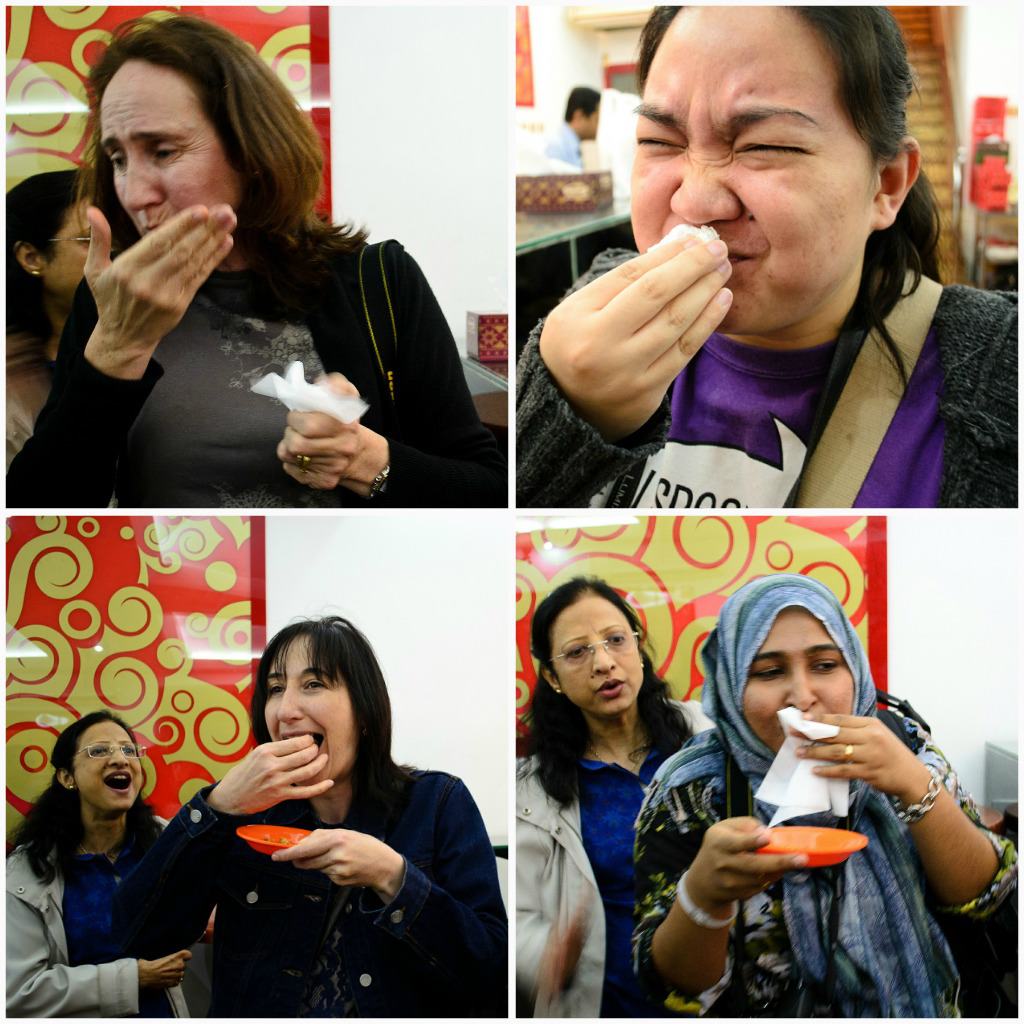
Don’t be fooled by our expressions. These were delicious – a unique eating experience!
The pani puri are just a little bit bigger than you can comfortably fit into your mouth. As soon as you crunch them, the spicy, sour, sweetish, tangy liquid spreads over your tongue and you want to swallow immediately but you can’t because you have to chew the fresh, crunchy sprouts and the crispy layer. It’s an eye-watering experience but strangely addictive. Indeed they have pani puri eating competitions where champions can eat twenty in one minute.

RAJASTHAN How the other half live! The sign on the wall outside the restaurant shows a glimpse of bachelor life. You can have two hot meals a day for 450 AED (£78 $122). Inside the clean and comfortable Karani restaurant we ate ground wheat which is formed into balls (given a slight sweetness with jaggery). You break them open and dip them into delicious savoury dhal, hence called daal bhati churma.
 PUNJAB After a short wander through the streets of an area known colloquially as Meena Bazaar, a place that was even more brightly-lit than the others (quite a feat) lured us to its doors, Sind Punjab. Chicken tikka is practically a national British dish these days but this was the real deal. It was the job of the chicken tikka man in his special room to grill the chicken to melting perfection over coals. We ate ours with our fingers while being eyed by hungry passersby.
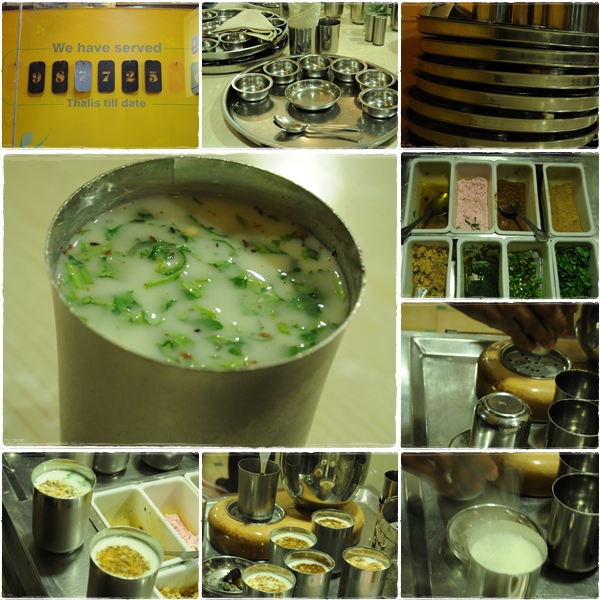
GUJARAT/RAJASTHAN We really needed Arva’s excellent guidance to find Rajdhani tucked away down a dark back street. The sign in the window showed that it was worth seeking out as 987,725 thalis had been served to date. This is a restaurant for the indecisive vegetarian – vegetable thali is the only thing on the menu (apart from desserts) and is displayed in the window. We weren’t here for thali though. A man with a trolley made his way through the lively tables of families and began a careful ritual. He was Merlin or perhaps Professor Snape in the Potions lab, lighting charcoal, drawing liquids, mixing brightly coloured powders. We were under a spell, transfixed. Smoked chaas is made by burning spices over charcoal, upending a cup over the smoke then quickly filling it with a thin yoghurt before stirring in a variety of fresh herbs and more spices. Sour, smokey, spicy and rich – it was the strangest drink I have ever tasted.
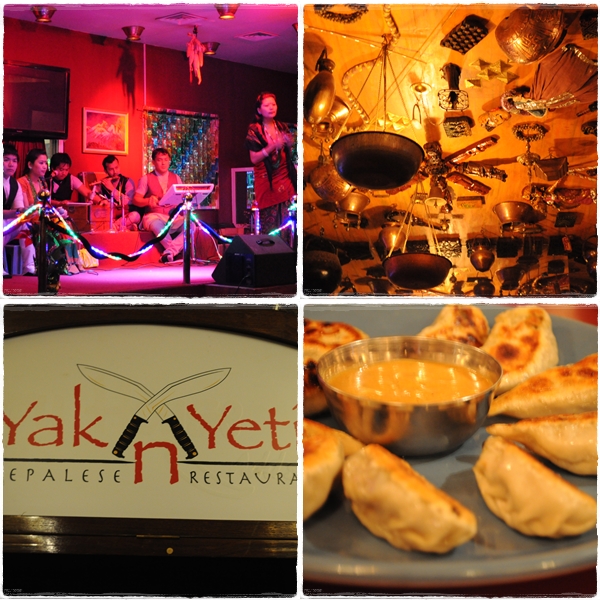 NEPAL My first encounter with momos (how I became a momo-eating expert to follow soon) by hopping over the border of India courtesy of the Yak n Yeti (name plaguerised from the original in Kathamandu). The traditional Nepalese entertainment completely drowned out the manager’s explanation of the chicken and vegetable momos but they were kothey-style (i.e. steamed and then pan-fried) with a lightly spiced dipping sauce.
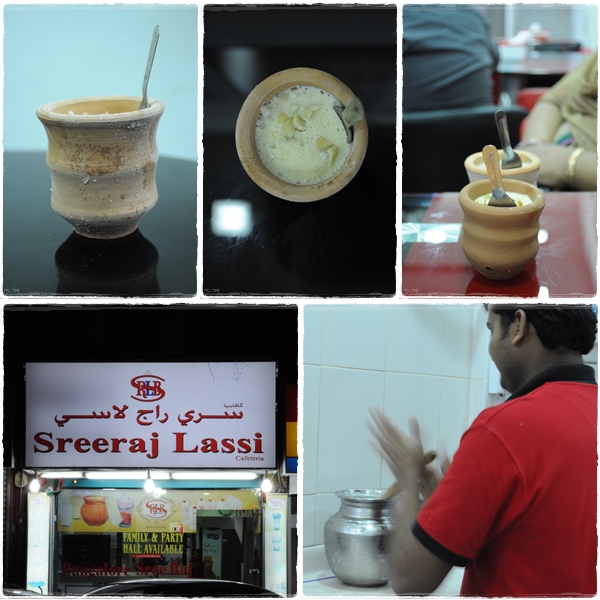 BANGALORE Could anything else pass our lips? Only something cold, creamy and sweet supplied by Sreeraj Lassi, famous for traditionally-made lassi (see pic) and homemade kulfi. The latter came in the sweetest little earthenware pots (called matka) and with cashew nuts (kaju) or saffron (kesar) hence matka kesar kulfi and matka kaju kulfi.

During a longer stretch of walking, I picked up some freshly made bread from a hole-in-the-wall Yemeni bakery (the bakers didn’t want to show their faces in the pics). Arva pointed out this little gem and her knowledge and research of the restaurants and their specialities is encyclopedic, driven by her genuine passion for street food, ethnic eateries and authentic cooking. She’s modest as well so will blush when she reads this bit!
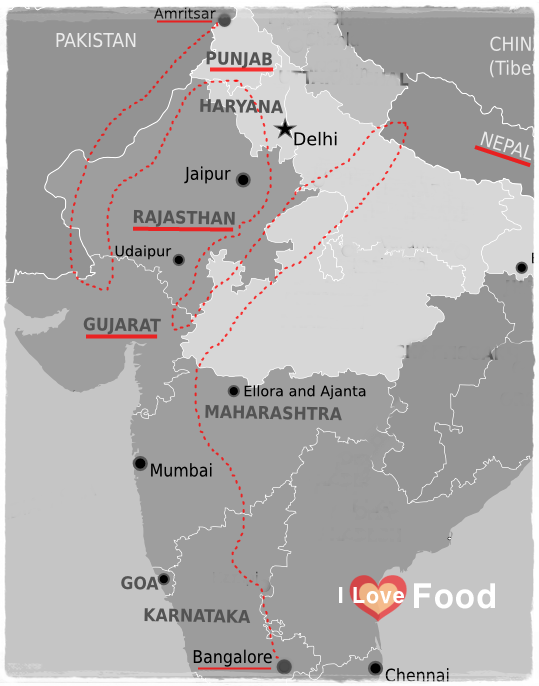
The sources of culinary inspiration we visited without leaving Bur Dubai
So who wants to be a guinea pig again? Me, me, me. I’d only just begun my ethnic food Odyssey and Arva translated my inane grin as consent to invite me to a food tour of the Middle East, in Deira. That was for another day though; sis and I waddled back to the Metro weary but replete. It was the highlight of her visit to Dubai, she sighed happily.
Frying Pan Food Adventures will officially commence sometime this Autumn so get yourself in line here and keep in touch via Facebook and Twitter.
P.S. Thanks to my fellow guinea pigs including Raji (who took the face-crunching photos), Farwin, and Didi
Have you been on a food tour elsewhere in the world?
Time to get fruity…with a breakfast loaf
 My family often moan when I serve up new things for supper. If I had my way I’d try out several new recipes every week, but they prefer tried and tested favourites. Breakfast time is where I need repetition. Decision-making and creativity has to be channeled elsewhere that early in the morning. Different choices are reserved for the weekends; so when the dogs are walked, the girls have left on the school bus and there’s a short gap before I hit my desk I usually reach for the toaster. The bread has to be substantial and I slice and freeze the nuttiest, grainiest bread that I make or buy.

Fresh from the oven and toasted
La Cuisine de Sarah threw down the Fresh From the Oven gauntlet with a breakfast fruit loaf and I’m so obsessed with Dan Lepard’s bread at the moment that I thought I’d have a tinker with something in Short and Sweet. While the oven is hot it’s more efficient to bake two loaves so I made Dan’s multi-grain and honey loaf and did a breakfast riff on a second batch of dough. Breakfast equals marmalade…so what about using it in the dough? Would dried sour cherries and some almonds go with the orangey flavour? There was only one way to find out.

Multi-grain loaf on the left, fruit loaf on the right
This uses the half-sponge method which means mixing some flour, water and a small amount of yeast and leaving it overnight for the flavours to develop by maturing slowly. A sort of porridge is added for texture too. Forget toning up your ‘bingo wings’ as Dan espouses a short and gentle manipulation of the dough rather than heavy kneading. The fruit loaf dough was much stickier to work with but I managed with a well oiled work top and a few extra gentle kneads. I was surprised at how completely different the loaves were from each other. The multigrain was very chewy and wholesome, the fruit loaf lighter and really good toasted and spread with butter. That’s breakfast decision-making taken care of for a couple of weeks.
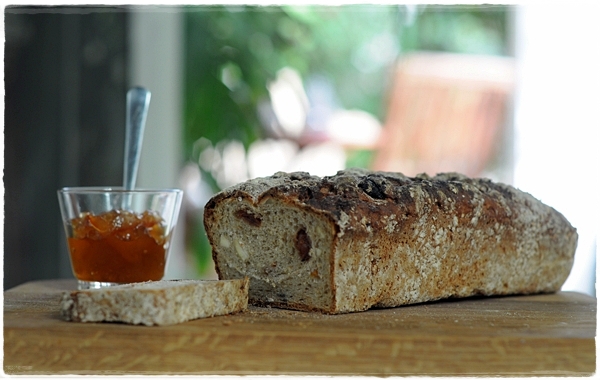
Sour cherry, marmalade and almond loaf – adapted from the Multigrain and honey loaf by Dan Lepard
Ingredients
sponge
225ml warm water (about 30-35C)
1 level teaspoon fast-action dried yeast (or you can use easy-blend)
175g strong white bread flour
oat mixture
30g rolled oats
3 tablespoons marmalade
50g dried sour cherries (or other dried fruit – I used some chopped dried apricots too)
50g almonds, chopped roughly
100ml water, boiling
For the dough
100g strong white bread flour
75g spelt flour
1 level teaspoon sea salt
25g unsalted butter

Method
Make the sponge: Stir the yeast into the warm water in a large bowl and then add the flour gently stirring until combined. Cover with clingfilm and leave overnight.
Make the oat mixture: Put the oats, marmalade, dried sour cherries and almonds in a bowl and pour in the boiling water. Stir to combine and leave to cool (you can do this the night before too).
Make the dough: The next day, scrape the oat mixture into the sponge mixture and beat well.
Put the strong white flour, the wholemeal flour, the salt and the butter (from the dough ingredients) into a large mixing bowl. Rub in the butter with your fingers until no lumps remain. Scrape the oaty, sponge mix into the flour and form into a sticky ball of dough. If you have a free standing mixer with a paddle attachment and dough hook you can combine the flours, rub in the butter (with the paddle) then mix together with the dough hook – I use a KitchenAid. Cover the bowl with a tea towel or cling film and leave for 10 minutes to rest.
Use Dan’s light kneading method to work the dough, so oil your work surface (I use olive oil) and turn the dough out and knead as per his basic techniques. Quickly rinse out the bowl and lightly oil before putting the dough back to rest for 15 minutes. Knead again, put back in the bowl, cover and rest for 30 minutes. Repeat the kneading one more time and rest in the covered bowl for another 30 minutes.
You can bake this on a tray or in a loaf tin (approx 19 cm long). If the latter, butter and flour it and also lightly flour your work surface. Using a floured rolling pin, roll the dough out into a rectangle about 2cm thick. The width should be the shorter side and measure slightly less than the length of the tin. Roll up tightly from the bottom to the top, and place it with the seam side down inside the tin or on a baking tray.
Cover with a floured tea towel until half its size again (about 3/4 hour). While it is proving preheat the oven to 220 C / 425 F/ gas 7 (or 240 C if your oven will heat up that much). Slash the loaf on top (I found it deflated a bit so this is optional). Put in the oven and immediately give a few squirts with a water spray. Close the door quickly and bake for 20 minutes, then reduce the heat to 200 C and bake for a further 20 minutes – just watch it doesn’t get too dark.
Cool on a wire rack and eat while just warm from the oven. Also great toasted spread with butter and marmalade.
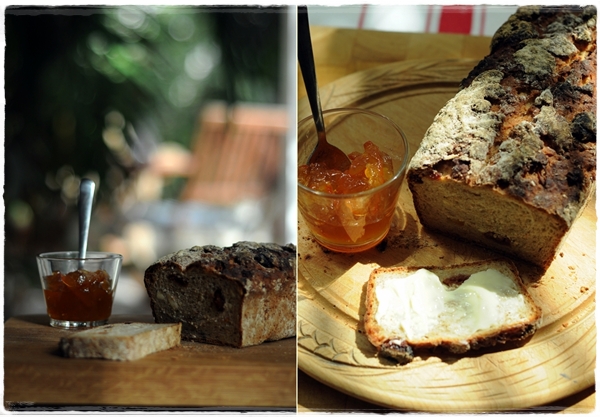
If you fancy baking a fruit loaf do check out Sarah’s recipe plus read more about Fresh From the Oven on Utterly Scrummy, where this month’s roundup will be posted at the end of May.
Do you stick to the same old favourites for breakfast or ring the changes?
Baking a new pie
Notice a difference?!
This month has been exceptionally busy for a number of reasons; so why have I found time to bake many more loaves of bread than usual? This is what I love about cooking. Under times of stress, it’s a creative outlet with a purpose i.e. someone can eat it. This is not only therapeutic and relaxing but practical; believe me, I have folders full of watercolour paintings and some rather large canvases that need a home.
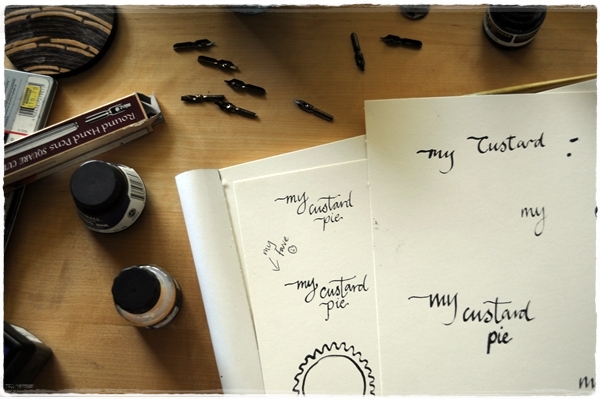
Writing and designing this blog is my other outlet. I use the Vigilance theme on WordPress.com which gives the options to change the header (the big picture at the top), the background colour and link colours. There is a frankly worrying amount of gorgeous free stuff available legally online (worrying because I think people don’t expect to pay for creative services anymore but that’s another soapbox). I Googled ‘free headers’ (try it and see) and eventually found this quirky hand-drawn one which has served me well for two years. The ‘My Custard Pie’ text (again using a font downloaded for free) was added using nothing more sophisticated than Microsoft Paint.

In the meantime I’ve had ideas swirling around in my brain. If you are not familiar with Pinterest, it’s an online pin-board where you can organise images and videos. Illustration and hand-drawn lettering has always appealed to me. I adored the Down with skool! books as a child and relished the anarchic script and ink-blotted pictures drawn by Ronald Searle whose work I continued to admire; ironically the school was called St Custards. I started a few boards on Pinterest for inspiration including ‘drawing and writing‘ and ‘impeccable illustrations‘.
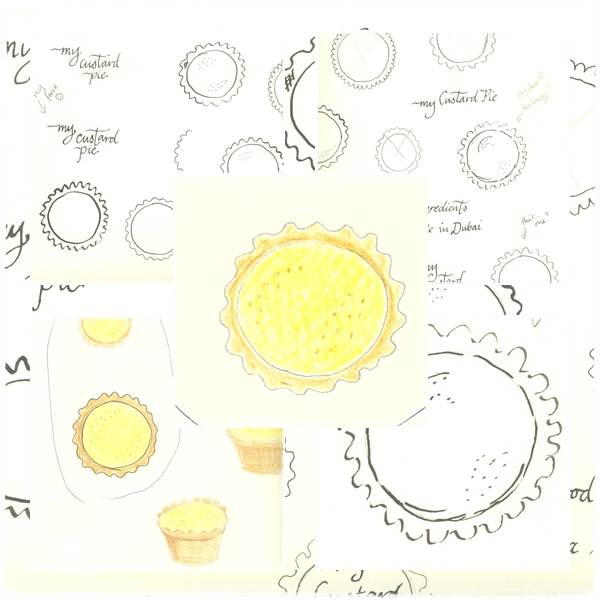
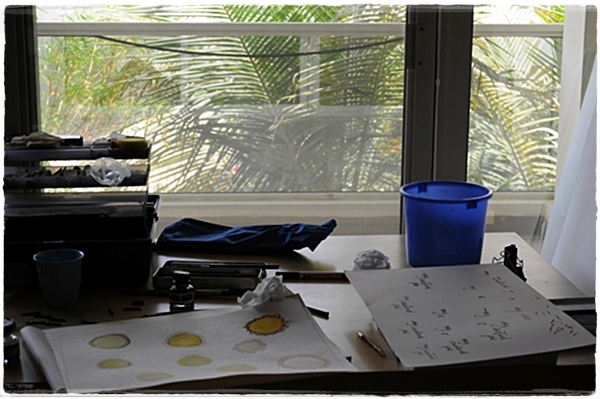
It was time to put thoughts into action; so last week I sat with Dunk a designer at ATOM and talked over my ideas. Then I sat down at my desk for the first time in ages with watercolours, pencils and pens. The first designs from Dunk were good but there was something missing; it needed hand-lettering and my pencil pies lacked ‘umph’, so it was literally back to the drawing board – me for the lettering and ATOM for the illustration. I was thrilled with the final logo and header results – it’s hard to explain, but for something as personal as a blog, it feels like me. Maybe it’s my imagination but I think ‘my Custard Pie’ logo even has an unexpected ‘Searlishness’ about it.
I hope you like my new look as much as I do. Do leave a comment (although I won’t be able to reply until next week as I’m off to Kathmandu for the weekend). What’s your favourite stress-busting creative activity?
Now is the month of Maying…in my kitchen
Now is the month of Maying, when merry lads are playing. Fa la la la la,
Each with his bonny lass, Upon the greeny grass. Fa la la la
This slightly risqué old English song about lads and lasses getting frolicksome is one of my favourites (listen here) and brings back happy memories. Once upon a time I would be looking forward to warmer days, watery sunshine, Spring flowers, walking in the countryside and the promise of Summer. Here in Dubai I’m clinging desperately to the last hint of freshness in the air as the daytime temperatures start to climb. I have to walk the dogs at 6am as an hour later they start to pant and look forlorn.
I certainly want to eat lighter food and spend less time by a hot oven too. What’s in my kitchen this month reflects this plus I’m still benefitting from the lovely goodies from last month’s workshop.
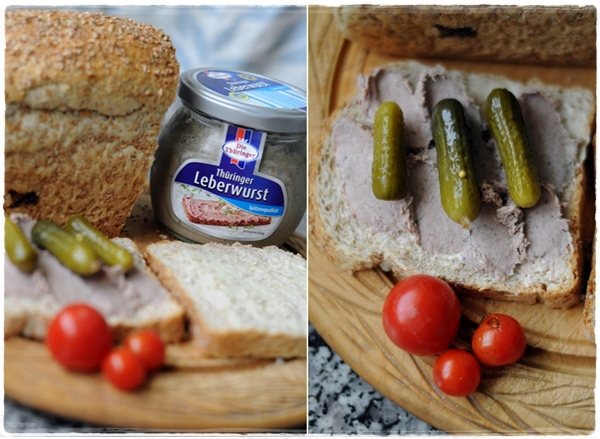
Leberwurst
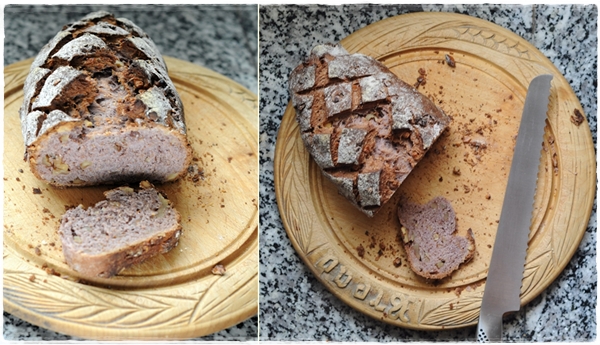
Sandwiches top of the things I want for lunch. I’m presently addicted to a walnut loaf which has red wine in it from the brilliant book Short and Sweet by the equally brilliant Dan Lepard. Otherwise I buy a loaf from Baker & Spice. Kind Meeta brought a jar of Leberwurst – a type of pâté that her part of Germany is particularly famed for – and I’ve worked my way through it single-handedly, paired with cornichons and fresh tomatoes.
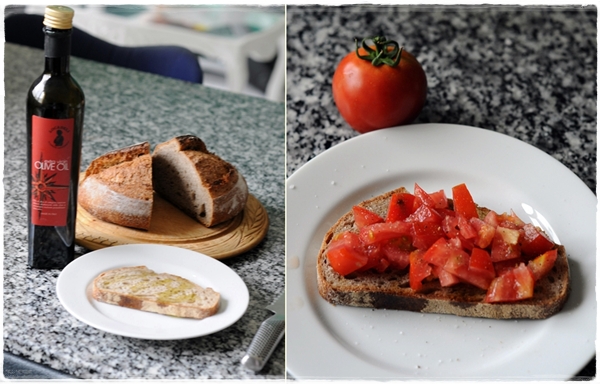
And tomatoes are the best thing to buy from the farmers’ market right now. Chopped and dressed with a little really good olive oil (I use the grassy-flavoured one from Giorgio Locatelli’s own olive grove in Sicily available at Atlantis), a tiny splash of sherry vinegar and some sea salt and black pepper, I stir them into pasta or scoop them onto bruschetta or just a lovely fresh piece of bread.
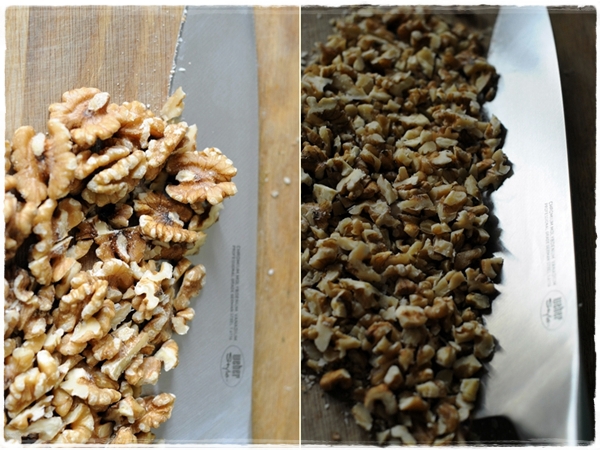
My new very large knife from Weber is perfect for chopping nuts
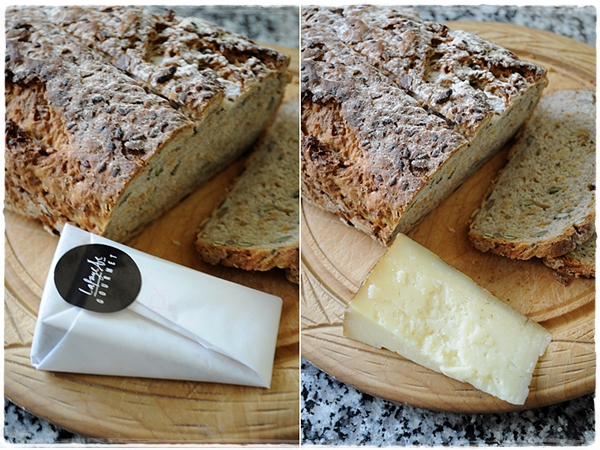
I was lucky enough to go to the launch of the new tapas area within Lafayette Gourmet this week. It’s called Tapeo, the chefs are Spanish and they do a simple, authentic and very tasty paella among other things. It’s the first time that I’ve had a piece of cheese and a Seville orange in a goodie bag – and I’m not complaining. I presume the cheese is manchego or something similar. It’s tangy and crumbly and goes really well on multigrain and honey bread (Short and Sweet again) with some membrillo (quince paste).
The Pierre Hermé chocolates almost don’t qualify as they were in my kitchen for such a short space of time. They had gorgeous ganache-style centres with intense flavours such as ginger and salted butter caramel . I’m very good at having a small amount of chocolate and making it last a long time. Sadly the rest of the family don’t share my puritanical eking out. We had a huge bag of Lindt Neapolitans this month too which disappeared before I managed to eat a single one (let alone take a picture). It’s GCSE time in our house (major exams) which I think accounts for the rise in chocolate consumption.
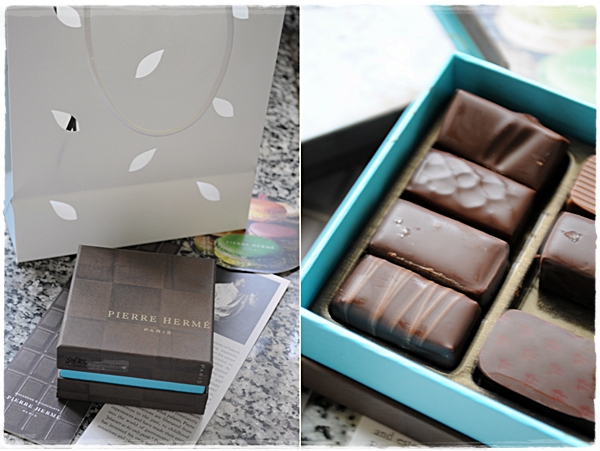
A combination of the heat and me opening the box upside down mean they look a bit bashed – but they tasted amazing.
Hope you enjoyed the peep into my kitchen this month. As aways this foodie voyeurism is inspired by Celia of Fig Jam and Lime Cordial.
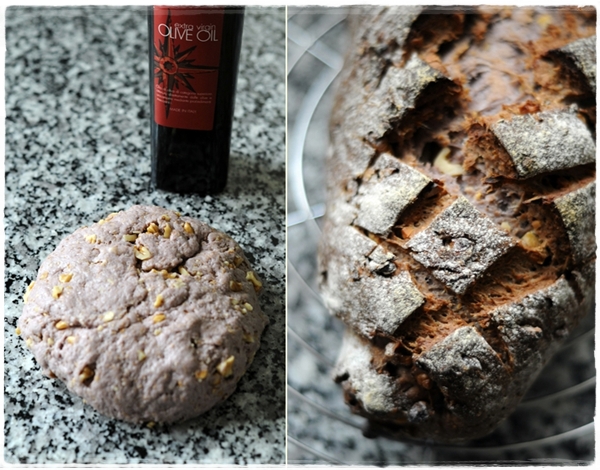
Oiling the work surface for Dan Lepard’s method of gentle kneading of this walnut studded dough – the pink hue is from the red wine in it
Perhaps I should have called this ‘bread in my kitchen’! What’s in yours this May?
The perfect cup of coffee
 My husband can drink a double espresso at the end of dinner and is asleep as soon as his head touches the pillow. My teenage daughter is now following in his footsteps. However, this isn’t because they have some genetic immunity to the stimulating effects of caffeine as espresso-based coffee is only actually in touch with the coffee for 20-25 seconds. This means less caffeine is extracted than methods like filter coffee; and accounts for why Italians are able to down little cups of seemingly strong ristretto throughout the day without their pupils being the size of saucers and hopping around like the Energiser bunny.
The school
I was in the International Institute of Coffee & Barista Training at Knowledge Village, Dubai on a morning’s course to learn how to make the perfect cup of coffee at home. The course was taken by Radi who knows a phenomenal amount about coffee and coffee-making. This was serious stuff and the facts and figures came fast and furious:
500 billion cups of coffee are consumed worldwide every year.
This will continue to grow, for instance Starbucks is opening 1,100 new shops in China
Coffee drinking outstrips tea in the United Arab Emirates with 7156 tonnes of coffee sold in 2011 (up 11%)
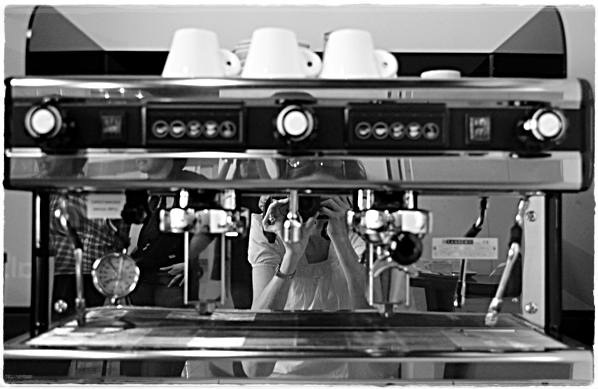 The last point is perhaps no surprise as this region played a major part in the early history of coffee. The story goes something like this:
The story
A goat-herd in Kaffa, Ethiopia noticed that his animals became rather frisky after eating certain fruit and he found similar stimulating effects when he ate them himself. Traders from Yemen took the cherries back to their lands and started cultivating them; a brew was used by sufi monks to help them stay awake during prayer. Gradually, trade in the beans started to reach wider and wider throughout the Middle East but the Yemeni’s protected their monopoly for two centuries by never selling the raw berries or plants. The port city of Mocha in Yemen was the major trading hub and beans were exported as far as Turkey where they were first roasted.

Coffee houses started to spring up around Europe and its first reputation as ‘the drink of the devil’ was overturned when the Pope blessed it. Eventually a sea-captain smuggled some plants across to the new colonies and planted them in Martinique. Coffee was declared the national drink of the colonized United States by the Continental Congress, in protest against the high taxes levied by the British government on tea. The first espresso machine was made in France in 1822 but the Italians adopted and perfected it; there are over 200,000 espresso bars in Italy today. Apparently lots of people think that coffee actually grows in Italy rather than a narrow sub-tropical band around the earth.
The beans
Now I always thought there were lots of different kinds of beans but there are only two: Coffea Arabica and Coffea Robusta and although the former is thought best, culture and taste often determines the blend. Like grapes for wine-making, the location, soil, altitude, climate and weather effects how the beans taste and single origin coffees often have a unique flavour. We all had a good laugh about Kopi Lowak, the most expensive coffee in the world as the coffee cherries go through the digestive tract of a civet before being collected. There is a trial to replicate this method with goats (goffee?!).

We smelled some unroasted beans, they had little aroma as it is by heating the beans that the colour changes, the sugar caramelises and oils are released to give the scents and flavours we love. A darker roast gives a stronger flavour, less caffeine and more bitterness (and can mask poor quality beans). Again, the degree of roasting can depend on national tastes; in Spain they love a burnt taste, French and Italians favour medium roast and the Scandinavian’s prefer theirs lighter.
More wine tasting analogies when it comes to assessing quality: colour, aroma, flavour and body. Getting a particular flavour and taste is difficult from a single estate which is where the art of blending comes in.
Radi went on to explain how cleanliness of equipment, the freshness of roasting, the timing and techniques of grinding, storage and packaging, water and brewing time all has an impact on the final taste. She demonstrated how to make Turkish coffee and how to use a French press, a moka pot and filter coffee.
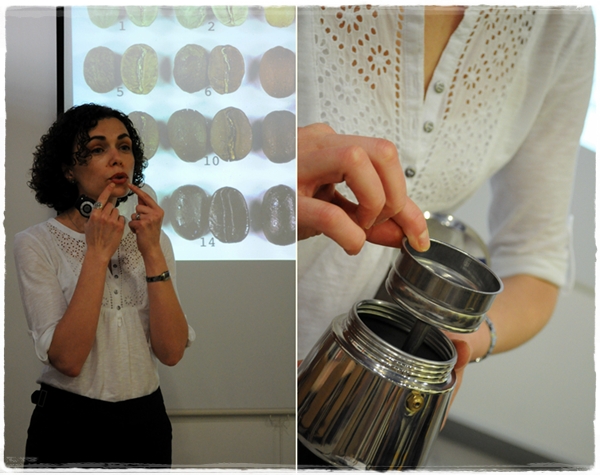
Radi also showed us how to make coffee using the espresso machine and she explained exactly how to achieve the perfect ‘crema’ which is the hazelnut coloured layer on top of the espresso which is a concentration of the essences from the coffee. Any white disturbing this shows that unwanted elements have started to be extracted. The precision and intricacy involved made me appreciate how difficult it is to get a good cup of coffee and how much depends on the skill of the barista.
Five essentials for good crema:
- Use a clean machine
- Use freshly ground beans
- Correct grind size for the coffee-making method
- The ‘thump’ to compress the coffee in the holder must be just the right pressure.
- Calculate exactly the right time for the water and the amount of coffee to get the perfect crema.
Believe me you can taste the difference.
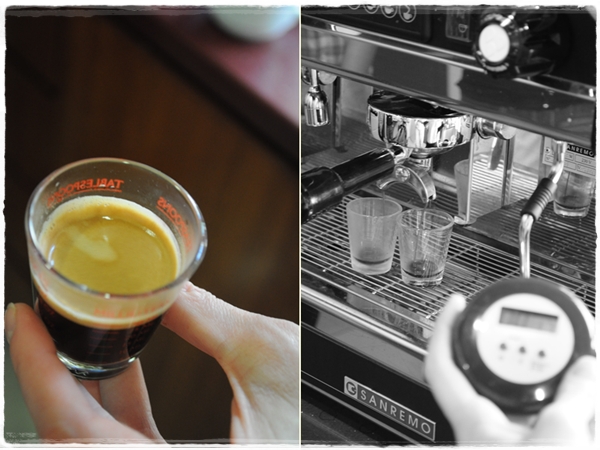
My morning at the IICBT was one of the most informative and enjoyable learning experiences I’ve had for a long time. I’ve recounted only a small amount of what was covered and feel I now have an understanding of coffee that I’d never had before. Cafés of Dubai watch out; there’s a new discerning customer on the loose! The IICBT does a range of courses, some aimed at professionals in cafés and restaurants, but others for enthusiasts like ourselves (all food bloggers). The cost is reasonable too, a day’s course is 550 AED including lunch.
There was a quick competition to rearrange some words into a sentence – my favourite kind of pastime. I won lunch for two at the restaurant at their Italian restaurant Tichino’s in Silicon Oasis. I’ll let you know what the food is like, but one thing’s for sure, I’m sure they’ll serve a good cup of coffee.

Read more about coffee
There are many blogs dedicated to coffee – here’s 42 of them. Is the rise and rise of coffee shops good for urban development? This blogger thinks so. Coffee prices are at a 30 year high due to increased demand (Brazil and China) and speculative investments leading t0 an impact on Fairtrade agreements – BBC R4 Food programme investigates. Raw Coffee Company roast and supply Dubai’s only premium 100% organic 100% fair trade fresh Arabica coffee. What makes coffee exceptional? Colonna Dashwood might have an answer.
Disclosure: I was a guest of IICBT
Are you a coffee aficionado? Or does a jar of instant lurk in your cupboard (like it did in mine until this course!)?








 My Custard Pie