Raspberry and chocolate muffins
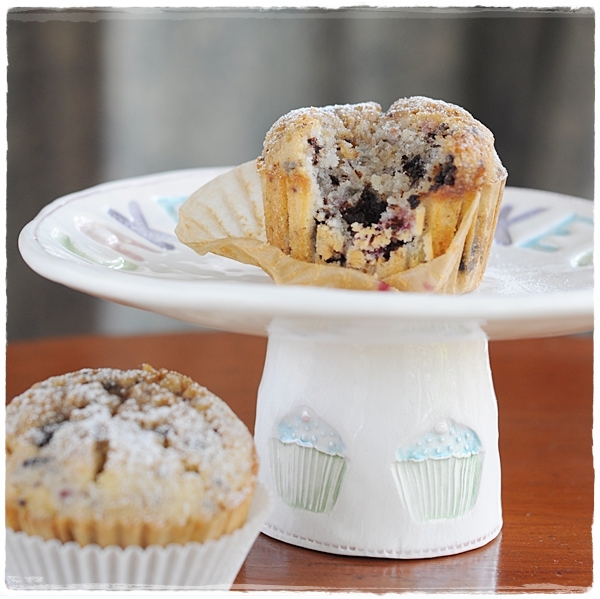 There is a hole in my life where the Great British Bake Off used to be. For the second year running this competition followed the highs and lows of the quest to find Britain’s best amateur baker. Presented by witty comedy duo, Sue and Mel who were permanently eyeing up the cakes and sometimes ate vital ingredients, judged by culinary experts Mary Berry and Paul Hollywood who dispensed practical baking advice liberally and supplemented by snippets of food history from the origins of Battenberg to Henry VII’s role in recipe development, these were the ideal ingredients for a must-view programme. We watched this as a family (rare in our household these days) until my teens boycotted it after Jason was voted off. In the final episode there was a little bio on the contestants including Mary-Ann who was filmed browsing through her collection of 700 cook books. My family turned and looked at me knowingly. “I haven’t got 700!”, I shrieked defensively; however, it must be said that I can’t resist the allure of entering someone elses kitchen or menu through the pages of a cookery tome as the bowing of the bookshelves testifies. As my collection grows, recipes languish and some books are neglected including The Bourke Street Bakery book that I was introduced to via last year’s finalist Ruth of the Pink Whisk .
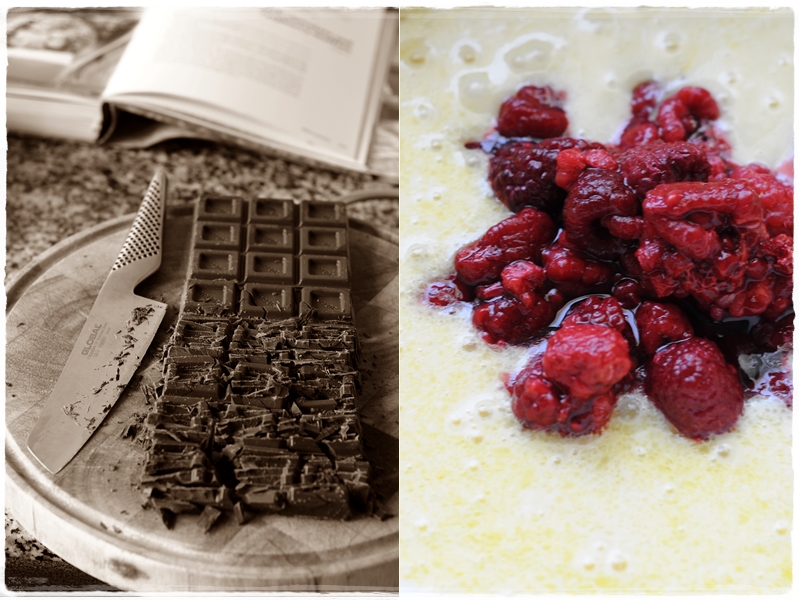
Prompted by a moan from my teens that “you never bake anything we like” after they turned up their noses at healthy beetroot muffins, with a pang of ‘neglectful Mother’ guilt, I made the raspberry and chocolate ones from Bourke Street. In a world where everything seems to be ‘the best ever’, will you believe me when I say that these were the best muffins I have ever tasted? So good that the teens were in raptures, so good that I started eating muffins for breakfast (just to use them up you know), so good that I had to make another batch within two days.
Now this recipe is a bit controversial on internet forums I notice (especially in Australia) with people saying that they aren’t really muffins and that the very liquid consistency of the mixture makes them hard to deal with. Nonsense I say – they were really simple. I’ve adapted the recipe so that you get lots of smaller muffins rather than the BSB huge ones and I used frozen rasbs as the fresh are ruinously expensive here in Dubai. This makes them a store-cupboard baking stand-by.
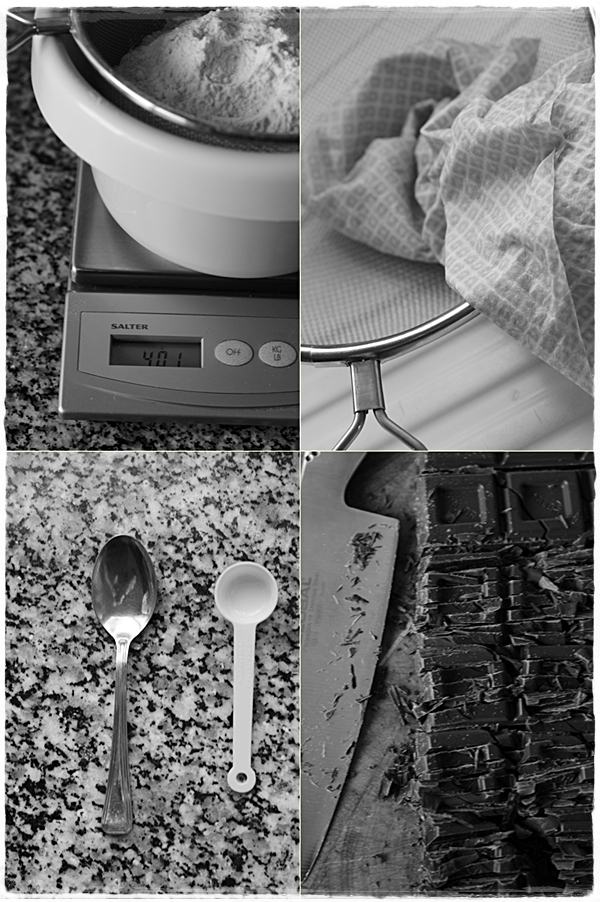
Five baking tips:
- Put your sieve and bowl straight onto your digital scales and set to zero. This way you can sieve and weigh at the same time.
- If you’ve used your sieve for a dry ingredient, it usually only needs a quick wipe with a cloth (they are devil to dry when you’ve washed one up).
- Use a teaspoon measure not one you use for stirring tea (to ensure accuracy)
- Use a sharp, thin, long knife to cut chocolate in very thin slices lengthways, then turn and repeat widthways. You get even chunks and it’s quick and easy.
- An ice-cream scoop (the type with a little lever on the handle) is the best tool for scooping mixture into individual cake tins.
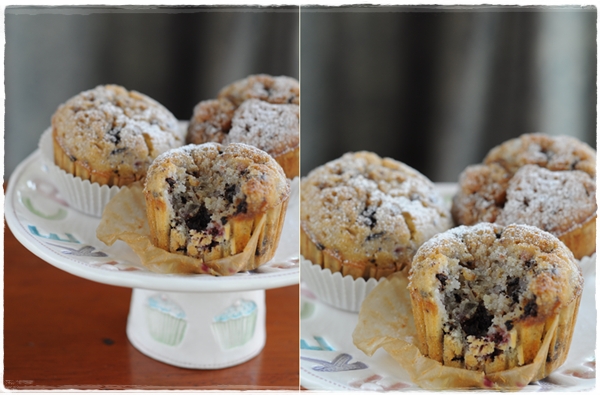
Raspberry and chocolate muffins – adapted from The Bourke Street Bakery
Makes 18 standard sized muffins
400g plain flour
2 teaspoons baking powder
300g vanilla caster sugar
310g unsalted butter
480ml buttermilk (you can make your own)
1 teaspoon vanilla extract
3 eggs, lightly beaten
225g dark chocolate, roughly chopped
225g raspberries, fresh or frozen
55g light brown sugar
Icing sugar, to dust
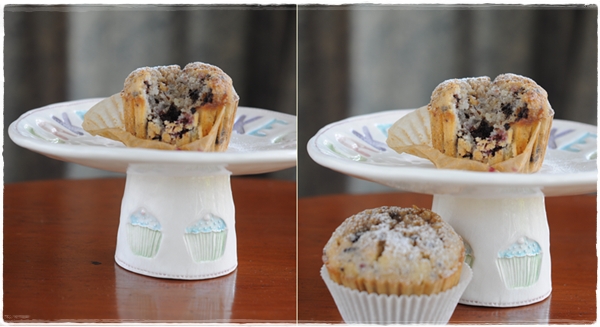
1. Preheat the oven to 190°C. Lightly grease a 12-hole muffin tin plus half of another one and line with paper cases.
2. Sift the flour and baking paper into a bowl and add the sugar, mixing well to combine.
3. Melt the butter in a saucepan over low heat, then remove from the heat and stir in the buttermilk. Using a whisk stir in the eggs to combine. Pour over the dry ingredients and whisk to combine but making sure it is still a bit lumpy. Use a large spoon to gently fold through the chocolate and raspberries.
4. Use an ice-cream scoop to measure the mixture into the prepared muffin tins. Sprinkle the tops with light brown sugar. Reduce the oven temperature to 180°C and bake for 20-25 minutes.
5. If cooked,the muffins will be firm if you push the top gently. Remove from the oven and allow to cool in the tins for 10 minutes before eating. Dust with icing sugar to serve.
What are you waiting for? Go and make them now. They contain one of your five-a-day don’t they….?
Custard Mingle
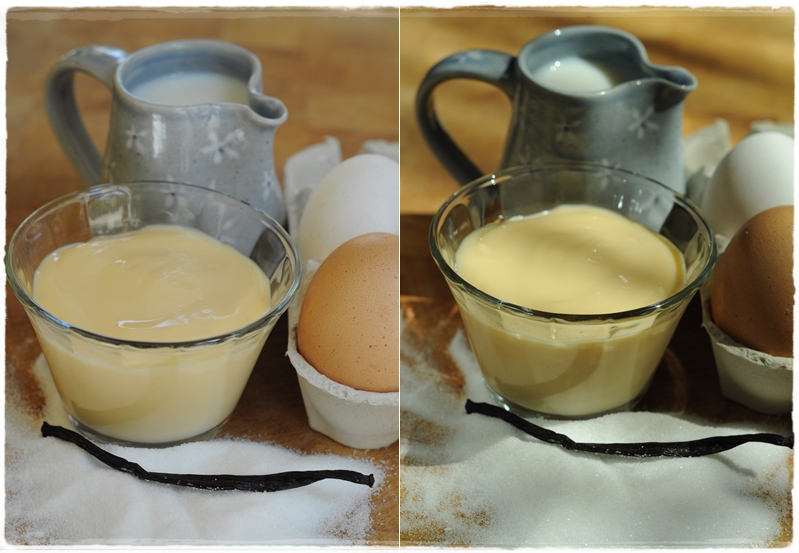
Custard in sunshine and shade
Custard; the alchemy of combining egg yolks with milk or cream and transforming them, by cooking, to an unctious, golden substance that I can’t resist in any form. When poured over a blackberry and apple pie, the fruit picked from the hedgerows, it’s my Autumnal food epitome. Then there are all the other sweet variations from crème brûlée, to egg custard tart, to crème anglaise in a dainty profiterole and, lest we forget, as a base for the best ice-cream. Furthermore there’s its savoury incarnation from quiches and tarts to components of some moussaka and bobotie recipes.
Are you inspired? I hope so because as the host of this month’s Mingle I can’t wait to see what you come up with. Thank you to Meeta, from What’s for Lunch, Honey? one of the warmest, generous and most talented food bloggers and photographers in the Universe for bestowing this hosting honour upon me. I can barely contain my excitement! See the rules for the Mingle below and do join me so we can make this the biggest, best and yellowest celebration of custard there has ever been.
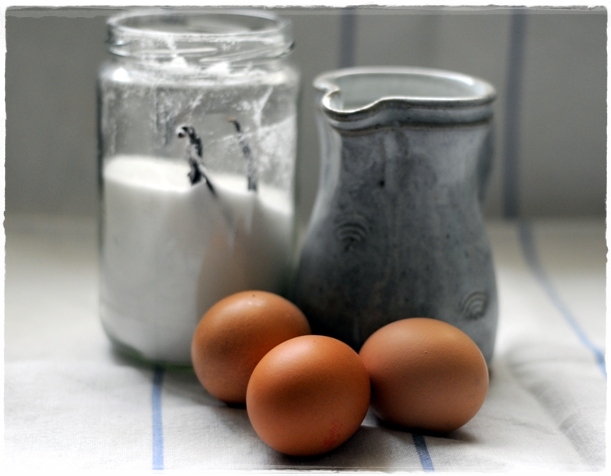
For anyone who wants to join me, here’s what to do:
1. Create a dish that fits the custard theme as described above.
2. Post about it on your blog from now until November 30, 2011 (it would be great if you could use the Monthly Mingle badge in your posts).
3. Link to this post and/or the official Monthly Mingle Page.
4. Send a link to your post to sallypro1@yahoo.co.uk (with “monthly mingle” in the subject line) and include the following: your name, your blog’s name and URL, the name of your dish/food/entry and the URL/link to your Monthly Mingle post, and a 500-pixel-wide photo.

So grab your apron, some free-range eggs and put Coldplay ‘Yellow‘ on in the background. I can’t wait to see what you come up with.
Here’s my recipe for plain simple custard sauce or crème anglaise to get you in the mood..
Crème anglaise
Ingredients
300 ml (1/2 pint) milk
1 vanilla pod, slit with knife
3 large egg yolks, beaten
1 tablespoon (15 ml) caster sugar
Method
- Heat the milk together with the vanilla pod in a heavy-based saucepan until almost boiling. Remove from the heat and leave for 20 minutes so the flavour of the vanilla can infuse into the milk. Remove the pod (you can rinse, dry and store in sugar to make vanilla sugar).
- Put the egg yolks and sugar in a bowl and whisk until thick and creamy. Gradually whisk in the warm milk, quickly wash up the saucepan, then strain through a seive back into the clean pan.
- Cook over a low heat, stirring constantly with a wooden spoon, for 10-20 minutes. It’s ready when it coats the back of the spoon. If you have been stirring for 10 minutes and nothing is happening, raise the heat slightly. The mixture must not come to the boil. If it does start to curdle, strain into a cold bowl, add a few ice cubes and whisk hard.
Think of all the flavours you could add to this alone…orange, lemon, chocolate, cardamon, lavender… See you for the round-up.
P.S. Since posting, I’ve had a minor rebellion about the Coldplay suggestion in my comments! So what would you choose to play in your kitchen?
Russian aubergine and green pepper dip – zakuski
 My new barbecue waves at me from the patio outside my kitchen window and beckons me at every cooking opportunity. Pears, gingerbread, fish, chicken, tofu, asparagus, mushrooms, broccoli and a full English breakfast have already been transformed on its cast iron bars. My personal transformation when cooking was not always so positive when the temperatures were high and humid here in Dubai. I’d dive in through the back door for a few lungfuls of conditioned cooling air before dashing back out with my tongs, emerging slightly glowing (this is irony). While we were eating the fruits of my labour the other evening I threw a few aubergines and a green pepper under the lid and rescued them about 30 minutes later. They were blackened to perfection and I’d planned to make mutabal or baba ganoush with them. However…

…Nikki from Art & Lemons wrote about zakuski. There are mezze aplenty in this part of the world and tapas is hardly unusual, but zakuski is a new one on me (reminding me of my very strange teacher, Mrs Kus, who determined guilt of a crime in our class of 7 years olds by pressing our noses). Russian travellers would be welcomed back from a journey or guests tempted with these morsels while they waiting for the main banquet. Intrigued, I wanted to join Nikki’s virtual zakuski party right away and found to my surprise that Russians eat aubergine dip too. These Mediterranean fruit are not something I conjure up in my mind’s eye when thinking of the steppes, snow-laden Moscow or the extremes of Siberia. It’s intriguing that ‘aubergine caviar’ a dish so redolent of the Middle East could have a Slavic version but then a map tells me that the Caspian sea borders Iran as well as Russia. It reminds me that although nations have differences, it is very often food that brings people together.
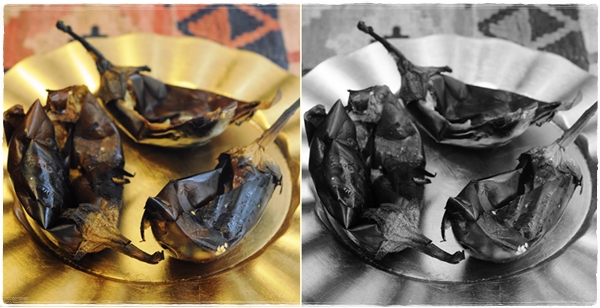
Blackened empty aubergine shells
The zakuski party (as part of Meeta’s Monthly Mingle) where people of all nationalities and backgrounds share food, ideas and recipes, albeit virtually is a tiny part of contributing to that understanding.
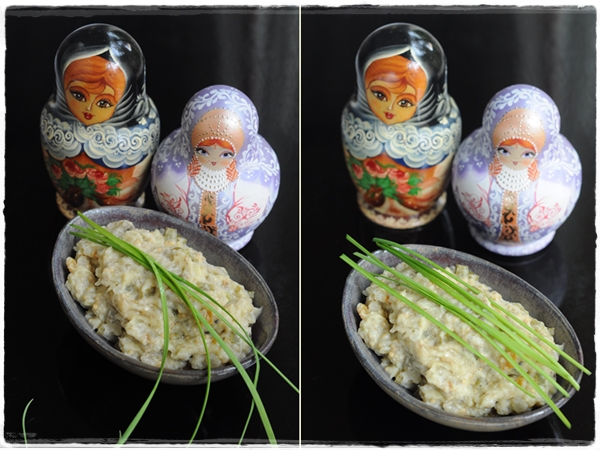
It’s not the most beautiful dip but deliciously smokey and perfect ladled up with some arabic bread. Infused vodka is also part of the zakuski table so a shot of my pear vodka would be perfect too (served with ice cubes containing a sliver of ginger).

Russian aubergine and green pepper dip
Ingredients
3 medium aubergines (eggplants)
1 large green pepper
olive oil
1 medium onion, finely chopped
2 cloves of garlic, finely chopped
2 tablespoons sour cream
juice of half a lemon
sea salt and black pepper
garlic chives (optional)
Method
Prick the skins of the aubergines and place with the green pepper on a hot barbecue over direct heat with the lid closed for about 30 minutes, turning occasionally. The skin of the pepper should be blackened and the aubergine black and totally soft, almost collapsing in the middle. You could wrap up a whole head of garlic in a double layer of heavy-duty foil and roast it at the same time too. While the vegetables are on the barbecue (or in a very hot oven), saute the onion and garlic in a little olive oil until soft but not coloured (about 10 minutes). If you don’t want to roast the pepper you can chop into small pieces and saute this at the same time too.
When the aubergine has cooled slightly cut in half and scoop out the flesh, remove the blackened skin, membrane and seeds from the pepper and chop. Mash all the ingredients together with a fork, stirring in the sour cream. Season and add lemon juice to taste and garnish with garlic chives.
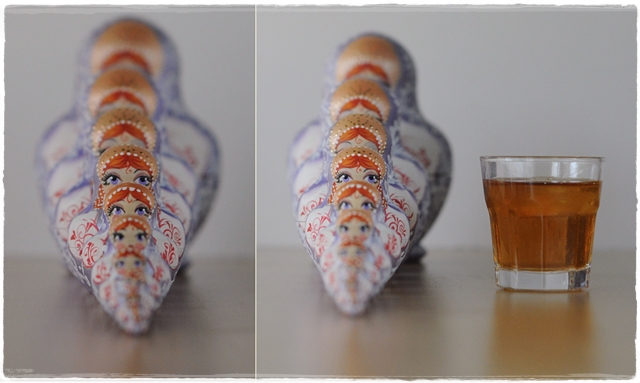 What’s your favourite food to share?
P.S. I’m thrilled to be the host for next month’s mingle, so please come back on 1st November when I’ll announce the theme. Can you guess…?!
Lemon curd buns with creamy lemon icing
 When I took on the Chelsea bun challenge I knew I’d be the only one to eat something with dried fruit in it so did a chocolate and cinnamon version with cream cheese icing that got hoovered up immediately. Therefore, when Claire suggested we make cinnamon buns I cast about for an alternative flavour. Sorry Claire, my ‘cinnabon’ recipe is now in the hall of fame in our household and there will be no usurpers tolerated by my younger daughter. Thinking of the icing I knew that lemon would be good but would it work as a filling? I tested two ways; one using a lemon, butter, sugar combination and one with copious amounts of homemade lemon curd – after all it’s made with the constituent ingredients. Light, fluffy, lemony with a seriously addictive topping, they were eaten before I had time to take extremely pretty pictures. So you’ll just have to imagine the doughy interior soaking up the citrus juices bathed in a blanket of cream cheesiness. Americans seem to have this sort of bun for breakfast but I would say it’s a tea-time treat (or anytime you just have to dip your finger into the icing). Home-made lemon curd recipe to follow very soon (or use a good shop bought version).
Pop over to Fresh From The Oven in a day or two to see all the other lovely cinnamon buns (with my rebel version included).

Lemon curd buns with creamy lemon icing – recipe adapted from Cinnamon buns by Things We Make
250ml lukewarm milk
2 sachets of instant yeast (14/15g)
1 tablespoon caster sugar
2 egg yolks
50g Melted Butter
400g strong white bread flour
200g plain flour
Zest of 1 lemon, finely grated
1/2 teaspoon salt
Filling
approx 150ml lemon curd
Icing
55g unsalted butter at room temperature
55g cream cheese at room temperature
190g icing sugar
1 1/2 tablespoons lemon juice
Zest of 1 lemon, finely grated

Instructions
- In a jug mix the yeast, warm milk and tablespoon of sugar.
- Leave to froth for 10 minutes if you have time then add the melted butter and egg yolks.
- Mix this into the flours, with the salt.
- Knead for 5-10 minutes on a floured surface or in your food mixer with a dough hook for 5 minutes.
- Put in a large bowl with a plate on top and leave in a warm place until doubled in size (1-2 hours)
- Knock down and flatten out until it’s about the size of a large baking tray.
- Slather with the lemon curd
- Roll up so you have a long swiss roll type thing.
- Slice into 2″ slices and place in a deep cake tin
- Claire used a 26cm Kaiser tin, with a bit of butter rubbed into it, I used a rectangular baking dish.
- Allow to rise for another 1/2 hour.
- Bake at 200 C for 10 minutes
- Cover loosely with foil and bake for another 15 minutes or so.
- At this point I brush it with a little melted butter and put it back in if not quite cooked through but it’s probably not necessary. I am a born fiddler.
- Tip out straight away – using a plate to tip it onto then back onto a 2nd plate.
- To make the icing: Mix the butter and cream cheese in a large bowl with an electric mixer on high-speed. Add the icing sugar and mix on low-speed until the sugar is incorporated, then add the lemon juice and zest. Mix on high-speed again until the icing is smooth and fluffy.
- Top with the icing and leave to cool….as long as you can bear it.
- They are still good on day two (and even better when warmed for 20 seconds in the microwave)

I love the swirls left in the dish
What brings out the rebel in you in the kitchen?
Eating white truffle with Giorgio Locatelli
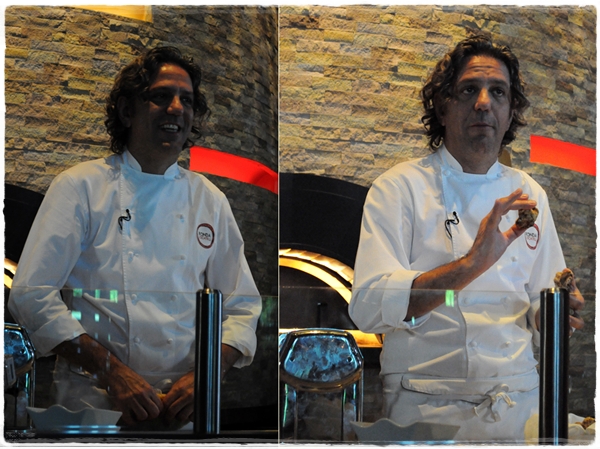 “Every year my Grandfather would get us kids together and we’d pile into the back of his Fiat Cinquecento and drive out to some remote garage in the middle of nowhere. He would hand over some cash for one of the new season truffles which had been picked that morning. The smell of it in the car was incredible; we were pickled by the smell. When we got home, I don’t know how she knew, but my Grandmother was always at the final minute of cooking the risotto and we’d get together as a family for an incredible truffle meal.”
This truffle ritual, his Grandmother’s cooking and standing on a crate, making risotto, from the age of six at the restaurant of his Aunt and Uncle were some of the triggers for Giorgio Locatelli’s lifelong passion for cooking. Working his way through some notable kitchens in Europe, he has earned a reputation as the ‘world’s greatest Italian chef’ (restaurateur Tony Allen), a London-based Michelin-starred restaurant Locanda Locatelli as well as his partnership with Ronda Locatelli at Atlantis, Dubai. Later, when I asked him what keeps him inspired in the kitchen he said “the ingredients”. His wife asks him how he can get so excited about truffle season yet again but, as he says this, he rubs his hands and grins widely. He still retains the enthusiasm of a six-year-old.
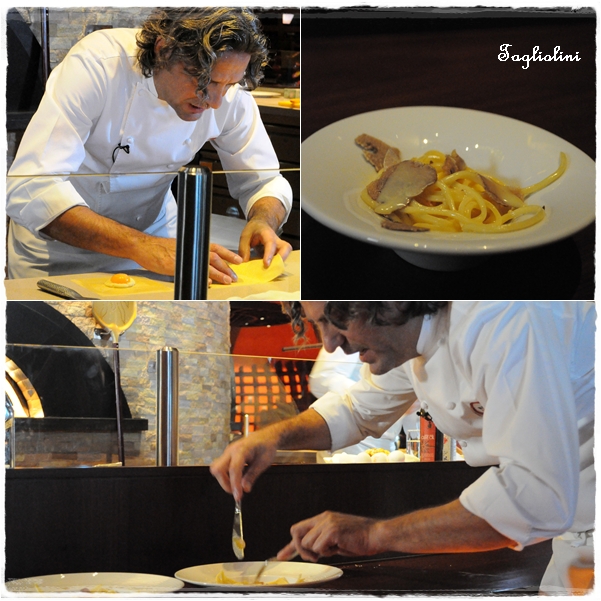
Giorgio making (and feeding me) pasta!
I’m at Ronda Locatelli for the launch of this season’s truffle menu. It includes a cookery demo by Giorgio which we then get to eat. He’s ebullient and energetic and uses expressive English vocabulary almost as though he’s speaking Italian. He imparts rapid-fire, detailed instructions about every stage of the cookery process as well as historical background on the ingredients themselves and what has influenced their use. For example he favours Carnaroli for risotto “a much more elegant grain” but explains that Mussolini’s drive for Italian self-sufficiency caused the planting of Arborio to be widespread.
He says that he is continually striving to use fewer ingredients to make the dishes simpler. “Anyone can add things, but when you leave a restaurant can you remember what you ate? More is a bordello“. This mastery of tastes and textures is demonstrated in the dishes we are served; fresh raviolo filled with a ring of finely mashed potato and an egg yolk; tagliolini slicked with a creamy, butter sauce; parmesan risotto; and zabaglione – all topped with shaved white truffle; simple dishes which in other hands could be very ordinary transformed to ambrosia-like food.
This menu is only for those who adore the musky, umami flavour of fresh, white truffle. “People either love or hate truffle. Sometimes when they hear I am serving it in the restaurant they don’t come in. I like that. I want food to strike a very strong emotion and when it does I’ve achieved something.”
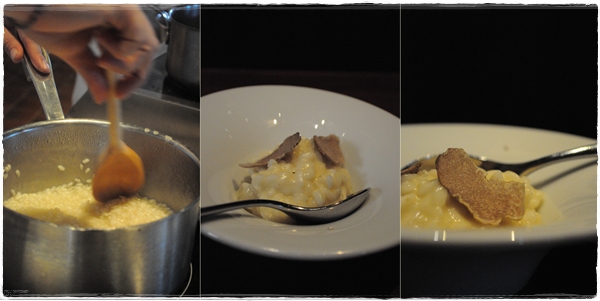 Giorgio visits Umbria at the start of every truffle season and it sounds like a macho-bonding session for lads (not washing, keeping dogs in the dark, getting up at dawn then sitting around a camp fire eating a slice of fresh truffle with bread and some fried eggs). The French use pigs where the Italians use dogs “and that shows the difference between us and the French” he quips. The Italian dogs are very highly trained and will signal the degrees of ripeness (one paw raised means unripe, two paws raised means ripe). The Umbrian truffle season is slightly earlier than in Piedmont as it is further South. The whole environment must be perfect for a truffle to thrive and they will not grow in an aeroplane flight path, near to a road or electricity pylon and are very susceptible to pesticides and chemicals. They grow between 10-20 cm underground, nearer the surface if they are close to streams or deeper near trees where they nestle by the roots (lower humidity). Giorgio calls the truffle ” the highest expression of nature”. He cut into one of the knobbly beige fungi and showed us a stripe of red meaning it had grown next to a tree root of an oak tree indicating a higher quality truffle. Foods high in protein go well with truffle but no other flavour can balance it. Eggs are a match made in heaven.
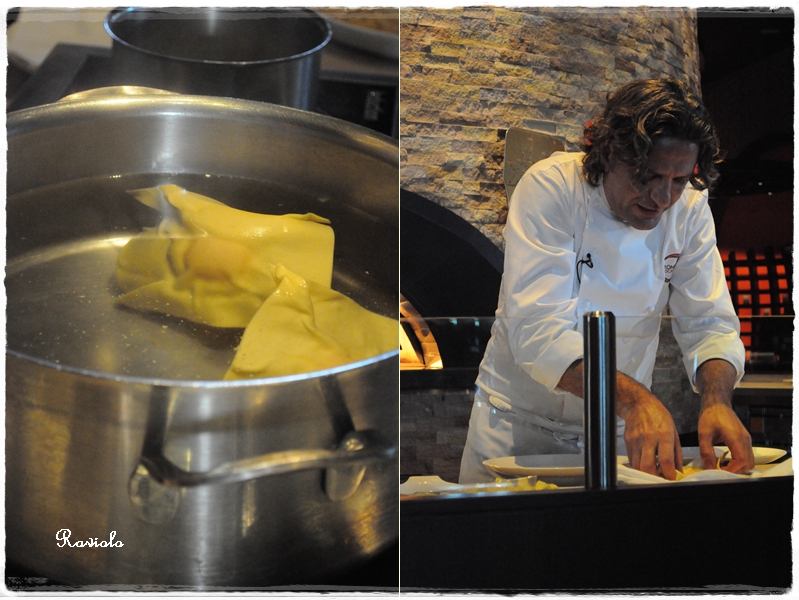
During the session Giorgio tell us about the land he has acquired in Sicily for a project with his daughter. It has taken six years to plant and grow an olive grove to produce his own olive oil and he said it was a great lesson about simplicity, putting passion and love into cooking, and that the island had given him a really vibrant feeling about food. It reminded him of his childhood where there was never TV in the room they were eating, not even radio and he strives to recreate the conviviality of family eating in his restaurants. “A meal is not just about the food. I would rather eat mediocre food with people I love than an exceptional meal by myself.” I agree in principle but would happily skulk off into a corner with a bowl of the risotto or a raviolo by myself. This is good, soul-satisfying food at its very best.
I asked Giorgio about his influences, inspirations, advice for the home-cook and his attitudes to animal welfare. You can hear his replies in the video below.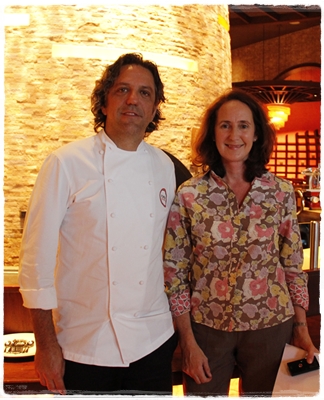
Eight top tips from Giorgio Locatelli about making fresh pasta:
- Eggs in the pasta helps the flavour of the truffle
- Make your pasta with 3 whole eggs, 2 egg yolks and 500g ‘OOO’ flour. Mix until crumbly then bring together in plastic wrap.
- Leave your pasta dough in the fridge for 24 hours to rest
- For home use you can store the dough for up to 7 days in the fridge
- When you roll out the pasta, store the sheets and spare dough under a damp cloth or give it a little spray of water to stop it drying out
- It’s best to cook shapes (like tagliolini) a day after you have made them so they dry out a little.
- Pasta shapes can to vary a little, it’s good to look homemade. Food doesn’t have to be perfect it just has to be good.
- Don’t add oil to the cooking water. If you want extra flexibility put a spoonful of oil into the dough
The truffle menu is available in October and into November at Ronda Locatelli, Atlantis The Palm, Dubai. Tel: +971 4 426 2626 The truffles are from San Pietro a Pettine, Trevi in Umbria.
P.S. I bought Giorgio’s new book Made in Sicily this week (in Kinokuniya Dubai), which looks at the ingredients, history and some of the local cooks and growers of the island as well as very simple, authentic Sicilian recipes. Good reference and a great read.
Disclosure: I was a guest of Atlantis Dubai at the demonstration.
Cheese snob
 Do you have any food obsessions? Looking through the chapter headings of a book titled Obsessions featuring the ‘favourite foods and heartfelt passions’ of the ‘Two Fat Ladies’ (Clarissa Dickson Wright and Jennifer Paterson) there are many that strike a chord ( and some that don’t). Pasta, garlic, lemons and crab have me scouring the pages, as do mustard, parsley, olives, butter and raspberries. The tripe chapter remains an intellectual curiosity only. However, there is a glaring omission – CHEESE; it isn’t even listed in the index. The neglect of this ingredient by cooks with such gusto for flavour and robust food astonishes me. Perhaps they just enjoyed it on its own with a glass of red wine.

My status as a ‘cheese-anorak’ was officially confirmed this week. Spending two hours with Ana Cerqueira at Jones the Grocer, peering into every nook and cranny of their cheese room had me leaving in a near state of nirvana. My own obsession with cheese has been coming on gradually, partly fuelled by the way the ‘cheese-scene’ is developing. Artisan cheese-makers, both those who have been following a tradition for decades or those who want to rediscover and expand this craft, seem to be thriving.
However, my appreciation of really good cheese was kick-started by the opening of The Fine Cheese Co in Bath in the early 1980s. Bread-filled wicker baskets stood by the door and the air was scented by the loaves made with basil. The cheeses were (and still are) displayed on a chiller cabinet that looks like an Edwardian kitchen dresser. A wheel of Brie de Meaux sat by the till, slowly oozing towards the edge of its platter. You always had to queue but once it was your turn there was no rush, Ann-Marie and team devoted their whole attention to sharing their knowledge, recommendations and genuine passion for cheese with you. Tasting was de rigeur. The business has expanded into branded biscuits and other cheese related items but the shop remains only a little bigger than it was 20 years ago including an excellent cafe.
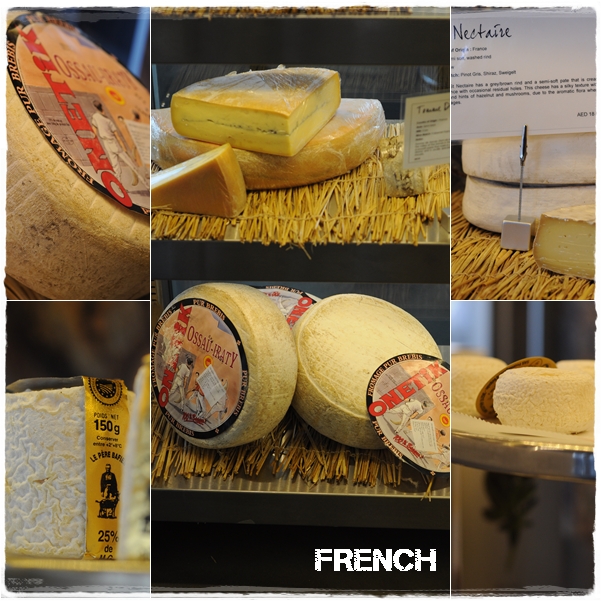
Am I a cheese snob? If this means that my heart-sinks when I pass the section of the supermarket which houses bags of shredded ‘Monteray jack’ in hues of tangerine, ‘mozzarella’ which resembles a house brick and comes from Holland, edible plastic described as ‘cheese strings’ and anything cheesey in a tube, then yes. But I’m not alone it seems given the outcry prompted by Alex James’s foray into tandoori masala ‘Cheddar‘ for Asda (yes mainly by Guardian readers, but I read the Guardian!).
Jones the Grocer manages to have such a unique and eclectic range of cheeses because they import most of it from two main exporters, one French, one British; and lo and behold the UK supplier is The Fine Cheese Co. Popular cheeses can sell out quickly, I noticed that the Devon Blue had gone and apparently the new season Mont D’or had cleared in a few days.
The optimum temperature for cheese storage is 8 C and our conversation kept moving from the warmth of the restaurant to the cool of the enticing cheese room. Wax paper is the idea wrapping (or the rind of the cheese itself for many) but municipality rules means that the arch-enemy of cheese – cling film – is in evidence, although they try to keep it to a minimum. Jones the Grocer trains its staff on every aspect from the production methods and origin of the cheese, how to serve the customer (including food matching suggestions) and – the best bit – tasting.

Ana cut into a new truffle Reblochon that had just arrived, the middle soft and flecked with black. I’m a big fan of this washed-rind style since tasting Baronet at the Tavistock Cheese Fair and this variation was muskily addictive. Our next stop was to compare the excellent Quicke’s Cheddar with its cave-aged cousin, discussing the effect of the humidity on the taste, softening the flavour without lessening its intensity. Although you can buy this by the slice, a whole truckle costs about 300 AED (£50) and would make a fantastic centrepiece for a Christmas spread. The Quicke’s goat Cheddar is popular with local customers who also favour sheep’s milk cheeses. Cheese is supposed to have originated in the Middle East where milk was transported in the stomach of a goat, sheep or cow and the resulting effect of contact with the rennet. The local cheese on offer in supermarkets tends to be very bland but Ana and I both share a desire to discover more about the cheeses of the region.

I spotted a craggy-looking ball with a pumpkin-hued interior; Mimolette, first made in France to copy Edam after Louis XIV banned the import of Dutch cheeses into France in the 17th century. Originally flavoured with carrots but now annatto, it had a slightly sweet, nutty flavour and has to be kept away from the other cheeses as its production includes the cheese mite which gives the distinctive appearance and flavour.
Ana’s theory on variations in cheesemaking is that countries produce it using methods that suit their climates. So the Northern colder places have hard cheeses that take a while to mature and keep for a long time to see them through the Winter, warmer places can make softer, fresher cheeses although they need to be eaten quickly. Italians use cheese for cooking in the main, so most are either very hard (a really excellent Parmigiano Reggiano is stocked) or soft – Jones imports Burrata, buffalo mozzarella and buffalo ricotta.
Manchego, from La Mancha in Spain which has cold winters, is a sheep’s cheese that is hard and dry. I confessed to finding it a bit boring although it’s nice paired with some quince paste. I was given a slice of Idiazabal, a raw sheep’s milk made in the Northern Basque region of Spain by artisan-producer Baztangoa which had a smooth, buttery, nutty flavour which immediately called for some red wine. This will be going on my cheese board.
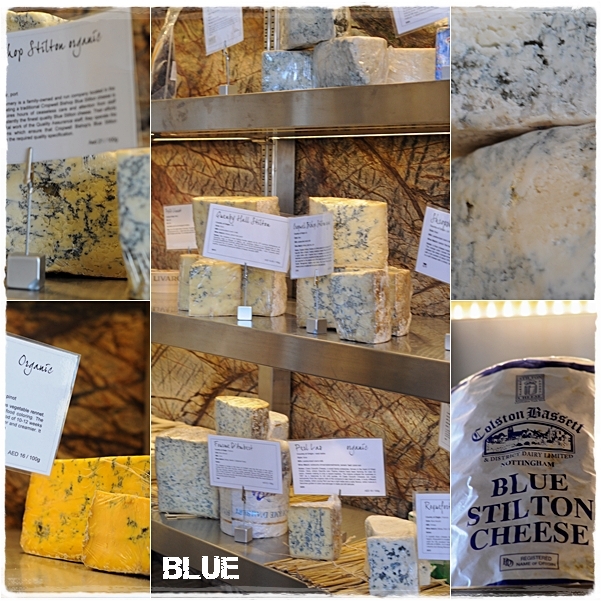
Originally from Portugal, Ana’s passion for cheese had been inspired by her Father who would often pop a slice of Emmental into her hand as she left the house. There is a tradition of cheese-making in the Azores, influenced by the Dutch including a raw milk cow’s cheese called St Jorge which goes very well with Port.
It’s rare to find such knowledge and passion from a food retailer in Dubai, outside the artisan stalls at a market. After nearly two hours of cheese conversation (fromaging?), clutching wax paper parcels, I drove home (a three-minute journey) with the sun glowing red, my obsession temporarily sated.
Jones the Grocer is on Sheikh Zayed Road (opposite Times Square) Dubai, UAE
Tel: +971 4 346 6886
Here’s a little tour of the cheese room from Ana.
Do you have any food obsessions? Or do you just want to talk cheese with me?!
Famine is the new F word, farming, fishing and other food issues

Mountains of grain – Image by Bugman50
Today is World Food Day.
The pages of My Custard Pie are usually filled with recipes and food-related experiences from a privileged point of view. That is having enough money to buy food and abundant food to choose from. This is not the case in huge swathes of our world. On a day where thousands of bloggers are joining a global discussion about food, I would like to add my voice. I believe that we should be very concerned at the amount of influence multi-national corporations have on food policy, quality, safety, animal welfare and the supply chain as their decisions are primarily based on increasing shareholder value. I also believe we can and should make a difference:
Food Inc
If you haven’t seen this movie, watch it today. It will change the way you look at your food forever:
Food speculation
 Price swings, upswings in particular, represent a major threat to food security in developing countries. Hardest-hit are the poor. According to the World Bank, in 2010-2011 rising food costs pushed nearly 70 million people into extreme poverty. “FOOD PRICES – FROM CRISIS TO STABILITY” has been chosen as this year’s World Food Day theme. Read more…
The World Development Movement’s comprehensive report on food speculation.
Banks and the trade in food commodities.
Goldman Sachs and the food speculation frenzy.
Wall Street, food speculation, and grain reserves.
The link between food speculation and high food prices.
How food speculation has impacted on Mexico’s maize farmers – and fuelled a tortilla crisis.
Why we need to regulate food speculation.
How to take action against banks involved in food speculation. *
*Many thanks to Tangerine and Cinnamon for these links.
Organisations tackling world hunger
Action Aid’s Hunger Free Campaign
Campaigns for sustainability and animal welfare
 Hugh’s Fish Fight
Fish stocks are in crisis worldwide with many species severely threatened yet half the fish caught in the North Sea are thrown back into the sea, dead, due to EU fishing laws. Due to public support of this campaign, in July, the European Commission published their proposals for a new Common Fisheries Policy and they included recommendations for a discard ban. This would not have happened without the pressure of the Fish Fight. But that doesn’t mean that the law will actually change. There is another 18 months to go before the new Common Fisheries Policy becomes law, which is why Hugh went back to Brussels to launch the Fish Fight campaign in another 11 languages and countries. The  pressure he generates across Europe could be the difference between success and failure, long-term sustainable fisheries or more years of pointless waste.
Sign up with Hugh’s Fish Fight today.
Other organisations lobbying on fish issues and sustainability:
I’d also recommend Jake Tilson’s book In at the Deep End
 Chicken Out!
Through the Chicken Out! campaign, Compassion in World Farming are reaching out to consumers, politicians, producers and retailers to put an end to the intensive ‘factory’ farming of chickens. This ranges from lobbying to demanding clear and honest labelling so that customers can make an informed choice at the till.
There are around 360 million egg-laying hens in the European Union (EU) and more than two-thirds of them are confined in barren battery cages. Thanks to a vigorous campaign, on 1 January 2012, the EU ban on barren battery cages comes into force. By that day, all laying hens in the EU should be out of these cages.
However, with less than one year to go until the ban comes into force, some countries around Europe are still a long way from complying with the new legislation.
 Food Inequalities
The trouble with trans-fats – read about it here
Listen to it here
Food Poverty (UK)
Blog Action Day
Since 2007, Blog Action Day has focused bloggers around the world to blog about one important global topic on the same day. Past topics have included water, climate change and poverty.
This year, Blog Action Day is on October 16, which coincides with World Food Day, so the 2011 theme is food. I registered for Blog Action Day 2011 to join in the global discussion about food. Follow #BAD11 on Twitter.
Changing things starts with small actions. Sponsoring a child in Africa, trying not to waste food, sending an email to a Euro PM (…you might be surprised, I got a personal response) and making the best choice you can at the till.
Thank you for reading; if there is anything that’s struck a chord please leave a comment. Normal format returns next time.
In my kitchen
 It’s a while since I gave you a peek into my kitchen but I always visit Celia’s over at Fig Jam and Lime Cordial. About my actual kitchen, as British expats in Dubai, we live in a rented house and I’ve had the same kitchen for 11 years. There are things I love about it and things I hate. It’s open plan into a part we used to call the playroom but really should be renamed the dogroom as Rosie and Hazel sneak up onto the sofa and chairs in here. I love the marble work surfaces and the view out of the ‘dogroom’ window of a small palm tree. I loathe the overhead strip lighting and the view from the kitchen window – a cement wall. The hinges are drooping, the drawers sag, there isn’t enough cupboard space (is there ever), but it’s been the scene of so many wonderful gatherings over the years that I forgive its shortcomings. So here’s what’s in my kitchen in October.
In my kitchen …
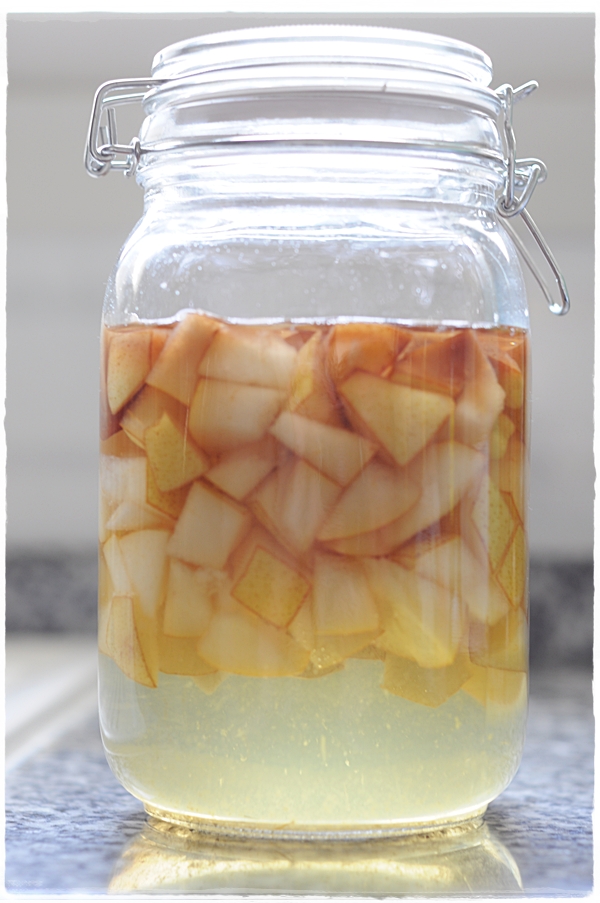
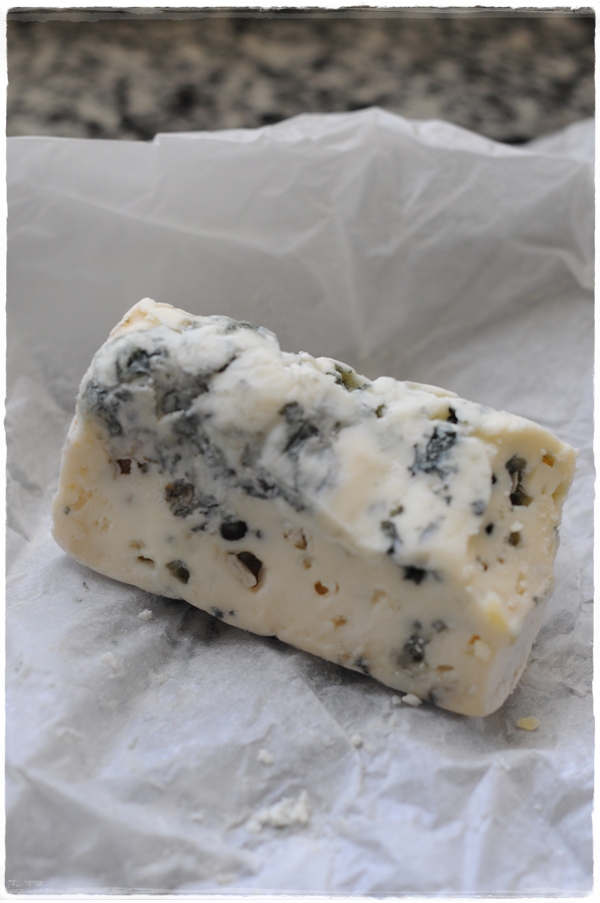
… pear-infused vodka (see above), an amber liquid inspired by Use Real Butter, warming and redolent of Autumn flavours and a slab Roquefort from Jones the Grocer which would go very well with pears.
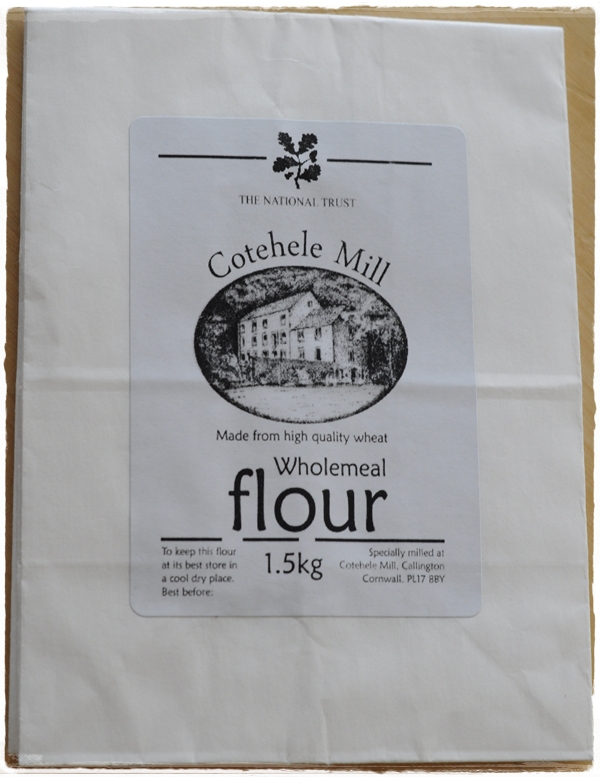
… a bag from the mill at Cothele. Sadly my baggage weight allowance meant I had to bring it back empty from the UK but it’s got a stamp on ready to be posted to the mill to be displayed on their wall.
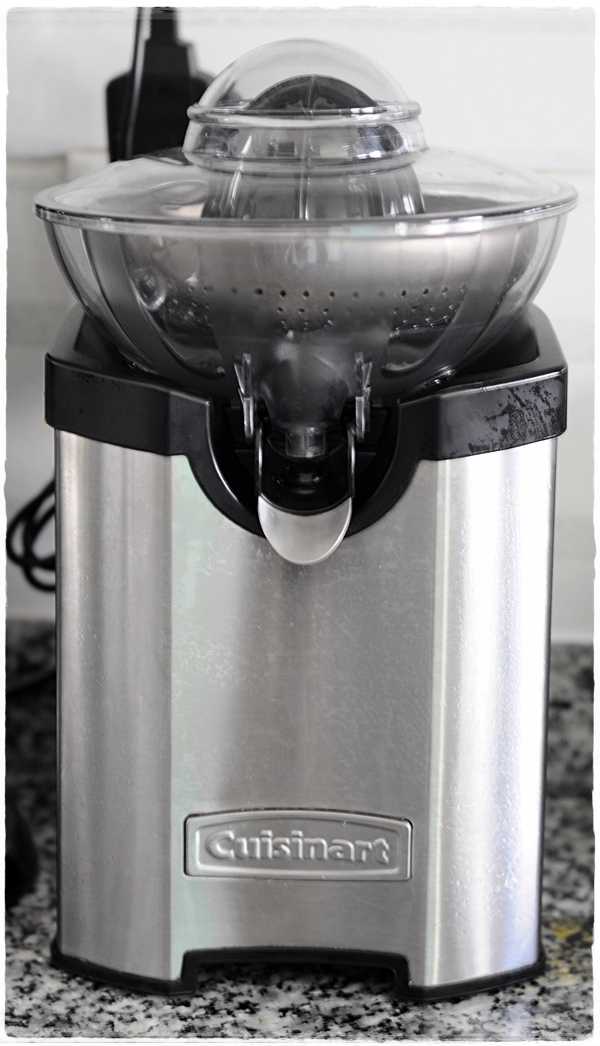
… a brilliant new juice press. My old one died and I’ve been searching for a good replacement for ages. Don’t you just love it when things are designed well? This is brilliant; you lift the spout up and down to control the flow of juice, there’s super-whizzy spin to extract every last drop and it’s easy to clean. I bought it from Tavola in Dubai.
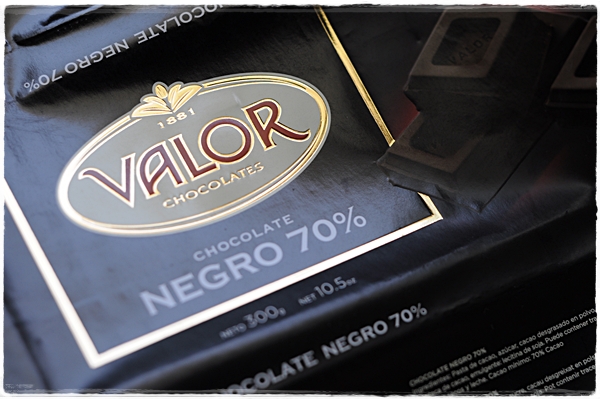
…Valor chocolate. I like to cook with the good stuff i.e at least 70% cocoa solids but it can be expensive. (This is 22 AED for 300g from Choitrams. Carrefour own brand is cost-effective too.)
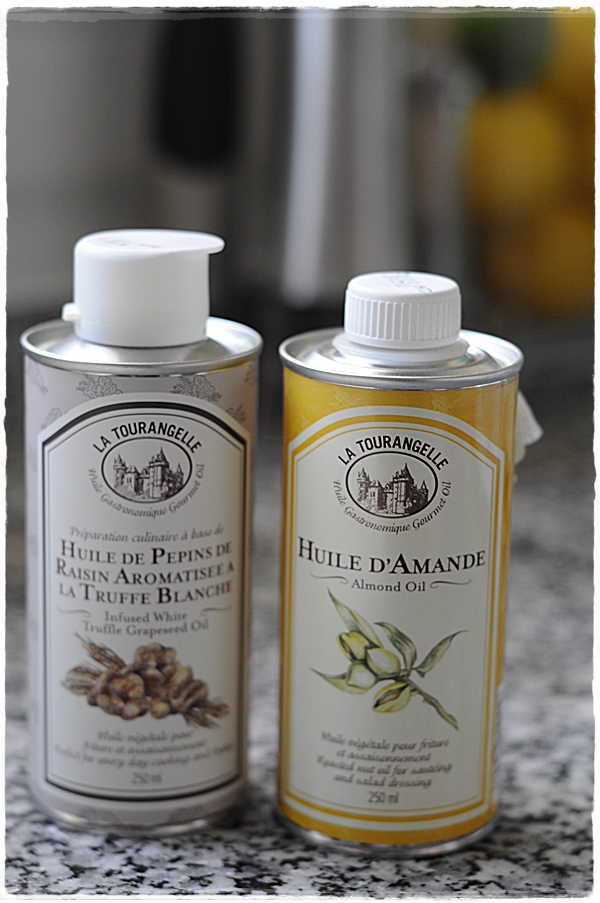
…white truffle oil and almond oil. Adds another layer of flavour to so many things from salad dressings to cakes. Giorgio Locatelli was disparaging about truffle oil but I think this is a good one.
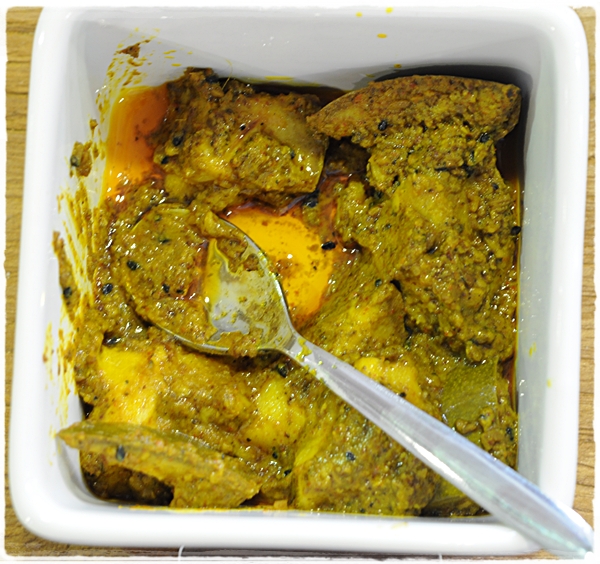
.. some homemade mango and fennel pickle from Pickle in d Middle.
…some cardamom sugar which I made from Vanessa Kimbell‘s book Prepped, ready for ssshhhh… I won’t mention the C word just yet . I met Vanessa this summer and she’s warm, generous and has a passion for intense flavours.
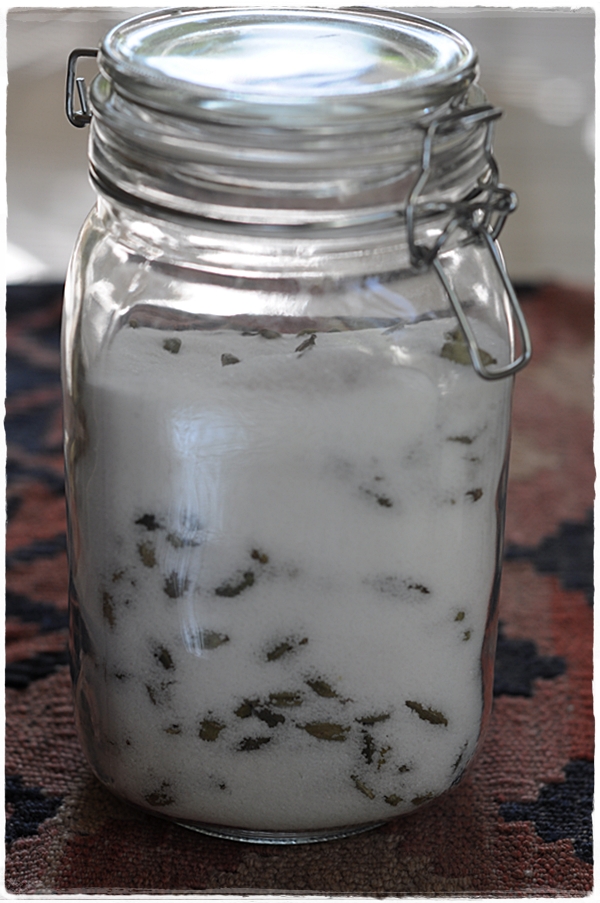
And always in my kitchen….
…are Hazel and Rosie.
 Tell me, what’s happening in your kitchen this month?
Locally-made cheese and a spicy pasta recipe
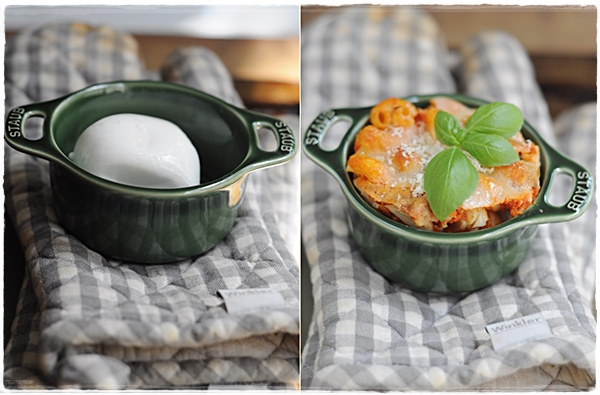 My role as a parent seems to have morphed into someone who ferries my offspring from a to b, opening my wallet somewhere along the way. I’m glad they have social lives that are interesting and interests that they are committed to and passionate about, but I still haven’t got used to having the plans for my own time that I’ve dreamed up turned completely upside-down.
Bumble-box organic market has rebranded itself as Ripe over the summer and relaunched to rave reviews by all accounts. Seeing a gap in my schedule as chaffeuse and motivated by the news of the debut of a stall-holder who makes cheese, I visited last weekend. The Dubai Garden Centre is almost a misnomer these days as it seems to sell an Aladdin’s cave of items not related to anything in the outdoor environment. From coffee machines to distressed furniture, from second-hand books to fish tanks, their strategy isn’t very focused and the weekly organic market is squeezed into a section that makes browsing quite difficult. However, customers were very focussed at getting in and out with their organic veg boxes and by 10 o’clock stocks were dwindling.
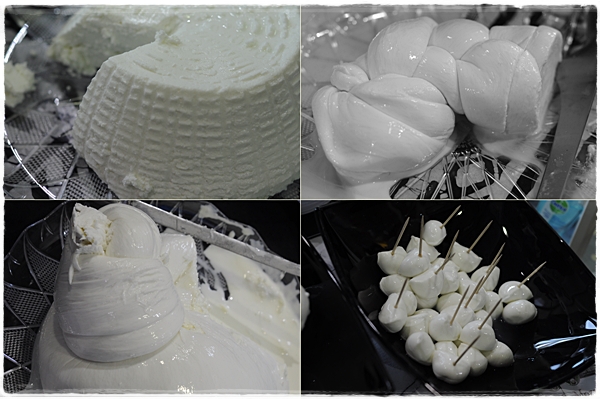
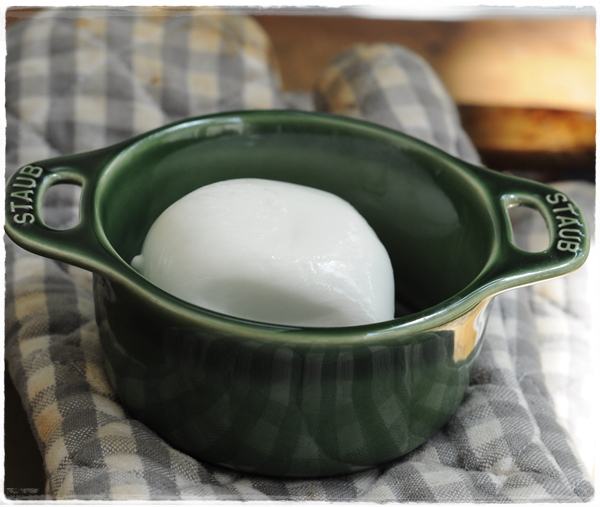
White, glistening shapes beckoned me to the cheese stall and the lady in charge (whoops – no name – I wouldn’t make a journalist!) said in a lyrical Italian accent “local milk, Italian expertise”. Regular visitors will know of my obsession for cheese but I managed to restrain myself and just bought a container of five balls of mozzarella (40 AED). They also had bocconcini, burrata, ricotta and scamorza – all looking fresh and quite sculptural.
While at the market I ate my first ever piece of biltong – cured locally – and some similar cured sausage, bought some fennel pickle from Pickle in d Middle and ‘sampled’ from Toffee Princess quite a few times (whoops!)
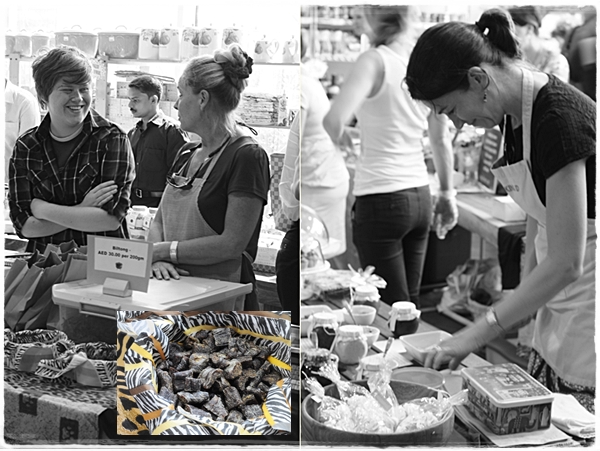
I bought a huge hunk of Parmigiano Reggiano on the way home and made this baked pasta dish which pleases the whole family ( I’ve tweaked a Jamie Oliver recipe here as I haven’t found a better version of this). The quality of the mozzarella really makes a difference. I hope the cheese-makers, Italian Dairy Products, (tel: 06 5269042) are a permanent fixture as the cheese is good, fresh, cheaper than the supermarket and doesn’t use food miles to get here (although arguably the feed for the cows to make the local milk does – but that’s another issue).
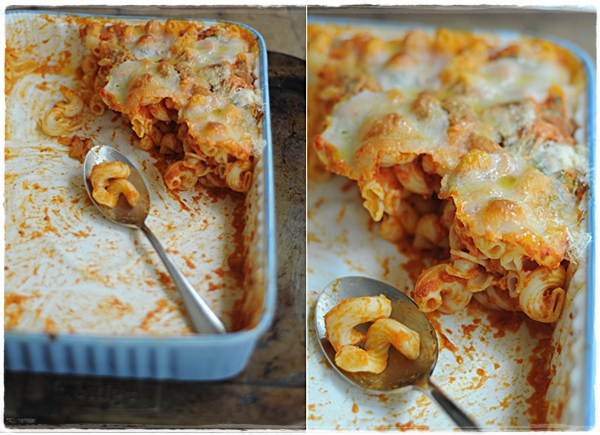
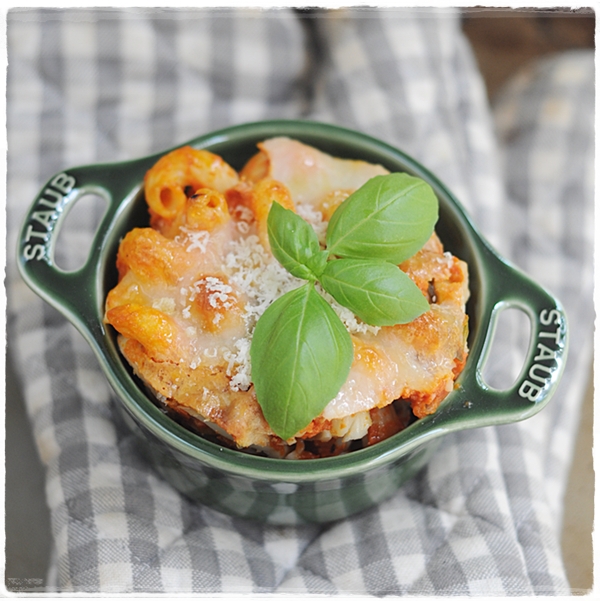
Spicy baked amori with mozzarella and tomatoes (Pasta al forno con salsa di pomodoro e mozzarella)
Ingredients
1 large onion, roughly chopped
3 cloves of garlic, chopped
400g of pasta shapes (I used amori)
3 x 400g tins of plum tomatoes
1 dried bay leaf
1-2 fresh red chillies (can used dried)
red wine vinegar
3 balls of mozzarella (approx 100g each), sliced
Approx 100g Parmesan, grated
A large handful of fresh basil leaves
Salt and black pepper
Method
- Preheat the oven to 200 C and put a large pan of water onto boil.
- Heat some olive oil in a heavy-bottomed saucepan (I use a cast-iron Le Cruset) and cook the garlic and onions over a low heat until they are soft and translucent. This takes about 10 minutes.
- Gently add the tinned tomatoes to the onion and garlic taking care to keep the tomatoes whole. Pierce the chillies with a knife; add with the bay leaf and about half a tin of water; simmer slowly for about 30 minutes.
- 10 minutes before the sauce if finished bring the water back to the boil and cook the pasta until al dente (about 1-2 minutes less than the time specified on the packet).
- When the sauce is cooked, take off the heat, remove the bay leaf and chillies and use a stick blender or food processor to blend to a smooth sauce. Taste and season with salt, black pepper, a dash of red wine vinegar if you like and torn fresh basil leaves (I use scissors to snip them in).
- Add half of the sauce into the drained pasta and mix thoroughly.
- Put half of the pasta into a lightly oiled, oven-proof dish.
- Layer with some tomato sauce, mozzarella and some Parmesan.
- Add the rest of the pasta on top.
- Pour over the remaining tomato sauce, mozzarella and a generous amount of Parmesan plus a drizzle of olive oil if you like.
- Cook in the oven and the top is golden and bubbling. Serve with additional grated parmesan if desired.
Variation: Layer some Parma ham in the middle instead of half of the mozzarella
How to eat crab – with chef Sam Leong
 We are in the Ah Chow in Cheltenham’s Albion street circa 1971, the waiter brings canned pineapple juice as our starter from the set menu. Then the main dishes appear including sweet and sour king prawn, round balls of batter which are slightly soggy in the middle swimming in a lurid neon orange sauce. My sister and I are thrilled and baffled in equal measure by these new foods. A few years later, the Mayflower takes its place with flock wallpaper and deep red furnishings – crispy seaweed (actually deep-fried shredded cabbage), Kung Po prawn (sweet and sour with pieces of pineapple) and duck with pancakes and plum sauce. Then a trip to China Town in London’s West End; we climb rickety stairs to a crammed top floor, a lazy Susan revolves in the centre of the table to deliver dishes thick with cornflour, dotted with limp straw mushrooms and bamboo shoots, accompanied by a huge pot of tea. My sister bravely orders duck’s webs and is appalled when it arrives – two feet sit upright on the plate as though the duck has just flown off and left them. This is the patchwork of my experience of Chinese food. Not much of it authentic I presume but I’m afraid that I would run a mile if it was. It’s still all a bit baffling so I jump at the chance to be instructed by chef Sam Leong, a star of Chinese cuisine who is visiting Atlantis.

Sam Leong is a sensation in Singapore who has worked his way up to celebrity status from fairly humble beginnings and after a succesful career as an award-winning hotel chef has set up his own cookery school with his Thai wife Forest. Punctuating his sentences with enthusiastic expressions – “POAANG!” – and lots of hand gestures, he demonstrated how to make wasabi prawns, hot and sour soup and black peppered crab while a small group of us tasted the results.
He warned us that, like durians, we would be divided on the soup. He was right, the thick, intense black shiny broth threaded through with strands of egg white was too much for me in terms of taste and texture but my neighbour ate her whole bowlful. Sam’s signature prawns were firm yet succulent, dipped in their mayonnaise-based coating with a sweet, spicy mango salsa. A marinade of egg white and cornflour was the secret to getting just the right firmness when cooking the prawn and it was this attention to detail about texture which was the biggest lesson of the day for me from Sam.

Our menu. Red lighting made this quite difficult to photography well.
The final recipe was black pepper crab, dipped in cornflower before deep-frying so that the brown-black sauce (which included HP and Maggi sauces) would cling to the shells. Given these rather odd ingredients I was a bit dubious but the final stir-frying in the pot released inviting peppery, hot aromas. Various tools were provided but I failed to get more than a few strands of the tasty crab meat from the shells until Sam gave us a demonstration of how to eat it. Filled with confidence we all grabbed the crab with our hands and tore the meat limb from limb. Billed by Atlantis as the World’ Best Peppered Crab, I have nothing to compare it to, but it was jolly good. You can download the recipe here or try it at Safrron in Atlantis which has some of Sam’s dishes on its extensive Asian menu – the Seafood night on Tuesdays is worth going to in particular. Watch the video below for Sam’s crab eating lesson.

The cookery session opened the door to Chinese cooking a little wider and I browsed through Sam’s cook book ‘A Wok Through Time’ eagerly. I was really disappointed to see the first three recipes include shark’s fin, encouraging the widespread and barbaric practise of finning. I hope his move from the Singapore hotel environment means this is permanently off Sam’s menu. To read more about this cruel and wasteful practise visit Sharkwater. Otherwise there are lots of ideas in this book worth reading , including an interesting pictorial glossary of ingredients at the end, although some recipes are a bit too ‘cheffy’ for home cooking.

Eager to taste the sweet prawn/hot wasabi combination again but for a lighter taste I adapted it slightly using labaan rather than mayonnaise (a sort of Middle East meets East adjustment).
Wasabi prawns with mango salsa adapted from a recipe by Sam Leong
Serves 4-5
Ingredients for the prawn marinade
10 large raw prawns, shelled and deveined
1 egg white
1/4 teaspoon salt
1/4 teaspoon sugar
A dash of sesame oil
2 teaspoons cornflour
Wasabi sauce
300g labaan
2-3 tablespoons wasabi paste
1-2 teaspoons honey
juice of half a lemon
Mango salsa
1 mango, diced
2 shallots, chopped
Mint, shredded
Thai chilli sauce, to taste
Method
Mix prawns with the marinade and set aside for 30 minutes.
Stir the wasabi paste into the labaan little by little until it is the concentration that you like. Keep tasting until it’s just right (mild or fiery). Stir in the honey, then add a little lemon juice, stir and taste again until it’s the right balance of creamy, hot and sharp flavours. Combine the diced mango, shallots and mint leaves with Thai chilli sauce. Put wasabi sauce and the salsa in the fridge until ready to use.
Deep-fry the prawns in hot oil until cooked, for about a minute, and mix immediately into wasabi sauce. Serve with the mango salsa.
My friend over at Ginger and Scotch has made a really useful map of Asian grocery stores in Dubai if you live here and are tempted to explore Chinese cookery further. You can get HP sauce in any supermarket!
I’d love to hear about your Chinese food experiences…are they similar to mine or completely different?
DISCLOSURE: I enjoyed this complimentary cooking course as a guest of the Atlantis The Palm. 









 My Custard Pie